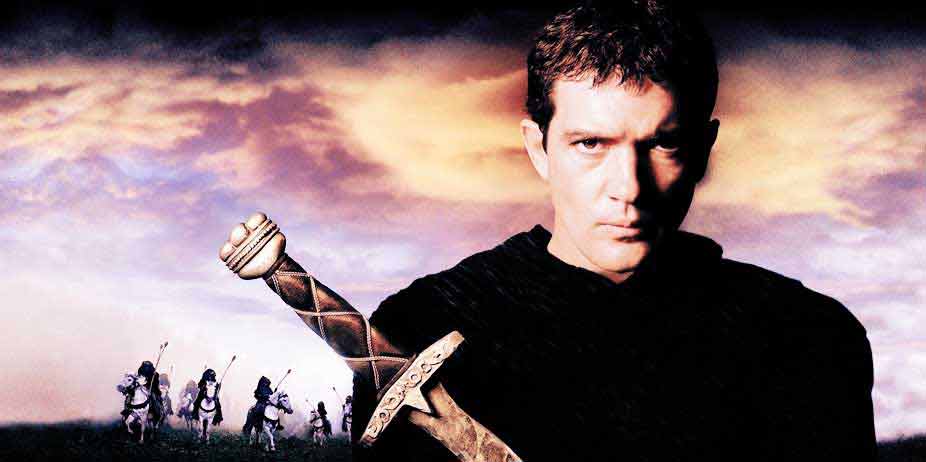
The 13th Warrior (1999)
Many adaptations of the oldest
known Anglo-Saxon poem, Beowulf, exist, but going
into this film I didn’t know its inspiration, so failed
to make the immediate connection.
Ahmed (Antonio Banderas) serves as
an Arab ambassador to the Vikings in the year AD 922.
His presence in their encampment, along with his
interpreter Melchizedek (Omar Sharif) coincides with a
child prince’s arrival from a distant colony being
threatened by flesh-eating monsters. His pleas for the
Vikings to assist them in their hour of need inspire
courage in the men and at the suggestion of their
oracle, who promises them success in their endeavor,
twelve volunteer for the position, including Buliwyf
(Vladimir Kulich), their leader. The oracle warns them
the thirteenth warrior must be a foreigner, and so they
recruit Ahmed. He does not speak their language, nor
know how to handle a broadsword, and their amusement at
his “tiny horse” makes him an outcast.
On the journey, Ahmed listens to
them speak until he understands their dialect and, by
the time they reach foreign shores, can communicate with
them enough that he makes a friend in Herger (Dennis
Storhoi). They arrive to find the kingdom ill-defended
against an adversary the locals believe are demons from
the underworld. These creatures come only at night when
the mist rises and steals the bodies of the dead, as
well as the severed heads of their fallen adversaries.
This terrifies the locals. The Vikings feel determined
but uneasy... that night, two of them perish when the
creatures attack the hold. After the second fatal
assault, Ahmad realizes their rivals are not unholy
creatures of hell but flesh and blood... which means
they can kill them.
Though a more “realistic” approach
to the source material and different from most
adaptations of the ancient poem, The 13th Warrior
is an interesting, epic tale full of interesting
characters and exciting battle sequences. It was a box
office failure and I understand why—Banderas is well
known, but his costars aren’t, and the quality of the
production hints at its limited budget. The first twenty
minutes suffer from a slow pace, but then it picks up
and blesses us with gorgeous cinematography. The acting
is excellent, and the filmmakers let the audience
comprehend along with Ahmed what his companions are
saying. It is enjoyable despite its faults, but I had a
hard time emotionally connecting with the characters;
there aren’t enough smaller moments to illustrate their
distinct personalities (humorous instances where Ahmed
defends his beautiful white Arabian against their jeers
notwithstanding). The style of filming is impressive and
the costumes are excellent. It also captures well the
gritty, difficult circumstances of the era.
There is no romance to speak of
(Ahmed has some sweet scenes with a Viking girl) but my
curiosity toward their enemies and my hope everyone
would survive kept me watching. It’s a decent approach
to a story that has been told many times, but never
quite with this much realism. Making the monster flesh
and blood rather than a distant, tormented creature was
a stroke of genius.
Sexual Content: The villains are an ancient, cannibal race that worship a
buxom, headless female goddess, whose statue we see several
times. Ahmed sleeps with a woman in his arms one night (the
audience is uncertain if anything happened). A naked child
is shown from a distance running across a field; we see part
of his nudity when he is wrapped in a blanket and put on a
horse. Language: None. Violence: Early on, Ahmed discovers the remains of peasants
slaughtered by their enemies -- blood drenches the
floor and a headless body is shown partially eaten;
he moves a blanket and a severed arm falls to the
ground. This isn't the end of the gore, either -- a
dozen or so times we see heads being severed from
bodies, with spurts of blood (sometimes bare hands
are used; in other instances individuals are
decapitated by swords). Other bodies missing their
heads are revealed. Many people are impaled with
arrows and pikes, some of them multiple times.
Others are stabbed and/or sliced open with swords
(mostly implied, but occasionally shown). Blood
spatters those involved and onlookers. Animal lovers
will be disconcerted by a scene in which a dozen or
more horses are impaled on spikes (to throw their
riders) and are shown writhing around on the ground.
In the lair of their enemy, our band of heroes
discover a cave full of bleached bones. Human skulls
in various stages of decomposition are entwined in
vines hanging in a cavern. Other:
Two other oracles are shown casting bones to foretell events. The Vikings make one or two references to their "many gods"; Ahmed is heard often repeating his belief that there is one god, and Mohammad is his prophet; he is shown praying before going into battle, and wishing blessings at the end on his "heathen brethren."