A Bear Named Winnie (2004)
Many of us grew up on Winnie the Pooh, but few of us know the origins of the idea. This beautiful little family film with a terrific cast introduces us to the original Winnie, during WWI.
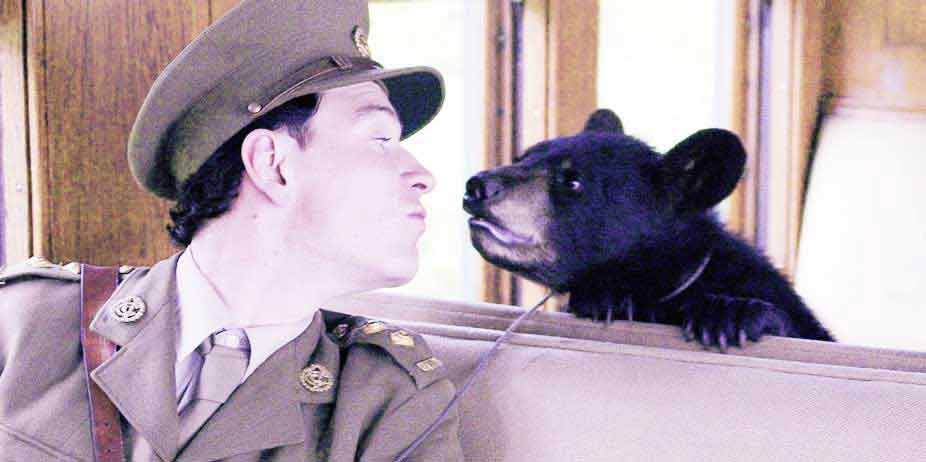
"Where did she get the name Winnie, Daddy?" The child's voice drifts across the morning air, the boyish eyes focused intently on the large black bear in the London Zoo. His father looks at the bear contentedly licking ice cream cones out of outstretched children's hands and smiles. Many years earlier, Lt. Harry Coleburn (Michael Fassbender) gets off the troop train in Ontario for a short stop. He wanders through the small town and finds a bear tied up at a hiding station. Seems one of the men shot its mother and couldn't bear to shoot the cub, but it'll have to be done. Touched and unwilling to let the poor cub perish, Harry pays them $20 for it, not knowing what he is going to DO with it. After unsuccessfully trying to find it a home, he gets on the train with it and the bear cub is an instant success...
That is, with everyone except the conductor, who won't have the bear doing its business on his train! Soldiers aren't allowed pets, so the bear cub is christened Winnie and made the veterinary core mascot. Once reaching their temporary holdings, awaiting deployment to England, Harry runs amuck of their superior officer, who tells him to get rid of the bear. Fortunately, their slightly bubble-off-plumb general (David Suchet) has rather a fondness for Winnie and permits her to stay. Harry and Winnie share the tent of the brilliant but somewhat inept scholar-turned-veterinarian Macray (Jonathon Young), but that does not solve the problem of what is to be done with the bear cub when they are all deployed overseas. What results is a surprisingly touching movie about the close friendship between a wild animal and a military officer. In a sense, it is a children's film only in its limited problematic content -- yes, there are a lot of scenes in which an adorable baby bear fumbles its way across the screen, but adults will find aspects of the plot heartwarming and I defy you not to tear up toward the end.
Watching the effect this bear has on everyone who meets her is marvelous, because Winnie, in all her adorableness, is a comfort to the men stationed in preparation for battle. Even the ones who don't like her at the start are won over quickly by her love for them. The cast is also quite good -- obviously, including Suchet (who seems to delve into this wacky role with delight) and up-and-comer Fassbender is a good choice, but they are well supported by Aaron Ashmore and Jonathon Young. I've only ever seen the latter for his stint on Sanctuary as Tesla, so it was marvelous to see him in a much larger role. It isn't a big budget movie but it doesn't have to be -- it has heart, and that's good enough. Parents (and animal lovers) should know that there are some sad and / or threatening scenes toward animals. Early on, we see Winnie's dead mother and the bear cub is threatened with being shot several times (once by a hunter, again by a troop leader). Winnie is left tied up in the woods (loosely) in the hope that the men can leave her there -- they are obviously distressed listening to her "cry" as they leave. A horse is threatened to be put down; we see several dead horses after an explosion goes off.
It is implied that a main character is killed by gunfire (off-screen) and that another character suffers a great deal from his death, to the point of extreme depression. The general gets raging drunk on one occasion. Winnie becomes melancholy and won't eat for awhile, leading the zookeeper (Stephen Fry) to believe she may die, which could be traumatic for some children. I was both a little reluctant and intrigued by this movie because I figured it would make me cry at some point. It did (in a happy way) but it was also one of the sweetest, most touching films I have seen in a long time. If you can find it, watch it. It's an inspiring little story about how God can use an animal to brighten lives, bring people together, and remind war-weary men there is something worth living for.