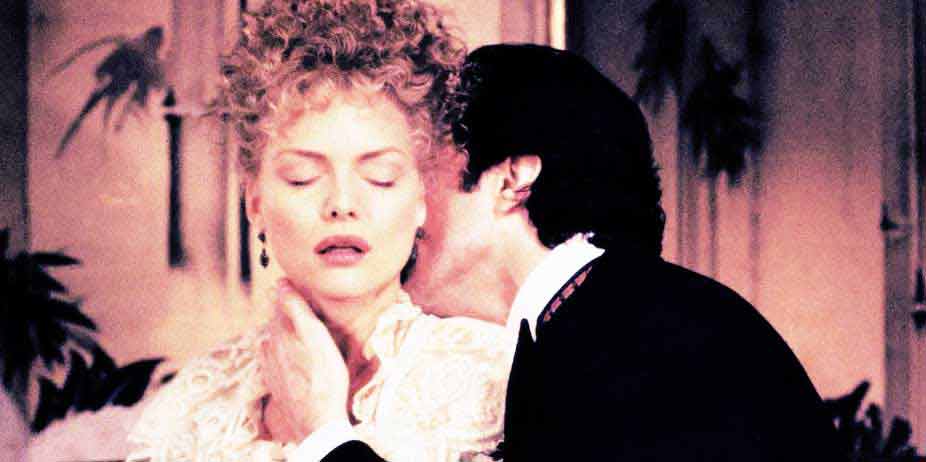
The Age of Innocence (1993)
Reviewer: Maggie Starr
This story takes place in a time
when propriety and decorum governed the upper classes
with a rigid hand, and when appearances were everything.
Lying just beneath society’s sparkling exterior,
however, was a world steeped in hypocrisy and stifled
passions…
In an elegant New York City Opera
House, a large audience sits captivated by the dramatic
performance onstage. All except Newland Archer (Daniel
Day-Lewis), that is. He is far more interested in a box
seat high above the crowd, wherein sits his pretty
fiancé, May Welland (Winona Ryder) and her mother. As he
fixes his opera glasses on them, we see a third occupant
in the box: a pale, lovely woman who wears an air of
mystery.
Mr. Archer discovers the stranger
is none other than the Countess Ellen Olenska (Michelle
Pfeiffer), May Welland’s cousin. Wed to a Polish Count
years ago, the countess has returned to America to
escape her soured marriage. Newland (Daniel Day-Lewis)
remembers Ellen from childhood and pitying her sad
situation, persuades May to announce their engagement
following the opera. By creating a diversion, he hopes
the gossips won’t pay as much attention to the countess.
Everyone joyfully receives their engagement; Newland and
May seem the perfect picture of romantic bliss. They
enjoy each other’s company, never quarrel, and are eager
for the wedding day to arrive. But we soon learn
appearances can be deceiving. The countess wants a
divorce and asks Mr. Archer, a lawyer by profession, to
handle the proceedings.
Newland has heard vague rumors of
Ellen’s scandalous life after her separation from the
count, which includes a lover or two. In his mind,
divorce is the worst option. The count would surely
reveal the secrets of her illicit affairs and parade the
lurid details on the front page of every newspaper.
Ellen would become an instant outcast; everyone knows
the inflexible Code of Society: society must ostracize
people of such wicked character. They cannot continue to
associate with the “Upstanding.”
The ironic twist to this unwritten
“law,” is many of Ellen’s would-be condemners (including
her husband) have dark secrets of their own, which
they’ve barely concealed from the prying eyes of
society. Through their professional interactions, Ellen
and Newland grow increasingly familiar. Her boldness
refreshes him; she couldn’t care less what New York
thinks of her and mocks their hypocrisy. In him she
finds a sympathetic confidante and a source of
comfort. As his intimacy with Ellen deepens, Newland
feels troubled. His future with May suddenly seems dull
and meaningless; the gay whirl of society, oppressive
and dampening. Will their consuming passion take them
beyond the point of no return?
This film is a feast for the eyes.
The gorgeous, detailed costumes are breathtaking (the
designer won an Oscar for her efforts and it’s easy to
see why). They brought 1870s New York City to life with
amazing accuracy and beauty, by overlooking no visual
detail. The sumptuous scenery, sets, and props are
overwhelming in their lavishness. It seemed as if the
filmmakers were concentrating more on the set design
than the plot, which may be why I found it difficult to
become involved with the characters. Despite this flaw,
the actors were nicely cast, especially Winona Ryder as
the vapid fiancé.
Newland ultimately decides not to
pursue a relationship with the countess, an action I
applaud, but his motivation isn’t right. God commanded
us not to commit adultery, but Newland’s decision comes
from the fear of society, not the Lord. It’s a quiet
film that moves along at a measured pace to a rather
bittersweet ending. If you enjoy costume dramas (as I
do) the stunning visual quality will well repay any
disappointment you have with the storyline.
Sexual Content:
Ellen and Newland never progress beyond a tortured embrace or two, but the subject of adultery permeates the script. There is the vague insinuation that both Count and Countess Olenska had extramarital affairs, and another well-known gentleman keeps a mistress (she’s never called by that term).