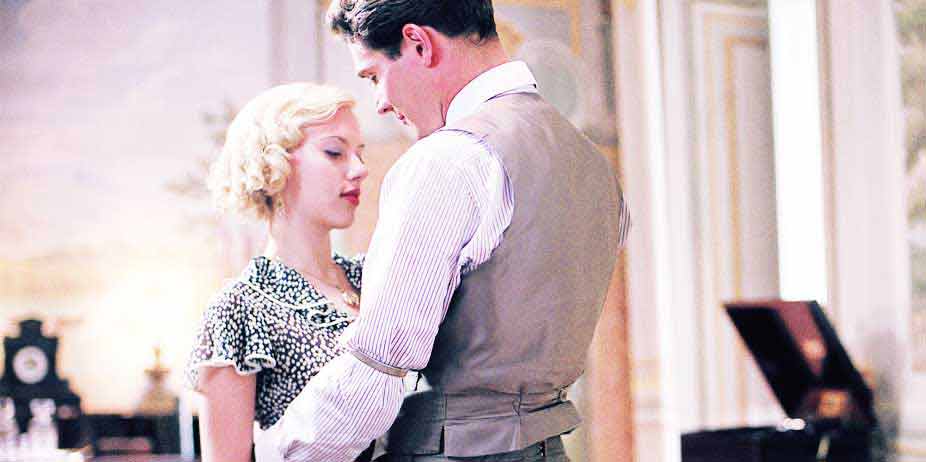
A Good Woman (2004)
I did not have high expectations going into this film because I was unaware that it was based on a play by Oscar Wilde. Imagine my delight then to discover a twist midway through that eradicated most of my concerns and made the humorous dialogue and situations all the more charming!
The women of New York have had more than enough of Mrs. Erlynne (Helen Hunt), who makes a profitable income by being the mistress of various powerful men. Their wives' disapproval of her in addition to her increasing age has made it uncomfortable to remain and so on a whim she chooses to go abroad to Italy. Once there, she encounters the newly married and extremely wealthy Robert Windemere (Mark Umbers) and it appears that the two begin a love affair. The only person oblivious to his odd habit of sneaking out of the house at all hours and spending exorbitant amounts of money on Mrs. Erlynne is his sweet and innocent wife, Meg (Scarlett Johansson). Her virtue and charm have brought her to the attention of a notorious playboy, Lord Darlington (Stephen Campbell Moore) and he is quite set on running away with her -- if her husband provides an opening. Thus he attempts to bring the affair to her attention without seeming overly involved.
Mrs. Erlynne has drawn the interest of Tuppy (Tom Wilkinson), an older man whose three failed marriages have made him something of a joke in society but that hopes for future happiness by making her his wife. He is intentionally ignorant of her scandalous behavior and dismisses it, not realizing that she has ulterior motives for entering the lives of the Windermeres. At first glance the story does not seem to have any redeeming value, since its premise does revolve around what the audience assumes is a group of immoral individuals... but there is where the cleverness of the author intrudes and we learn midway through the production that all of our assumptions are incorrect and in fact could not be further from the truth. The intelligence in it is that we suddenly feel guilty of slander, since we have thought the worst of all involved and are proven wrong. As is typical of Wilde, running rampant throughout is a social commentary, this time denouncing our worse nature in leaping to sinful conclusions and taking a good-natured prod at such things as marriage and secondary motivations. The wonderful banter and humor of the original shines through in an exquisite 1930's setting, with a fun score and terrific cast. What I loved is that some characters you expect to dislike you wind up loving, and others flirt a bit with your emotions. The film does a great job of setting up a potential romance and making us almost be in favor of it, then dropping the floor out from under our feet and causing us to hasten back to the safety of "moral" social confines.
The cast is quite good but at first I was uncertain of Helen Hunt; she seems a bit too mild-mannered for the role, but as we learn more about this woman we come to understand that she is not all that she seems; her faults are apparent but her intentions are not what we might expect. Stephen Campbell Moore also won me over as Lord Darlington, a difficulty considering one cannot help but disapprove of his obvious intentions. There are a few minor things worthy of mentioning but most of the potentially offensive material revolves around the premise of adultery. It is apparent that Mrs. Erlynne has had numerous love affairs with married men and that is, in fact, how she has managed to maintain a decent social status. Her relationship with Robert has all the overtones of an affair -- discreet luncheons, him slipping in and out of her private chambers, etc. Tuppy seems quite excited at the thought of "going to bed" with her but she instead sends him home. Meg is at first appalled to learn the truth and then entertains the thought of having her own affair to pay her husband back for his impropriety. She goes so far as to sneak out to meet another man on his boat, before being brought to her senses. There is some sensuality present between a man and wife; they roll around on a bed and kiss one another, before she asks him to turn out a light. In another scene late on in the film, they are shown snuggling bare-shouldered beneath the covers. Mild language and a few sexual references intrude. There are references to adulterous affairs and jokes about infidelity. When Meg first meets Mrs. Erlynne, she is wearing a very revealing gown "with no back and very little in front." Meg later purchases and wears a dress exactly like it; both of them show large amounts of cleavage.
The minor faults in the script are those present in the original manuscript, namely that it suffers from the same formula that most of Wilde's productions do in that there is an elaborate deception toward the end, a lie intended to protect a not-so-innocent party that will in fact impact a secondary romance. In that regard certain aspects of the outcome are predictable but that did not diminish my enjoyment of it. While some audiences have found it slow moving and uninteresting, I was captivated by the wit, sarcasm, and quirky characters that pervaded the script. One of the more amusing additions is an older woman and her daughter, who is quite fond of bird-watching. Often, her binoculars are "borrowed" by the gossips around her in order to spy on various individuals walking about the town -- without bothering to remove them from around the poor girl's throat. It's intended to make you chuckle and does. If you do not mind feeling a bit scandalous for the first half, and can put aside moral judgments until you learn the truth, I think you will find it a rewarding and entertaining film more than worthy of your time.