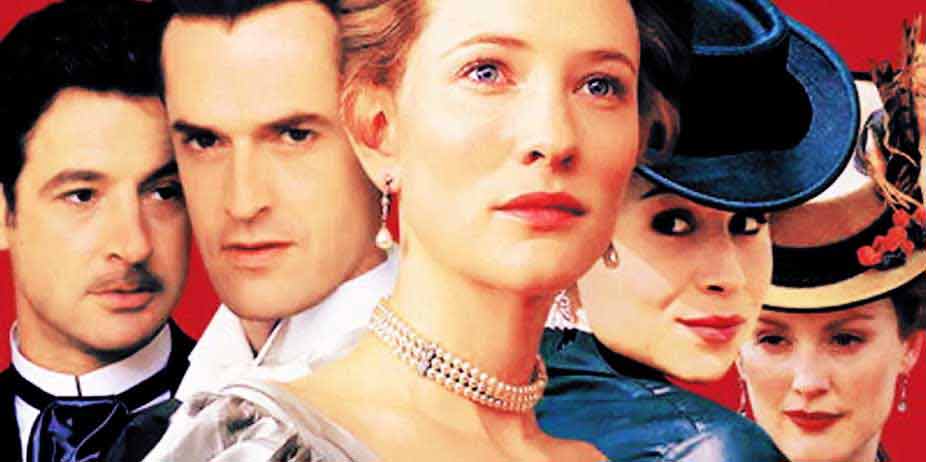
An Ideal Husband (1999)
Oscar Wilde was known for his English satire, the mockery of the upper class, and a cynical view of romantic love, of all of which come across vividly in the latest masterpiece of good filmmaking. An Ideal Husband plays like a game in which all central players are their own little mixture of intelligence, wit, and sarcasm. And surprisingly, it works! It more than works. It creates an amusing two-hour ride into Victorian England at its best. The cast, although magnificent, are merely the faces that breathe life into a story fraught with humor, wit, irony, and more than one mistaken case of identity.
At the age of thirty-six, Arthur Goring (Rupert Everett) is as yet unmarried. A notorious flirt and favorite of the ladies, he is devastated when his father (John Wood) informs him that he must find a suitable match before he can claim his full inheritance. But Arthurs problems seem simplistic when Laura Chevely (Julainne Moore) comes to town with a purpose of her own. A beautiful, clever, manipulative redhead, Mrs. Chevely's intentions are to blackmail Arthurs best friend Sir Robert Chiltern (Jeremy Northam), a rising star in Parliament. The woman has in her possession an incriminating letter from his youth that could easily jeopardize his political career. The price she demands is Roberts support of the new canal scheme, a political den of unrest and a financially dangerous endeavor.
If he refuses, she will give the letter to the newspapers. If he agrees, he risks loosing the trust of his beloved wife Gertrude (Cate Blanchett), who has formed the opinion that her husband is in no way flawed. The villain may have more than a slip of paper up her sleeve, and Arthur finds himself caught in the midst of more than a political get-rich-quick scheme that may forever jeopardize not only his friendship with Robert, but Gertrude's faith in him, and possibly his marriage prospects as well. Arthur finds himself struggling in the current, half-seduced by the woman's clever nature and cruel beauty. In the meantime, he may overlook the one woman in London who adores him... Roberts younger sister Mabel (Minnie Driver), who regularly refuses marriage proposals in the hope that Arthur will come to his senses. In the meantime, Gertrude has learned of the letter and the Chiltern household erupts in a violent disarrangement, Arthur has made a dangerous wager, and the clock is ticking.
What can come of this muddled mess of sinister intentions and human flaws can only be the very essence of Oscar Wilde... wit, irony, and satire to the last. With a gorgeous setting of the late Victorian era, the director has gone all out to make his adaptation as splendid and visually-stunning as he possibly can. Lovers of the era will gasp with delight at the architecture, the rich fabrics and intimate detail of imagery and color; if not sigh with the obvious romantic passion between the leads, and envy the women their gowns. The singular flaw in detail is the hairstyles, which seem slightly out of place but not overly pretentious. The characters are well-defined and entertaining; and many valuable lessons are taught during the course of the film. In the end, one and all make the right choice, each in their own personal struggle against the evils of their own human nature. The production manages to be both deep and comical at the same time, with many memorable moments. Arthur may at first seem shallow but his insight into human nature is a keen one. Robert makes a sacrifice for good, well knowing the possible result. Gertrude, who has very high ideals, learns that men (and women) are not without feet of clay. In addition, marriage is highly romanticized, and each character is willing to sell themselves short for the good of someone else.
Utterly charming and full of romantic humor, it is a brilliant adaptation, a mixture of elegant romance and light-hearted comedy that focuses more on wit and intellectual tousles than slapstick or stupidity. The film takes great pride in building up the Victorian era only to knock it down again with its mocking character parallels which include both suave bachelors and mindless cynicism. It throws in a number of clever tie-ins to Oscar Wilde and his numerous other plays and travels at an agreeable pace. The cinematography is memorable, the setting magnificent, and a speech in Parliament highly prioritizes England's responsibilities. When all is said and done, it's a masterful production to be lavishly enjoyed.
Sexual Content
In the first twenty seconds, we glimpse a blurry figure of a nude woman leaving Arthur's
bed. Robert and Gertrude become romantic in bed and kiss
passionately before the scene fades. Later in an attempt to
retrieve the letter, Arthur engages in some light petting with
Laura Cheveley. It ends, however, in a comical argument.
We also glimpse momentarily the two leads in a sauna, and some cleavage on the
part of Laura.
Language:
There are a few mild profanities, played for their humor.
Violence:
None.
Other:
Drinking and lying.