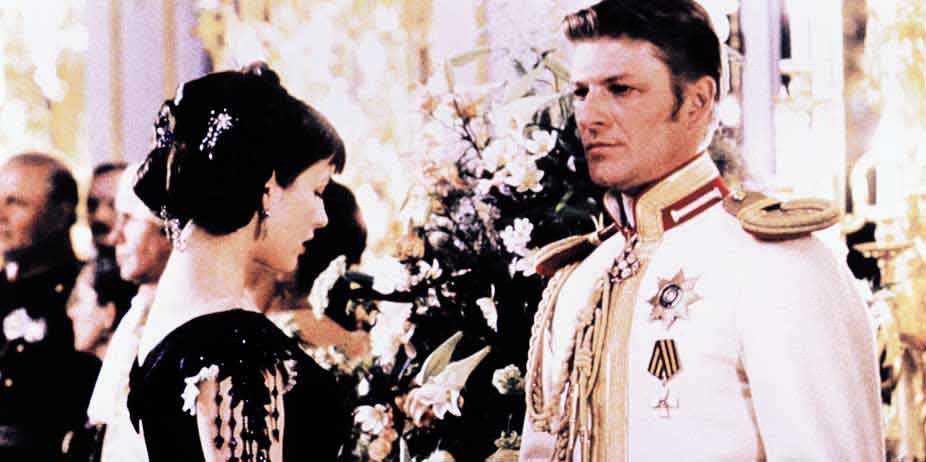
Anna Karenina (1997)
One of the most controversial and haunting novels in Russian literature, Anna Karenina is considered by some to be the greatest novel of all time. Whatever conclusions the audience reaches, it is a poignant, haunting story of a woman's search for fulfillment and the destruction it brings to her life.
Told through the eyes of Levin (Alfred Molina), we meet him and the beautiful woman he intends to marry (Mia Kirshner) at the height of society in Moscow. A countryman content with his freedom in the fields, Levin has abandoned all attempts at society but now hopes to win the hand of the lovely Kitty, whom he has loved in secret for many years. At the encouragement of his friends, he proposes and is crushed when she turns him down, believing soon she will have a more ambitious marriage proposal from the dashing Count Vronsky (Sean Bean). Desirable and passionate, Vronsky is distracted by the presence of Anna Karenina (Sophie Marceau) at the annual ball. Mysterious and elusive, dancing with one another generates a spark that cannot be denied and in spite of all appearances and her attempts to flee back to the safety of her husband (James Fox), Anna finds herself drawn to the handsome Calvary officer.
Scandal envelopes them when her husband learns of the affair and threatens to take her away from her son if she does not remain with him in St. Petersburg. The bonds of love are stretched within the boundaries of propriety and all comes to a violent climax as lust, love, forgiveness, and turmoil are appeased. I tracked down this adaptation with some difficulty since it is not readily available in the States and had mixed feelings about it. Marceau is a much more likable Anna than many of her contemporaries. I sensed more reluctance and regret in her, and her emotional turmoil in the second half was made more realistic given her fragile state throughout. It seemed that she was pursued by the count more than an active instigator in the affair, and that made me more fond of her. She and Bean have great chemistry together (much better than the Masterpice Theatre presentation) and the audience aches whenever their arguments turn to threats and shouting. But her husband has been somewhat more vilified in the process, and his transition from hatred to forgiveness is not as apparent in his actions.
For some reason, the secondary plot line involving Levin and Kitty is somewhat bland, either because of the chosen actors or because it pales in comparison to the primary protagonists. But what I did like about it is that the script was careful to identify each person to us, so it was easy to follow who was whose relation, friend, or close associate. The costuming was exquisite and the cinematography gorgeous. The costume designer deserves praise for some of Anna's breathtaking outfits... and the scenes at the train station surrounded by fog are so luminous and romantic you want to pause and just gaze at it.
There are a handful of mild profanities and abuses of deity, I found certain aspects of the plot missing (Anna miscarries instead of having a child, Levin never asks Kitty to read a journal of his past sins) and others added (more political emphasis, talk of spiritualism), but this film does have more of a religious tone toward the end. Levin concludes that his life is better for having found God, and he intends to serve Him for the rest of his natural days. I liked that this was enhanced to contrast with the self-destructive behavior of Anna and the Count, but overall it felt as if much of the plot was missing, and did not hold my attention as powerfully as the miniseries did, even though this was much shorter. It is a reasonable adaptation but by no means the best of the bunch.
Sexual Content:
We see the Count's bare side after
he has slept with Anna, and Kitty's bare back once; there is a creepy and
strange shot of her giving birth, in which we see most of her naked thighs and
abdomen; the camera shows us a brief shot of a topless woman during a
celebration, then pans a room full of half-dressed drunken people the next
morning -- private areas are obscured. There's no vivid sexual content but a
heavy scene of undressing and down-the-body kissing. Alexei drags Anna around
the house, forcibly kisses her, and wrestles with her on the bed; the audience
fears he might rape her, but he doesn't.
Language:
A handful of mild profanities and abuses of deity.
Violence:
Two implied deaths, a botched
suicide, and an instance in which we see a horse put down after a bad accident
(blood spray).
Other:
Social drinking.