The Aristocrats (1999)
Based on the bestselling book by Stella Tillyard, Aristocrats follows the lives of the great-granddaughters of King Charles II, through his mistress, and is seen through the eyes of the second-eldest of the girls, Emily. It is a lush and fascinating historical epic that follows the triumphs and tragedies surrounding the Lennox family.
The eldest sister Caroline (Gordon) has been out in society for three years, without attracting a husband, something that disturbs her father and mother profoundly. They have made a number of matches that would do her well, but the forward thinking Caroline believes that she cannot marry without love. When she is attracted to, and marries in secret, a local politician by the name of Henry Fox (Armstrong), her father disowns her and vows never to speak to her again. This is of particular distress to her younger sister Emily, who has idolized Caroline from infancy, and makes a vow to make no such mistakes in dealing with her parents when it comes time for her own marriage. Years later, Emily (Somerville) has no difficulty flirting her way into the attentions of Lord Kildare (Daniels).
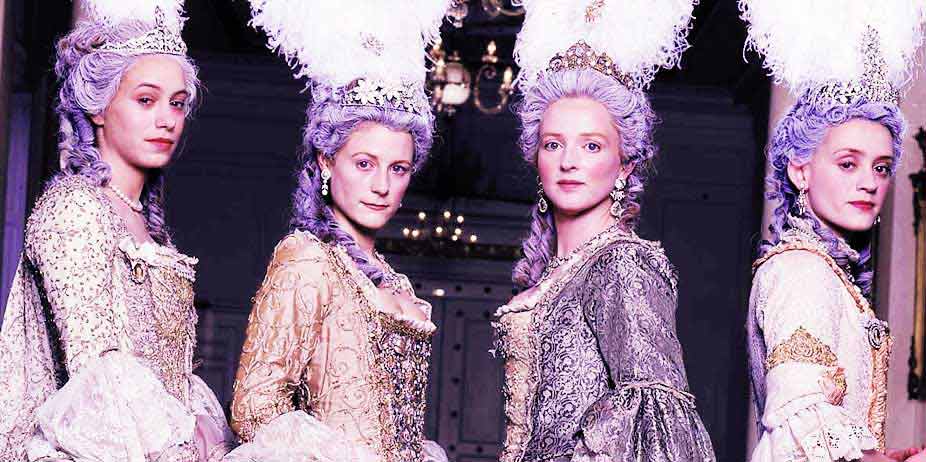
Her parents are against the match on principle because he is Irish, but her patience and obedience eventually allows them to concede. Caroline and Emily are reunited only to be torn apart again through family circumstances and difficulties. The death of their parents leaves Emily to raise her younger sisters. Louisa (Duff) is made most happy in marriage, and the childish Sarah (May) attracts the attentions of the Prince of Wales, but what lies ahead will test all family ties. The result is a very engaging six part miniseries full of absolutely gorgeous costuming and skewed morals. On its face, the series is fantastic since it spares no expense in granting us a taste of what life really was like during the age, from the extravagance of two hundred pound silks to the financial and political reasons that made marriages advantageous and often unhappy. What I found the most interesting was the contrasts between the sisters. Caroline married for love and found unhappiness because her husband was so often preoccupied. Emily married for love and turned a blind eye to her husband's indiscretions, eventually pursuing an affair of her own. Sarah married without love and scandalized the family by running away with her lover, while Louisa affectionately married a man she admired and lived "happily ever after." But none of the women are predictable or depicted as anything less than human.
The BBC mini-series could have been a wonderfully romantic and exquisite tale of sweet romance bound by conflict; it falls far short by lingering upon the immorality of its characters, something which is looked down on in disgrace by a few in the film. I cannot praise the costuming enough, for the gowns were stunning if a bit low and the great sprawling manors made me long to step into another century, but I was swiftly turned off by objectionable content. Undesirable plot aside, characters dash in and out of the story and I was confused much of the time as to who was who and how this person or that related to the family. As one character states brutally, "Adultery in men is tolerated but in women is disgraced. Who, then, is a man to have adultery with?" I understand perfectly that society was much divided in the past and women were little more than playthings but each participant in an affair should share equal disgrace -- man and woman. I would avoid Aristocrats at all costs.
Sexual Content
There is an abundance of vague sex-related dialogue and several sex
scenes. One is between Emily and Lord Kildare after their marriage and consists
of a gentle if racy love scene; the other is in which Sarah is seduced and
although the shot is only seen from their shoulders up, contains graphic
movement and leaves no doubt in the viewer's mind as to what happened. Gorgeous
costuming and breathtaking scenery cannot save Aristocrats
where common decency and morals abide. Adultery, as Emily says, was not shunned
in society as long as it was kept low-key. Infidelity in men is to be expected
-- and indeed nine out of the ten men that appear in the six-hour epic are
more than willing to invade either on another man's wife or cheat on their own.
Two out of four of the main characters, our "heroines," are unfaithful to their
husbands. Sarah -- dull and uninteresting Sarah --
is caught in a wave of scandal as she conducts an affair with a young
Frenchman, even to the point of bearing him a daughter and leaving her husband's
house. Later, "reformed" by Louise, who is distraught over the affair, she does
not refute the affections of a married soldier. Emily is steadfast for eighteen
years until her husband's growing aversion to her leads her to find greener
pastures in the bewitching smile of her children's tutor.
Language:
None.
Violence:
None.
Other:
Drinking.