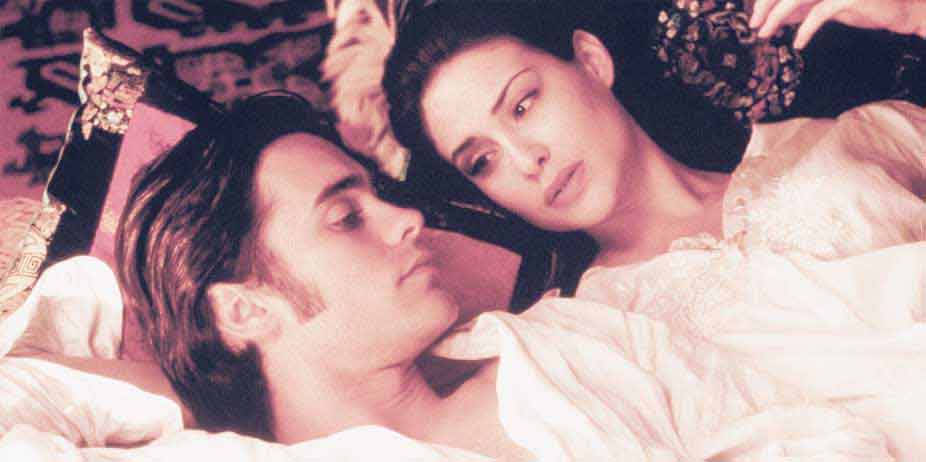
Basil (1998)
Wilkie Collins thought his greatest masterpiece was The Woman in White, which is perhaps why the book is so well known. However, he also penned two other gritty mystery masterpieces in the serials The Moonstone and Basil. The lesser-known of the two is Basil, the story of a young aristocrat in turn-of-the-century England who is unaware that his life has been prewritten by an evil adversary.
Basil is the younger of two wealthy sons and is possessed of a vivid imagination. He manifests himself in his many drawings and stories of "the man in the mask," which his ill mother adores. However, his overbearing, class-conscious father (Derek Jacobi) believes this to be the fruit of evil and forbids Basil from telling any more of his wild tales. About this time, young Clara is brought into the household. Her mother has died, and out of pity the family has taken her in. Windermere, the family estate in the rolling British countryside, is open to the public each week and one day a beautiful golden-haired stranger wanders in. Basil's older brother is captivated, but she is below his station and so the two make discreet lovers' meetings upon the beach... until the inevitable occurs. The girl is found "with child," the marriage is forbidden, and Ralph is disinherited and sent away. The family fortune and reputation now rests solely upon Basil's shoulders. As the years pass, Basil (Jared Leto) is ever-attempting to please his strict but flawed father as to keep his inheritance. Stranded on the beach with a twisted ankle and the tide coming in after a mishap, Basil's savior comes in the form of John Mannion (Christian Slater), a foreigner.
Intrigued by his newfound friend, Basil is introduced through John to the selfish, spoiled daughter of a London cloth merchant, Julia Sherwin (Claire Forlani). The prideful and arrogant woman swiftly gains his fascination and he attempts to pursue a secret courtship without his father's knowledge. The more he pays court to her, the more she pushes him away. In a last desperate attempt, he asks her father for her hand in marriage, a decision that could cost him Windermere and his inheritance. Mr. Sherwin accepts, but with a dark condition: the wedding will take place in secret. Julia will continue to live at home in the appearance of a single, virtuous girl. Basil cannot visit her until the three months have passed and he is owner of Windermere. So deep is his infatuation that he accepts, little knowing that he is playing into the hands of the enemy. Such is the film production of Basil. Where it differs from the book, I could not tell you, as I have never managed to obtain a copy of the novel.
Nobody is very likable. Julia carries on an affair after her marriage, blackmails her husband, and dies unrepentant before all is said and done. The whole conception of the Victorian era in regards to marriage and intimacy are taken with a devil-may-care attitude. Basil loathes his father (appropriately) for taking a mistress during his mother's illness, but sees nothing wrong in attempting to induce Julia into an intimate relationship early on. It is not for impregnating a young woman that Ralph is disinherited, but for choosing below his station. As Mannion puts it carelessly, " 'One to wed, another to bed.' Is that not your class tradition?" A man commits suicide. In a fit of temper, Basil mutates the face of Julia's lover beyond all recognition. Although this scene is handled off-screen, its implications are still chilling, as is the scene in which the unmarried teenage mother is found laying in a pool of blood after an apparent self-inflicted abortion. She dies. The family is disgraced. Overall, the film borderlines on the morbid and chooses to focus on the grittier side of social class. It mocks and degrades what really went on behind the scenes of Victorian life while still managing to come up with a somehow enthralling mystery.
Visually, the production is stunning with gorgeous costuming and architecture, imaginative camera angles, and a formidable soundtrack. Derek Jacobi and Jared Leto turn out praiseworthy performances. The emphasis is on direct hinting rather than showing, which is fortunate, although there are some sexual implications, some scattered innuendo, and a great deal of passionate kissing on the part of all involved. In all appearances, the filmmakers were attempting for a PG13 or lower by taming the content level. The R-rating is undeserved and misleading. There are a few lessons to be learned, but they are sparse. The one singular figure which I couldn't help but admire was Clara, who remained steadfast and virtuous until the end. She manages nicely her innocent, loving attitude which shows true compassion and selflessness. She loves people despite their flaws, and is the only even remotely Christ-like character in the film. With as much said, I came out with mixed feelings... and the realization that this is what life is like without the acceptance of Jesus Christ. Those who are easily offended or prefer light-hearted romances such as Austen will want to skip Basil entirely. But for students of human nature, it could be a thought-provoking if morally-corrupted ride.