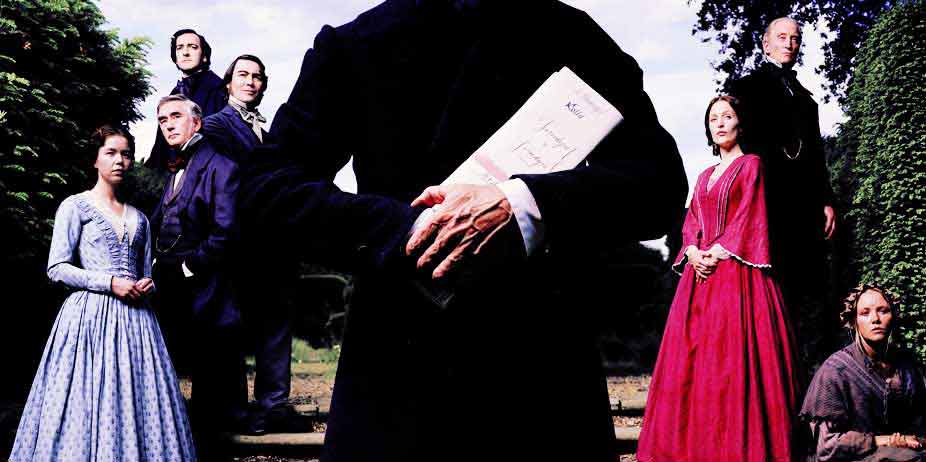
I once heard it said that classics are novels that captured the essence of a social era. Charles Dickens did as much in his numerous, wonderfully-written books about various individuals in different walks of life. I have not read all of his novels but have seen many of the film adaptations of them, and believe that the latest Masterpiece Theatre adaptation of Bleak House is my favorite.
The extended family of Jarndyce has been engaged in an epic battle over the estate for numerous years. The old Jarndyce when he died left multiple drafts of his last will and testament, all of them contradicting one another and naming different beneficiaries; few of the manuscripts are dated and only half of them signed, leaving his division of in-laws waiting in anticipation for an inheritance that may never come. Among this odd assortment of peculiar characters are Richard Carstone (Patrick Kennedy) and Ada Clare (Carey Mulligan), taken in as the ward of John Jarndyce (Denis Lawson) at the estate of Bleak House. Mr. Jarndyce hires the emotionally abused and abandoned Esther Summerston (Anna Maxwell Martin) as a companion to Ada. The move encourages Esther to search for answers to her mysterious past, that of a child raised by a guardian who refused to reveal her parentage, implying that it was shameful.
One of the attorneys engaged in the ferocious battle over the estate is Mr. Tulkinghorn (Charles Dance). After the penmanship on a document copied by a local tradesman distresses his wealthy client, Lady Dedlock (a luminous Gillian Anderson), he becomes obsessed with learning the truth. His search leads him to the dark upper room of a boardinghouse where the document's scribe is found dead of an opium overdose. The seedy landlord has made off with his tenant's personal documents, a packet of letters written in a woman's hand. Esther encounters romantic attentions from an unwanted suitor, financially-challenged Harold Skimpole (Nathaniel Parker) comes looking for a handout, and Richard attempts to find a profession that suits him while counting on his would-be inheritance to finance enough to marry Ada.
One of Dickens' faults lied in his ability to create so many characters that it makes his novels difficult to transcribe to the screen. Most screenwriters either severely limit the participation of characters or exclude them completely. Douglas McGrath did a hatchet job on Nicholas Nickleby but managed to create a brilliant adaptation. The BBC is more devoted to extolling the virtues of Dickens' quirky characters and situations and this makes the first half hour of Bleak House somewhat difficult as you attempt to figure out who all the characters are and how they pertain to one another. The filmmaking takes some getting used to, with a variety of different camera techniques and rapid cuts that grow on you with time. The true gem is the performances by such veteran international thespians. Gillian Anderson is astounding in a role that requires her to be cold but vulnerable, Charles Dance has never been more sinister and unforgettable, and Anna Maxwell Martin is given the opportunity to reveal her ability to carry off a leading role.
Bleak House both amuses and astonishes its viewer with a series of intricate little mysteries. Some happenings are expected and others take you completely by surprise. Just when you think things are settling down, a murder is committed. A detective becomes involved. Scandal, travesty and financial manipulations torment the occupants of Bleak House. It may be the most complex of Dickens' works and as a result has a fascinating psychological aspect that develops into a study of human nature. There are motivations behind all the actions of the characters and these are slowly revealed. There are numerous quirks and eccentricities within the storyline, proving that Dickens can maintain a morbid sense of humor while leading us through an emotionally-impacting plot. There is very little objectionable content, found primarily in the depiction of various thematic elements. Death takes the life of more than one character. A woman becomes ill and is marred with smallpox. A child is kidnapped. A man is shot and killed. It is implied that another bursts into flames through spontaneous combustion (the flash is seen through a window, leaving a pile of ash behind). The irony is that while others are miserable, the house for which the story is named hardly lives up to the name, remaining a center of happiness through the oftentimes bleak tale.