Braveheart (1995)
Reviewer: Brett Willis
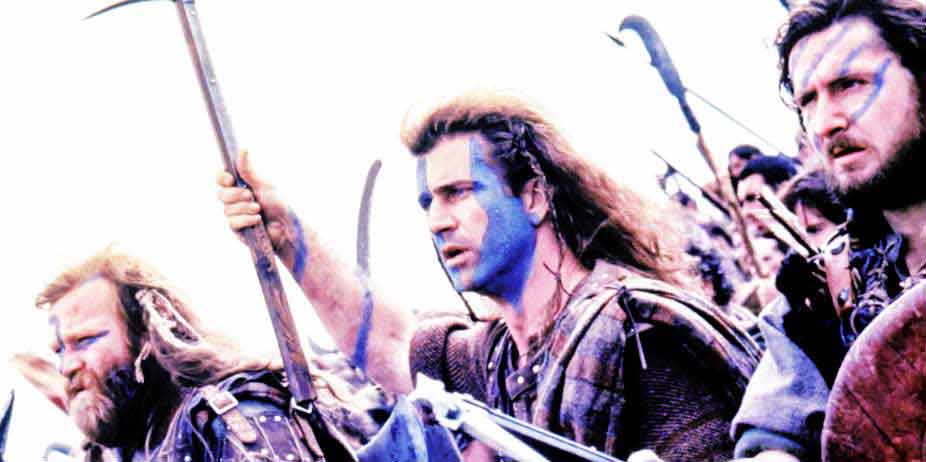
Mel Gibson's character in this film is a man who, though skilled in warfare, attempts to stay out of trouble and live in peace with the status quo of being ruled by a foreign power. But when a representative of the tyrannical English king assaults his family, he's galvanized into action, and many like-minded patriots rally behind him.
The above paragraph could have been written about Gibson's 2000 film The Patriot, in which he portrays Francis Marion, The Swamp Fox (renamed Benjamin Martin). But it applies equally well to the 1995 Best Picture Oscar-winning epic Braveheart, in which Gibson plays Scottish leader William Wallace. Certain dramatic formulas have always worked well, so there's no point in changing them. Gibson initially turned down the starring role in this film, thinking he was too old, and asked to direct it instead. He ended up doing both, and picked up a Best Director Oscar.
The story covers the period from 1280 to 1314. The general history is accurate, but several dramatic liberties have been taken. It opens with eight-year-old William Wallace (James Robinson) seeing a barn full of the bodies of Scottish nobles and their young pages who were lured to a truce meeting by English King Edward I the Longshanks, and hanged. Shortly thereafter, Williams father and older brother are killed in battle against England, and the orphaned William is to be taken away, raised and tutored by an uncle. At his fathers burial, he's given a flower by a female friend, young Murron MacClannough (Mhairi Calvey). It will be a long time before he sees her, or his redheaded playmate Hamish Campbell (Andrew Weir), again.
The politics of the film are fairly simple. The King of Scotland died without leaving a clear line of succession, and Longshanks covets the Scottish throne. The Scottish nobles bicker among themselves, rather than presenting a united front. The most logical heir, Robert the Bruce (Angus Macfadyen), holds back from claiming the throne and tries to play both sides of the fence in the conflict. While many of the nobles are two-faced due to being bought off by Longshanks with titles and lands, Roberts motive is different. He's trying to honor the wishes of his secluded, leprous father, and playing politics is his fathers direct advice. After some years, the adult William Wallace (Gibson), schooled in French and Latin and trained in combat, returns to his ancestral village. He rebuilds his house. He still has the flower Murron gave him, pressed and preserved. Promising her father that hell seek peace and not get involved in the rebellion, he courts the now grown-up Murron (Catherine McCormack). He also reconnects with Hamish (a barely-recognizable Brendan Gleeson), now a giant bruiser of a man who'll be one of Wallace's staunchest supporters through thick and thin.
Longshanks (Patrick McGoohan), still usurping the Scottish throne, has new tricks up his sleeve. To induce English nobles to resettle in Scotland and become District Administrators, he decides to revive the practice of Prima Nocte or First Night. When a commoner girl is married, the Administrator (rather than her husband) will have rights to her on her wedding night. We actually see a noble and Longshanks soldiers crash a wedding feast and carry off the new bride of one of Wallace's friends. If murdering people under a guise of truce weren't enough, this sequence makes it crystal-clear to the viewer who the heroes and the villains are. Aside from getting himself some conscienceless Administrators and demoralizing his opponents, Longshanks half-jokingly stated purpose for imposing this custom is The trouble with Scotland is that its full of Scots. If we cant drive them out, well breed them out.
At home, Longshanks has domestic troubles of his own. His son and heir, the Prince of Wales (Peter Hanly), is gay, has a male lover, and has no interest in his arranged-marriage bride Princess Isabelle of France (Sophie Marceau). Nor does he have much interest in warfare or other Kingly things. When summoned by Longshanks to a war council, he sends Isabelle in his place. To avoid Prima Nocte, Wallace and Murron are married in secret and she continues to live with her parents. Even so, their bliss is short-lived. A lecherous old official, with the help of some soldiers, attempts to rape Murron in broad daylight. She puts up a good struggle, and Wallace comes to her aid and fights off the attack. But Murron is recaptured, and the Administrator publicly slits her throat as an example of the consequences of rebellion and as an inducement to Wallace to attack him. Wallace, of course, takes the challenge.
The above covers the first 35 or 40 minutes of the film. The remaining two-hours-plus is warfare, intrigue and betrayal, punctuated with a few tender human-interest moments. Most of the characters are Roman Catholics, and (insofar as the subject is dealt with) they appear to take their faith seriously. Priests give communion and blessings to the Scottish army before a battle. When captured, Wallace prays for the strength to die well. A few exclamations like Jesus that appear to be curses might actually be meant as prayers instead. While some characters on both sides of the conflict waffle in their loyalties or openly sell out, Wallace (once committed) never wavers from his fight for Scottish freedom. At long last, Robert the Bruce gets off the fence and openly takes up that cause as well.
When Wallace uses brains instead of brawn, knocking out Hamish with a well-aimed pebble to the forehead, he appears to be David fighting Goliath. When the long-haired Wallace initially takes up arms against Longshanks due to a personal affront, and the rest of the film is a case of raising the stakes on both sides and it all started when he hit me back, were reminded of Samson and the Philistines. And when the condemned Wallace refuses a painkilling drug, is spit upon and reviled by the crowd, is fastened to a cross, and calmly accepts his death, it doesn't take a genius to pick up on the Christological imagery. The acting is stellar throughout, as are the cinematography, the sound, the editing, and the James Horner musical score. One nitpick would be that the actors accents vary in degree of authenticity.
In case anyone still doubts whom the villain is supposed to be, Longshanks sends an infantry charge by Irish mercenaries rather than call for an archery barrage, because arrows cost money while dead Irish cost nothing. Later, he does call for the archers during an infantry battle. His rationale: yes, hell hit his own troops, but hell hit the enemy as well. And he has reserves. When Wallace's army becomes strong and invades England itself, were not shown any killing of women and children when he sacks the city of York. (That's known as selective storytelling.) *SPOILER* Longshanks decides to send a representative to negotiate with Wallace. He's certainly not going in person, and he cant send his weakling son. So he sends Princess Isabelle, who knows by the grapevine of Wallace's exploits and who eventually falls in love with him, clandestinely aids him, has an affair with him and becomes pregnant with his child (meaning that Longshanks bloodline will die out and Wallace's genes will be injected into the English monarchy). This is a completely contrived situation...a device to make most of the audience approve of adultery in this special situation, as a fitting retribution for Prima Nocte. (Note: The real-life Longshanks did NOT institute Prima Nocte, nor could Wallace have carried on an affair with Isabella since she was still a small child in France at the time.)
Although the Academy awarded this film the Oscar, many Hollywood folks strongly protested the negative gay stereotype portrayed by the Prince of Wales. Of course, there are many falsely positive gay stereotypes in film, and Gibson might have considered this a make-up call. But even I think he overdid it. Scripture condemns all nonmarital sex acts (which of course includes all gay sex acts), but it makes no mention of sexual orientation. I see no need to make anyone's lot in life harder than it already is. In summary: those who enjoyed The Patriot despite its violence, and who expect this film to be another of the same type, need to lower their expectations a few notches. The violence is much more intense, there are many other offensive elements, and there are more historical inaccuracies. Id let my 13-year-old daughter watch The Patriot if she were interested. I would NOT let her watch Braveheart. Not now, nor any time soon.
Sexual Content:
On Wallace and Murron's wedding night, we see them in the moonlight, hugging, explicitly nude from the waist up. During one engagement, the entire front rank of the Scottish battle line lifts their kilts, and flashes and then moons the English army (as a tactic to make them abandon caution and charge). This is shown explicitly, mostly in long-range shots (which means there are more total bodies involved, but less detail of each one).
Language:
There are a few profanities, including two occurrences of f*, four of arse, and various references to God or Jesus such as For the love of C*. Referring to the noncommittal Scottish nobles, Hamish says that those bast* couldn't agree on the color of s*. Stephen, an Irishman who joins Wallace's army and who may or may not be a little touched in the head, spews some creative blasphemy. He claims to have two-way conversations with the Almighty; he says that an Irishman has to do that, in order to be speaking with an equal. He's the one who utters the two f-words, and in both cases he claims to be quoting something that God just told him.
Violence:
The battle violence is extreme. More intense and drawn-out than in The Patriot. One reviewer said that a certain battle sequence in this film is second in intensity only to the opening sequence in Saving Private Ryan. And with medieval weaponry, the violence is more up close and personal. Were talking about severed limbs, severed heads, face gouging, arrows in bare butts, slit throats, blood-splattered clubbing with blunt instruments, boiling oil, flaming oil etc.
Other:
None.