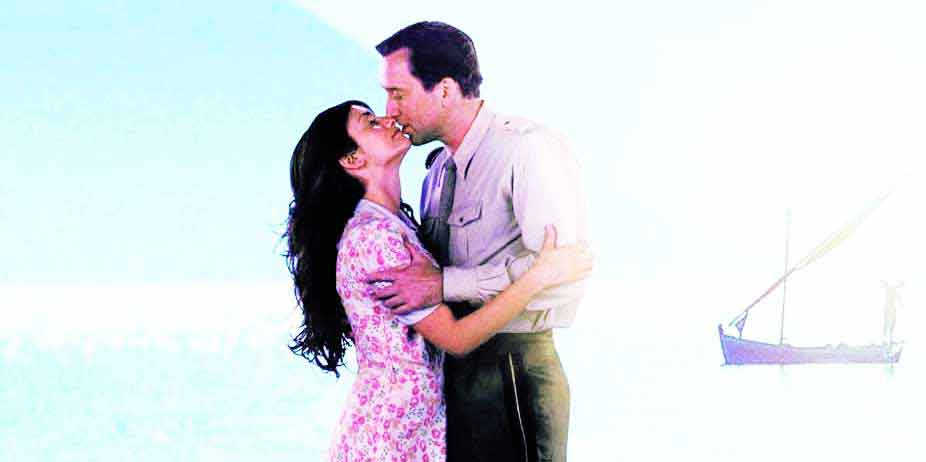
Captain Corelli's Mandolin (2001)
Have you ever wanted to see the world from someone else's perspective? Captain Corelli's Mandolin is a film that dares to be different, adapted from the bestselling novel by Louis de Bernires. At it's core is a love story, but also a subtle revelation toward life itself. This makes for a very charming but emotionally impacting story of selfless people caught up in the midst of a brutal war.
Life is quiet in the small village in Greece where Dr. Iannis (John Hurt) makes his practice. There are rare extraordinary cases but for the most part he is content pulling peas out of men's ears and mending broken arms... and occasionally taking buckshot out of unfortunate young men's backsides. Mandras (Christian Bale) is just such an unfortunate, having chance to stray in the way of cannon fire at a local celebration. The doctor's only daughter Pelagia (Penlope Cruz) has caught Mandras' eye and he begs to become engaged to her. Disapproving of the match because they are not equal, Iannis threatens to give her no dowry if she marries Mandras. Believing that their love is too strong to be denied, she goes against his wishes and becomes engaged, promising to marry her beloved when he returns from the wars. Germany is taking over the world, and Italy under the command of Mussolini has promised to tame Greece.
When they successfully beat back the Italians, Hitler sends German forces to support them. Enemy soldiers pour into the village, among them Captain Corelli (Nicholas Cage), a happy go lucky Italian whose mandolin is his most prized possession. Obsessed with music, he and Pelagia share an instant attraction that both attempt to ward off. According to local laws by the invaders, each home must house a soldier. Corelli comes into Iannis' household, and against her better knowledge, Pelagia begins to fall in love with him. There is also the charming German officer Weber (David Morrissey), who is distrusted throughout the community but is drawn to a local girl. And then there is Mandras, who has vanished on the battlefield. Soon Mussolini will fall. Corelli, despite his charm and interest in humanity, is on the wrong side.
If I could say one thing about this film, it would be heart wrenching. It's not tragic in the most common sense of the world, and has more light than many films centering around the Holocaust and resulting chaos throughout Europe. There's a good soul at the center of the story and the film does well in representing that the people of the war were just that: human beings. They loved, they lost, they experienced hatred and anger and jealousy and love. Even the Germans had hearts. Because of this, Weber becomes the most fascinating character. He is sweet in many instances, extremely shy, and in desperate need of kinship. He accepts the friendship of Corelli and is thankful for it, even when others shun him. This is what makes us so shaken and horrified when he is forced to reveal that whatever else, he is still one of Hitler's men. He believes some humans are inferior and, because of poverty as a child, has aspirations toward power.
Many of the other characters are just as fascinating, and I appreciated that Mandras behaved honorably when it came to Pelagia. Rather than seeking revenge, he showed Corelli mercy when it was most needed. The movie has excellent acting, a wonderful sense of humor, and a beautiful musical score. Which is why the content becomes so troubling. When the Italians come to take over the town hall, the mayor sends them a message: "F*** off." This phrase is repeated four times. Topless girls are seen on the beach. Corelli and Pelagia make love after declaring their hearts; there's breast nudity on her, but nothing beyond gentle kissing. The scene is completely unnecessary and degrading. We get several ganders at Mandras' bare backside as he lies on the operating table to be examined (his pants are pulled down part-way). Violence only once becomes gruesome: there are numerous explosions as bombs go off, and men are shot and killed in a crossfire. Revisionist Italians are lined up and slaughtered with machine guns. Weber graphically shoots one man in the head, complete with spurting blood. If it weren't for the pointless nudity, I would recommend the film as a study of life in Greece during the invasion. Most stories about WWII take place in England or France. It was nice to visit another culture and see the impact on its people.