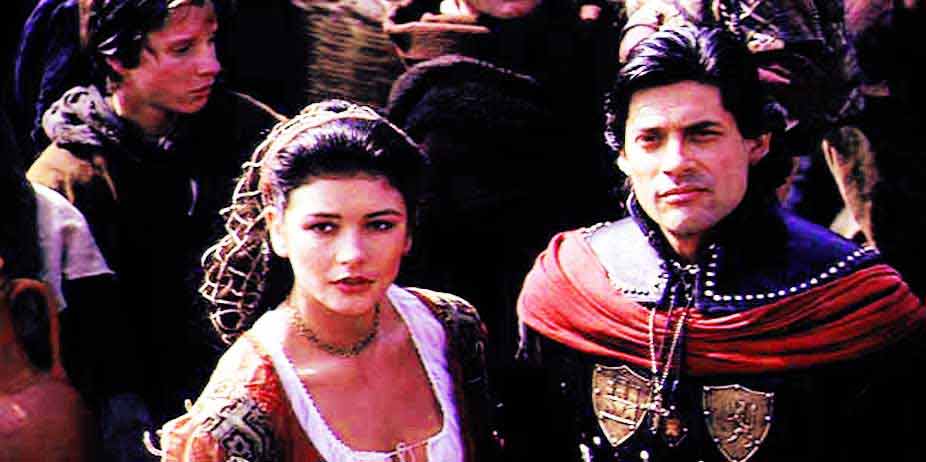
Christopher Columbus: The Discovery (1992)
In 1492, Genoan explorer Christopher Columbus obtained permission from the monarchy of Spain to sail across the seas in search of the Indies. What he found instead is another world previously uncharted that changed the face of global history forever. This film is decently accurate if at times overly melodramatic, but is not the best depiction of Columbus' struggles and victories that I have ever seen. In fact, it seems rather short at its conclusion, not so much because the time limit is small, but rather because there is so much left to tell.
It is the greatest ambition of Columbus (George Corraface) to find a new route to the provinces of Asia and India, in order to prove that the distance between Europe and the rest of civilization can be reached from sea ports. Believing that it is no more than a few thousand leagues from the coast of one empire to another, he takes his case before various princes in order to gain the finances and ships needed for his experiment. The king of Portugal laughs at this ridiculous notion, which causes him to turn to the rulers of Spain, at the encouragement of a Franciscan monk who tells him that Queen Isabella (Rachel Ward) is particularly eager to spread Christianity to the far ends of the world. His first interview with the queen and her husband, the doubtful King Ferdinand (Tom Sellick), far from produces the desired results, but Isabella thinks highly of his ambitions and gives him a small allowance to live on while she and her husband continue the defeat of the Moors.
Shortly after the expulsion of the Islamic believers from Spain, it is decided that the Jews too should leave, unless they agree to convert to the true faith. Columbus is employed with a Jewish map maker, and the man's departure from his homeland coincides with a second call to court. This time, his excitement and promises of riches convince Isabella to fit him with a fleet and whatever sailors he can find. Columbus cannot locate enough men willing to risk their lives on a "fool's sailing" and is forced to employ a few convicts, some of which have been bought off by the Portuguese to sabotage the voyage at all costs. Leaving behind his children and his mistress (Catharine Zeta-Jones), Columbus sets sail for adventure, never realizing he is not making his way toward India at all.
This film is hard to categorize in a review because it has both merits and faults that seem to counteract one another. At times it is very good and at times it is rather bad, but the biggest problem seems to be miscasting. Perhaps I have seen the monarchy in too many modern roles, but I had a lot of trouble accepting Ward as Isabella. Her passion for faith and excitement over the sea voyage was right on target, but her performance was not succinct enough to be believable. Sellick likewise was rather a droll Ferdinand; he fit the costume well but there was no depth to his character. Marlin Brando was also briefly involved as a priest, but he was equally dull. The best roles were those of the sailors, Columbus himself, and the absolutely gorgeous Zeta-Jones in an early performance before her major stardom. The costuming is quite good (although inept when it comes to Isabella's garments) and the passages on the sea are believable. But as formerly stated, it ended far too abruptly and left me feeling cheated, since Columbus' journey hardly ended with his first return to Spain.
Unfortunately, this film also had an enormous amount of tribal nudity, which I was not warned of nor aware of before I got to it. If it were just once or twice, I might have ignored its impact on a formerly decent film, but it seems like there is not a single shot on the islands without more than one pair of bare breasts in it. The women run around topless and the camera has no scruples about eyeing them. I don't care if it is accurate or not, for the sake of making this suitable for family viewing, they could have tied some material around the actress' chests. The island sequence takes up about fourth of the last half of the film, so there's no getting around it. Apart from that, there is some violence (a man is brutally stabbed by his son; dead bodies are strewn over the camp site after an Indian revolt; a shark attacks a body buried at sea and blood spurts into the water; later, the shark drags a man underwater), and there is an uncomfortably long scene of Columbus kissing and undressing his mistress.
One thing the movie doesn't do is gloss over Columbus' faults, which even might be judged as too severe by critics. He has a certain amount of respect for the natives until he realizes that he will not have mountains of gold to take back to Ferdinand; so he has his men remove all the gold from the Indians, then forces six of them to return with him to Spain. When they refuse to learn a Christian song (proof for Isabella that they are being good missionaries), he has them shackled. It also doesn't shy away from the horrible reality that Ferdinand and Isabella ousted innumerous Jewish families from Spain in the name of God. If nothing else, it gives you a tantalizing glimpse into history that has not been tamed so as not to offend, but still it could have done with a bit more consideration for its younger viewing audience.