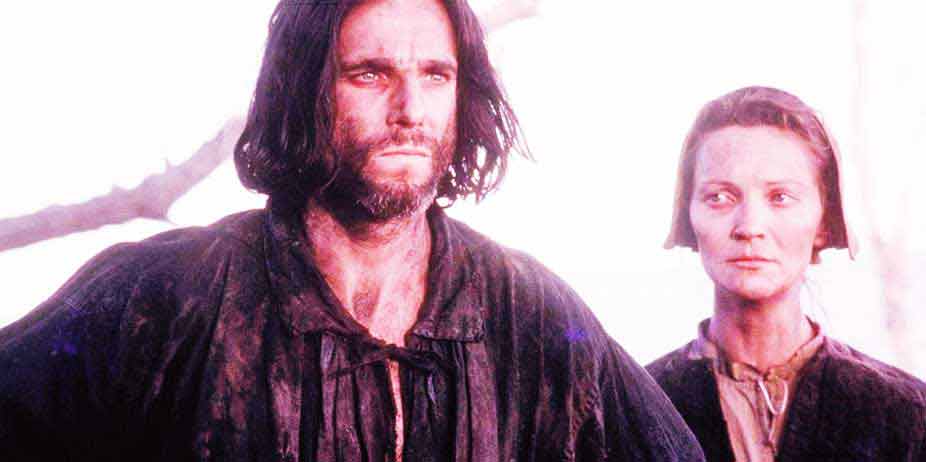
The Crucible (1996)
The Salem Witch Trials were some of the darkest moments in the history of the American church. In 1692, just two years after a Boston hanging of "witches," there sparked a controversy that the devil was afoot in Salem. The Crucible predicts just how it might have happened.
In the wee hours of darkness a gaggle of girls steal from their beds and into the wood for a firelight dance to mix lover's potions. Their leader Abigail Williams (Winona Ryder) is a girl bent on vengeance for the spurning of her former lover John Proctor (Daniel Day-Lewis). On the outskirts, terrified by the display, stands young Marry Warren (Karron Graves), Abigail's best friend. But Abigail seems to suddenly go mad, crying out for the death of her lover's wife. The ruckus is discovered by Abigail's uncle the town Reverend (Bruce Davidson), and whispers of witchcraft begin to spread throughout Salem. The next morning two children, the youngest girls in attendance, are found witless; as if dead in some kind of horrified trance. The Reverend is not able to rouse them; the doctor cannot wake them, not even the town's single gentle soul can bring them about. Even Abigail cannot wake her sister until she whispers that she has told all; then the girl comes alive but seemingly possessed and tries to leap out the window.
Help is sent for in the form of a man who knows the workings of the devil. As he attempts to unwind truth from fantasy, Abigail attempts to find her way back into the arms of John Proctor. History can attest to the rest -- a mass hysteria that resulted in neighbors shouting "witch" at one another over old wounds; pointing fingers into the homes of innocent people throughout the surrounding countryside. Abigail has not yet fully played her cards... when a finger is pointed toward her she rallies the girls into a terrible wall of unflinching defense, claiming they can see the devil's hand working among them. Inevitably her anger will lead her to strike out at Proctor's unassuming wife.
The film is thought provoking if nothing else. What would you do? Admit to a lie against God and save yourself, or refuse confession that you're a witch and hang? This was Christian piety in the extreme: a church so bent on the letter of the law they failed to acknowledge the means of assuming guilt. Innocent people were jailed and killed because they refused to denounce their affiliation with witchcraft. Most were God-fearing people and the church was overreacting. In that sense, this film is valuable since it shows the horror of persecution and fear. Many will be offended by how most of the Christians are portrayed -- excitable, over-reacting "demon behind every bush" fanatics. Proctor is an atheist, having left the church long ago. His wife is religious "in her own way." The Reverend is a pious old fool; the church relies more on self piety than Christ to judge those brought before them; and the hero refutes the charges against him not because of his faith and loyalty to God but because it would tarnish his good name. There is one reasonable minister involved who encourages Proctor to save himself and his wife, and also speaks out against the wrongful charges of the church.
The girls fake seeing demons behind every bush; they scream, faint, carry on, and give chilling performances. The views of the devil and his minions are very skewed; much is made of people supposedly "sending their spirit" to do harm to others. Abigail claims several times that Mrs. Procter's "spirit" came to her in the night and attempted to kill her, once stabbing her with a needle. There's nothing overtly evil about this film but I would not recommend it lightly. The darkness of the subject, the fact that the main character is indeed dabbling in witchcraft, and the nudity make it unsuitable for younger audiences.
Sexual Content:
References to a past affair; a woman touches a man's crotch. A girl dances naked in the woods -- we see her bare butt and breasts.
Language:
Uses of the word "whore."
Violence:
Abigail breaks a chicken's neck and wipes the blood on her face.