Dances with Wolves (1990)
Many years ago, Dances With Wolves swept the Oscars, thumbed its nose at historians, and became a classic. If you can overlook the historical inaccuracies and content issues, you will enjoy it.
Jon Dunbar (Kevin Cosner) is a lieutenant of the Civil War who has just barely resisted going "under the knife" for a foot infected with gangrene. Limping out of the tent when the doctor's back is turned and stealing a horse, he rides away, determining to kill himself by riding full-force in front of the enemy encampment. But instead of being killed, he is hailed as a hero, since he draws enemy attention and firepower and allows his men to take the opposing force by surprise. In thankfulness, the doctors are ordered to do everything they can to save his life... and his leg. But what's more, he's asked where he would like to be posted next. Desiring to see the prairie "before it's gone," he asks to be sent to the Dakotas. But there's something strange about his post... his guide and the fort commander are odd people, secretive and unwilling to divulge anything, and his commanding officer kills himself after sending Dunbar off on his assignment. Since he was the single figure of authority who knew of Dunbar's destination, the man is "lost" in military records... and no one is sent to join him at the lonely prairie fort.
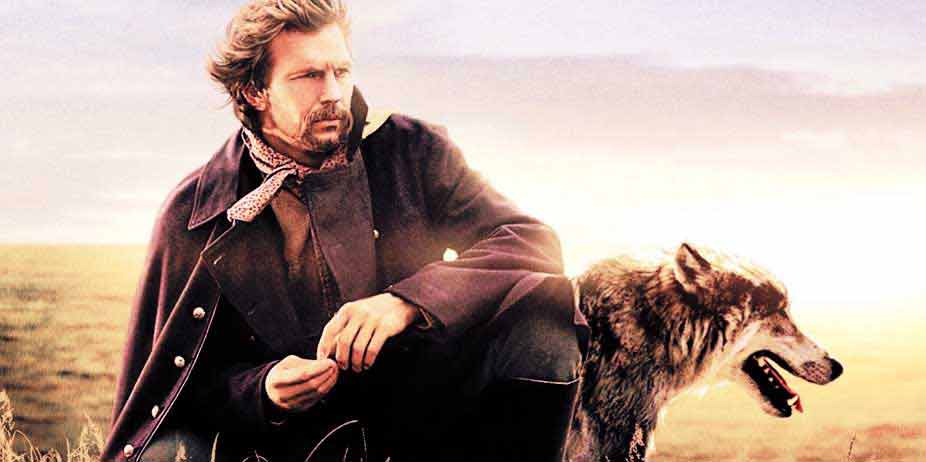
His one companion is a beautiful gray wolf whom he slowly befriends... but the prairie is a dangerous and deadly place to live, particularly alone. There are the hair-raising Pawnee, who brutalize and scalp pioneers for kicks, the pack of wolves that run the wild, even buffalo who stop for nothing and no one in their way. But soon everything changes when he's introduced to a Sioux Indian tribe... one day while walking, he comes across a young white woman (Mary McDonnell) raised by Indians who is cutting her wrists in a show of mourning for her newly departed husband. In stopping her suicide, he is brought into the tribe and a spark of romance is eventually ignited, changing his life forever...
This film is "politically correct" in all the ways you might imagine -- from the cold, brutal, cruel white men to the liberated Indian women, but also emotionally engaging and ultimately entertaining. It is an authentic look into the life of the Sioux tribe and does involve some humorous and likable characters. The acting is also terrific, apart from Cosner who has something of a habit of chewing up the screen. Dunbar is rather bland in comparison to the rest of the colorful characters, which include the woman he comes to love and the braves that surround him in the encampment. Even the wolf becomes a character in of itself, which makes his ultimate demise all the more devastating to the audience. It is beautifully scored, photographed, and written, with touching insights into humanity without sugarcoating the difficulties and horrors of frontier life. There were many things I liked about it, but to be honest, also things that I found off-putting. I am an animal lover, and as a warning to other sensitive souls out there -- you are not going to like the emphasis on animal brutality in this film. In addition to the camera panning hundreds of skinned buffalo carcasses left out in the sun to rot, we watch a hunting party take down buffalo with arrows and gunshots. Horses are shot and killed -- one of them is shot multiple times (we see the hits) in the neck, chest, and flank, before it goes down and is left to die in agony. Soldiers shoot at a wolf for fun and kill it. Dunbar spends several days hauling dead deer out of a pond and carting them off.
These horrific images aside, Dances With Wolves is a very brutal and violent film in general. We see the scalped bodies of settlers along the trail, as well as some actual scalpings (only partially seen) by Pawnee warriors. Battle scenes are graphic, filled with flying arrows and bloody gunfire. A man is rescued from a group of soldiers, all of whom are shot with arrows, drowned, or impaled with tomahawks. A war hospital is strewn with bloodied figures, many of which who are in the process of having body parts amputated. There are frequent harsh abuses of deity, and "God" is sometimes coupled with a profanity; other instances of vulgarities and profanities are used. We see brief backside nudity as Dunbar skinny-dips in the pond and is taken by surprise by intruders; he dashes screaming up the bank. Partial nudity is seen later on as we witness a man relieving himself. There are two scenes of sexual content -- one between an Indian and his wife, and another more graphic one between Dunbar and the woman he loves, prior to their marriage -- much is made of the villagers teasing them about always being in their tent after the wedding. The scene includes partial nudity (all of her bare back, part of her side), and then movement.
This film moves very slowly with long spaces of time in which nothing of significance happens... we watch Dunbar walk around on the prairie, toss meat scraps to the wolf, and repair his house. Yes, it's beautifully filmed and deserves a handful of the Oscars that it received for excellence, but the savagery kind of soured me on the experience.