Daniel Deronda (2002)
Having a familiarity with the field of psychology, I have always found morality plays fascinating. If you delight in thought-provoking films with careful layers of morality and virtue, Daniel Deronda will be just your cup of tea. In addition to being a magnificent piece from a purely artistic perspective (the gowns, horse-drawn carriages, and exquisite English countryside will stir the hearts of even the most ardent modernist), it also offers a magnitude of ideal conversation starters. The miniseries is based on the classic novel by George Eliot, and is essentially two plots woven into one.
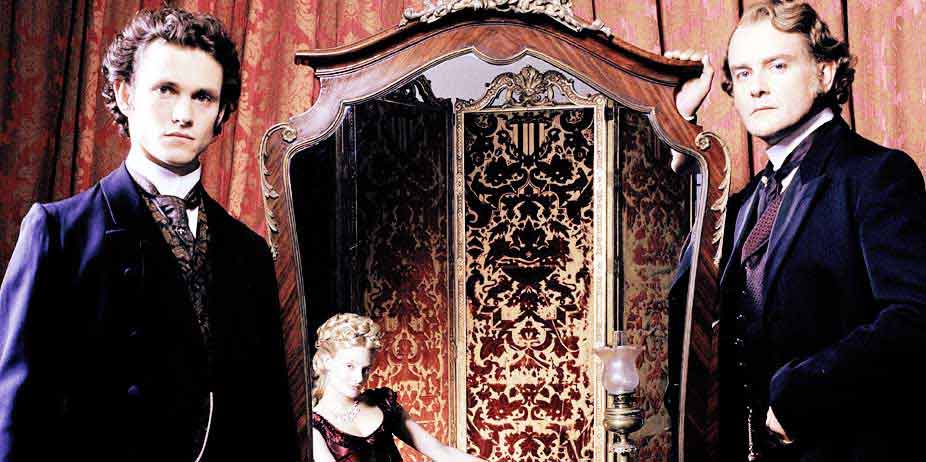
We are first introduced to the beautiful Gwendolyn (Romola Garai) at the gaming tables, where she carelessly loses a fortune in roulette. She also briefly catches the eye of a handsome young man but denies her friend's offer to introduce them. He is not like young men in general, she remarks with a smile. Taken several months back in time, we observe Gwendolen at the height of society. All the young men of the county, wealthy and impoverished alike, are in love with her. But as Gwendolen confesses, she has "not the nature to love" and does not particularly like any of them. Among her suitors is the imperial Grandcourt (Hugh Bonneville,), a wealthy squire with a mysterious past. His predatory nature has drawn him to the ravishing beauty and he intends to "master" her. Gwendolen also feels a strong attraction to his financial stability but shrinks away when a terrible secret from his past comes to light. After fleeing to Germany and the gaming tables, she is informed her family has lost their fortune and she must return as soon as possible to England.
Pawning her necklace, Gwendolen is touched by the compassion of a stranger, who returns it to her with a note not to be so careless as to lose it again. Daniel Deronda (Hugh Dancy) is the ward of Sir Hugo, Grandcourt's wealthy uncle. Many suspect Daniel to be Hugo's illegitimate son. He was the figure to observe her at the roulette tables, and finds her a "Van Dyke duchess of a beauty." A man of a kind heart and wonderful sensibilities, Daniel becomes a savior to a young Jewish girl by saving her from drowning. Mirah Lapidoth (Jodhi May) is a consummate singer with a traumatic past. She was kidnapped by her father at a young age and forced to perform on the stage for money until her father's scheming became too much to bear. She has returned to London in the hopes of being reunited with her long lost mother and older brother.
In his search for Mirah's family, Daniel will come to desire information of his own history. Journeying into the Jewish community of London, he instead finds a mysterious man by the name of Mordecai who believes Daniel has been "chosen" to help his people. In the meantime, unable to submit to the humility of becoming a governess, Gwendolen instead allows herself to become swayed by Grandcourt's lavish attentions. Their engagement is announced but his intentions are sinister. Eventually our spoiled heroine will come to learn that life's choices demand consequences. The two storylines combine into one for a powerful, thought-provoking conclusion with a labyrinth of opportunity for discussion. From rationalizing and defending one's wrong choices to showing the difference between attraction and subtle, strong love, Daniel Deronda is a gem not merely for its beauty but also its hideousness.
The filmmakers have created a tasteful film that deals with many heavy subjects without becoming vulgar or crass. Too many movies go too far in showing us the bane of life; this one does it with modesty and integrity. We're aware Grandcourt sexually abuses his wife but only through the intensity in the scenes between them. There's virtually no sexual content, very little violence, and only mild profanity common to period pieces of this genre. Still, some elements are worth noting. Grandcourt is overly fond of sensuously kissing his wife's neck in an act of intimidation. On their wedding night, after she's become hysterical over the contents of a letter, he slides his hand into the neckline of her gown before she pulls away from him. (He then drags her into the bedroom and shuts the door.) There is some talk of mistresses. Gwendolen befriends Daniel after her marriage and some of their scenes together obviously contain attraction, but thankfully neither ever submit to even a kiss. Gwendolen often shows varying amounts of cleavage in her gowns (and is shown briefly in an extremely low-cut corset).
The premise of the film is basically positive toward the Jewish culture but lacks one of the book's most Christian passages of dialogue. Still, it's rare to see a respect toward any form of faith, particularly from the liberal BBC production company. The costuming is absolutely gorgeous and there's not a weak link in the cast, which includes such well-known actresses as Barbara Hershey and Gretta Sacci. Fans of other period films will recognize actors from Pride & Prejudice, Persuasion, and Emma. Daniel Deronda is not a perfect film entirely but it's rare to find a wonderful Victorian bodice ripper where the bodice actually stays on.