Doctor Zhivago (1965)
Reviewer:
Brett Willis
This is a long and complicated story, sometimes seeming disjointed and confusing for those like myself who've never read the Boris Pasternak novel, but an epic nevertheless. The story takes place in Russia. The primary time setting is just before, during and after WWI. But there's a brief glimpse of an earlier time when young Yuri Zhivago (Tarek Sharif) lost his mother and was taken in by another family, gaining a new sister, Tonya, in the process. And, the primary story is bracketed by sequences from apparently the 1940s or 50s in effect, told in flashback and narrated by Yuris half-brother, Gen. Yevgraf Zhivago (Alec Guinness), who is searching for the long-lost daughter of Yuri (played as an adult by Omar Sharif) and his mistress Lara (Julie Christie).
As the primary story opens, Yuri is both a medical doctor and a poet of some note. Czarist Russia suffers from war with Germany and from political turmoil within. An anti-Czarist rally is attacked by mounted police who use their swords to cut down women and children and to put a permanent scar on the cheek of activist Pasha Antipova (Tom Courtenay). Meantime, Pashas fiancé Lara is serving as a lover to the rich and slimy Victor Komarovsky (Rod Steiger), who is also her mothers lover. Eventually Pasha forgives Lara and they're married. Yuri marries Tonya (Geraldine Chaplin). And Yevgraf is busy betraying the Russian army from within and helping them to lose the war, because he believes the additional suffering will usher in the Bolshevik (Communist) Revolution. And he's correct.
During the Revolution, all hope of a normal life is lost. Anyone who is deemed an enemy of the State is re-educated or shot. The possessions of the rich are confiscated. Finding food and shelter is a constant struggle. And men can be impressed into the army either the White (Czarist) Army or the Red Army with no warning. This of course includes doctors, who are needed as medical officers.
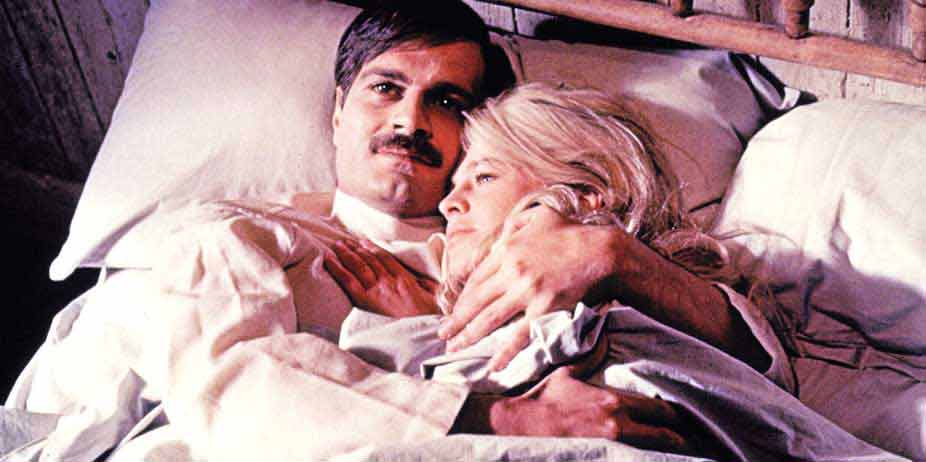
The violence is intense at times, very sad at others (such as a platoon of very young boys being cut down by a machine gun); but filmed in the old style with blood but no splattering. The language is quite clean. I counted one instance each of b*tch, bastard and slut, and some mild innuendo. At one point, Yuri and Lara are very attracted to each other while working together as a doctor and nurse for a period of six months, but behave themselves. Lara explains she wants them to have no regrets when he returns to his wife. But later, when they meet in other circumstances, they finally give in to their passions. The way this is presented is also in the old style, with the two of them seen together in bed but with no visible nudity or overt sexual movement. Lara is still married to Pasha, though he no longer acknowledges her, now calls himself Strelnikov, and is a ruthless and feared Red Army leader.
Yuri now divides his time between Tonya and Lara. At one point (while Tonya is pregnant with their second child), he breaks off the relationship with Lara. But then he's forcibly taken away from contact with both Lara and Tonya; and when he is able to return its Lara he returns to and writes famous poetry about. The films overall impact is that their relationship is nothing to be upset about; in fact, its presented as a loves sweet agony ideal. The overall mood is one of sadness. Peoples lives forever changed because of a war with an obscure cause. Needless suffering and death. Lovers separated from each other. Children separated from their parents. Not the kind of thing you want to watch just before going to sleep. And there are no heroes to attach oneself to; all of the main characters are flawed. Yet, this story represents a real slice of history and as such may be worthwhile for mature viewers.