Dracula (2006)
One might call me a connoisseur of Bram Stoker adaptations. The novel is a complex exploration of subtlety when it comes to Victorian traditions and morality, an often harsh view of immortality existing outside Christ. In many ways it is not merely a condemnation of ultra-feminism and chauvinistic behavior, but also a weighty look into supernatural fears and misconceptions of the times.
Throughout the years, many have attempted to adapt Stoker's vision for the big screen, ranging from decidedly romanticized versions to those that give the title character no more personality than that of a raging animal out for blood. The BBC this time around chose to take an unorthodox approach, transcribing only the parts of the novel that suited their own particular style of filmmaking. The result is a surprisingly decent if at times preposterous retelling of a story that is familiar in some form to most students of literature. Arthur Holmwood (Dan Stevens) has just proposed to his beautiful lady friend Lucy (Sophia Myles), with the expectation of being married in the summer. Then he is summoned to his home in Whitby, where his deranged father is suffering from an advanced form of syphilis. Upon his death, the family doctor informs Arthur that since both his parents had it at the time of his conception, he no doubt carries it as well.
Concern that he will give it to Lucy once they are married, Arthur turns to the dark group of followers of a local supernatural cult. Devoted to the undead, they believe their immoral leader Count Dracula (Marc Warren) is capable of curing Arthur's disease. The young lord makes every arrangement to send for the count, little knowing that he is placing John Seward (Tom Burke) into danger. In the midst of a long-term engagement to the beautiful Mina Murray (Stephanie Leonidas), Jonathan is eager to make his way in the world and give her everything she dreams of. But once he arrives in Transylvania, and makes the acquaintance of the sinister occupant of the castle, his dreams come crashing down around him, propelling his family and friends into a living nightmare...
If you are a stickler for the book, this adaptation will not be your cup of tea. While certain details remain the same (the fact that Harker goes to Transylvania, that Dracula sets his eye on Mina, and so forth) many others have been altered, including the number of deaths and the fact that the reason for Dracula coming to England has more to do with the lure of a satanic cult than anything else. Because of this added element, scenes toward the beginning of the film are often confusing and difficult to follow. And despite early attempts to spread rumors that this would be a much more "sexualized" interpretation of events, for the most part the count doesn't have much chemistry with the leading ladies, which is both an asset given the fact that he's so horrible, and a determent given that the film wanted to rely on it. That much being said, I enjoyed it much more than I anticipated, once I got over the shock of all the blatant changes to Stoker's vision.
Some of the special effects and early approach to the script have been heavily borrowed from Coppela's version, including the flashbacks, seduction of Lucy, and filmy blood cell sequences. What is unique here is its approach. Dracula is a heartless, dislikable, bloodthirsty fiend with no moral compass -- just like Stoker invented him, and yet he's not a complete barbarian, as many adaptations have made the mistake of portraying him in the past. Arthur and Lucy make an adorable couple early on, and then he progresses to a stage where you want to beat him about the head for being such a fool. Mina is absolutely sweet and innocent, the perfect foil for Lucy's more aggressive approach to life. Van Helsing (David Suchet) is under-used and somewhat toned down, but does provide a good Christian influence. One line he quoted stroke me as memorable, that future generations might look upon them and scoff at their science, but not at their faith.
Mina is a devout Catholic and is shown praying and rubbing her rosary beads; a cross necklace prevents her from becoming Dracula's early prey. Van Helsing is also a follower of faith, and encourages Arthur not to lose his belief in God, prompting Arthur to pray for God's strength to fill him for what needs to be done. The occultists have a number of satanic rituals, including bloodletting, and inverted images of Christ on the cross. Dracula mocks common faith in Christianity and forces his followers to turn on one another. There is no language, but a certain amount of blood. It spurts when vampires are staked, streams when people are bitten, and drips from the count's mouth on a number of occasions. Victims are found with fang marks in their throats. A man has his neck snapped, and another is decapitated in much the same way, leaving Dracula holding his severed head. (Much of the latter is in the shadows.)
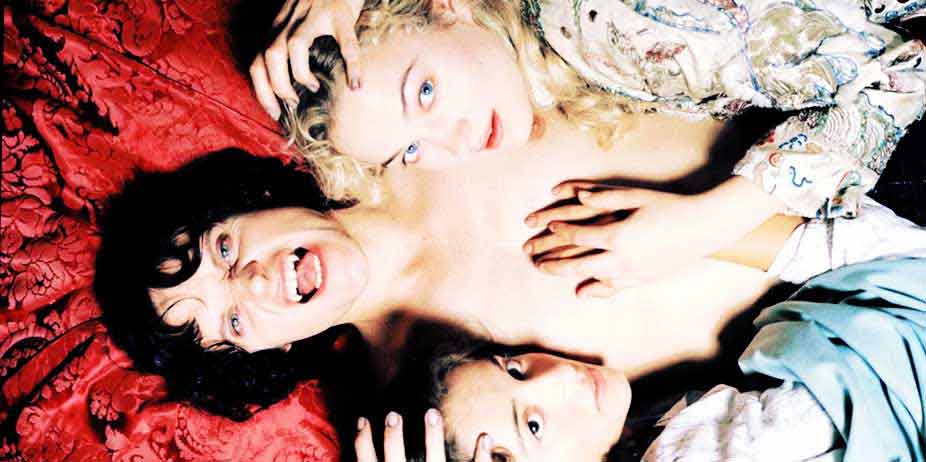
There is an amount of sensuality in the film, most of it revolving around Arthur's inability to consummate his marriage, a fact that frustrates Lucy to desperation. She and Mina speak of consummation and intimate touching in delicate terms, but both remain virgins. (Because of her faith, Mina rejects Jonathan's single advance to go further than a kiss.) In an attempt to lure her new husband into bed, Lucy puts her hand between his legs. The most offensive scene involves Dracula drinking Lucy's blood. The approach of the actors make it seem more like a sexual encounter than anything else, and it lasts for several minutes. (Dracula's hand creeps up under the covers and touches Lucy's breasts, then he crawls out on top of her and eventually bites her.) That aside, I loved the sense of fear that pervaded the screen. Dracula stalking Lucy and Mina was so spine-chilling that it left a lingering impression long after the film ended. And that's what makes you want to sink your teeth into it.