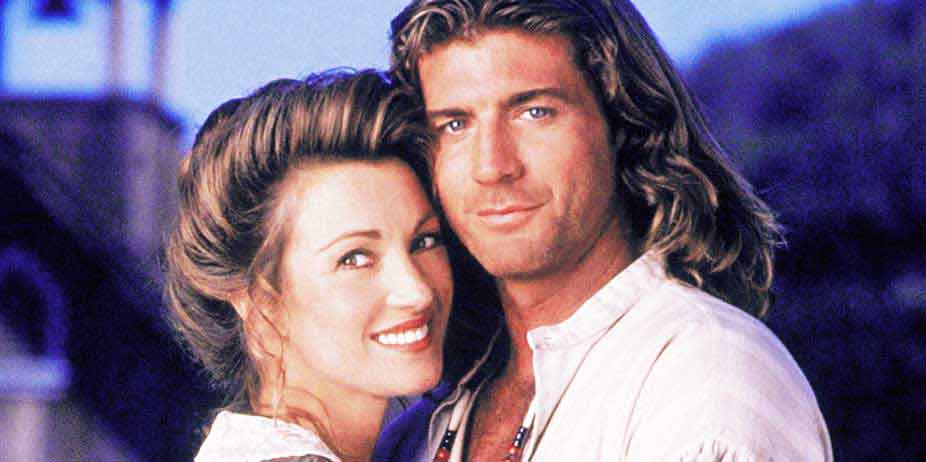
Doctor Quinn, Medicine Woman, Season Three (1995)
Having come into its stride as one of the most popular family shows on television, Dr. Quinn presented viewers with arguably its finest season in the third year, beginning with the arrival of the railroad and concluding with one of the most anticipated television weddings in history.
The small but bustling community of Colorado Springs is about to be changed forever with the arrival of the railroad. It promises civilization and most of the occupants of the town are eager for the traffic that will soon be coming into their businesses. Dr. Michaela Quinn (Jane Seymour) anticipates faster medical supplies from Denver. Her disappointment that her soon-to-be-husband, the rugged mountain man Byron Sully (Joe Lando) hates the notion of impending change is profound, but Sully is concerned the railroad will bring too much civilization to the mountains, forcing out the Indians and introducing new problems to the frontier. Their constant bickering causes them to wonder if marriage should be in their future or not. In the meantime, Matthew (Chad Allen) heads up an unexpected cattle drive after the unfortunate death of a friend, and runs into trouble that threatens the fragile state of his sister Colleen's (Erika Flores) young heart.
When the family travels to Washington to intervene on the behalf of the much-abused Cherokee, something from Sully's past rises up to threaten their future. All of our favorite characters are present through both amusing rivalries and serious difficulties. In one of the series' most interesting Halloween episodes, Brian (Shawn Toovey) meets and befriends a scarred outcast after hearing his "ma" read Frankenstein. Dorothy (Barbara Babcock) faces a life-threatening operation, and Robert E (Henry G. Sanders) sets out to prove himself. Though most of the episodes are independent of one another, there is a running theme throughout as Sully becomes the Indian Agent for the territories, and the wedding approaches. But most of the episodes revolve around individual incidents and townspeople, and addresses somewhat serious issues, like whether or not when you become old, you become worthless, or even a case of too much censorship when the reverend objects to the contents of the new library.
If there is one fault with the series, it is that it continues to presume that Colorado is a great deal like Southern California, where the show was filmed on-location in a sprawling ranch. The differences between the two climates should be apparent to anyone who has spent five minutes anywhere around the real Colorado Springs. But that is just a personal complaint. Most of the episodes in the third season are excellent family viewing, as well as tackling some very harsh and difficult topics, but there are things that come up that parents might want to be forewarned about. Content is mild but in "Ladies Night Out," Colleen's increasing bust size attracts the unwanted attention of the boys at school, one of whom discreetly tries to touch her. It also revolves around a woman who discovers she has breast cancer and does not want the operation, thereby tackling the fears women have about not being a complete person after a removal.
The final scene of the series is of Michaela and Sully kissing and caressing one another on their honeymoon. It is a little risqu in the sense that he undoes the back of her dress, but there is nothing more shown than tender kissing. Violence is present in a number of episodes, with gun battles, fist fights, and hold-ups. Several people are shot and wounded. The most emotionally difficult two-episode arch revolves around the massacre of the Cheyenne, and the resulting rage, horror, and devastation of the survivors. Other excellent episodes revolve around political intrigue (Brian manages to prevent the president from being assassinated), while another brings back Johnny and June Carter Cash for a Thanksgiving guest appearance. The Christmas episode also encourages the townspeople to welcome a Jewish family into their midst.
However, there was one episode that rubbed me wrong and another that was just plain offensive. The first is "The Library," in which the Reverend is depicted as an overly narrow minded prude when it comes to which books he feel are appropriate for the public library, and confiscates a number of them, ranging from Faust to The Scarlet Letter. Even though he does not participate, his actions do incite the townspeople to a religious fervor that accumulates in a mass book burning. Michaela sets them all straight by reminding them that there are tales of adultery and violence in the Bible. While that may be true, I feel the series was overly critical in its message of anti-censorship. The offensive episode was "Permanence of Change," in which Michaela openly supports the theory of Darwinism and teaches it to the school children as a fact. Anyone who does not agree with her (including the Reverend) is depicted as a fool.
Worse, she twists Darwinism to suit her purpose in removing an abused child from her father, stating that as humans are no different than animals, they have the right to take away the little girl simply because they did the same thing to an abused dog a few months before. I cannot count the ways that this offended me, because not only did it reduce human beings to being little better than animals, it also forced the townspeople to agree with her. Even though Michaela tries to argue that Evolution and Christianity do not have to be at odds, her arguments are weak and insulting at best, not to mention completely contradictory to the series' consistency in depicting her as a God-fearing churchgoer. Whether or not the audience believes in evolution is not the point, but forcing it down our throats was not appreciated either. Fortunately, that is only one problematic instance in a twenty-two episode season that provides a lot of humor, emotion, and occasional heartache.