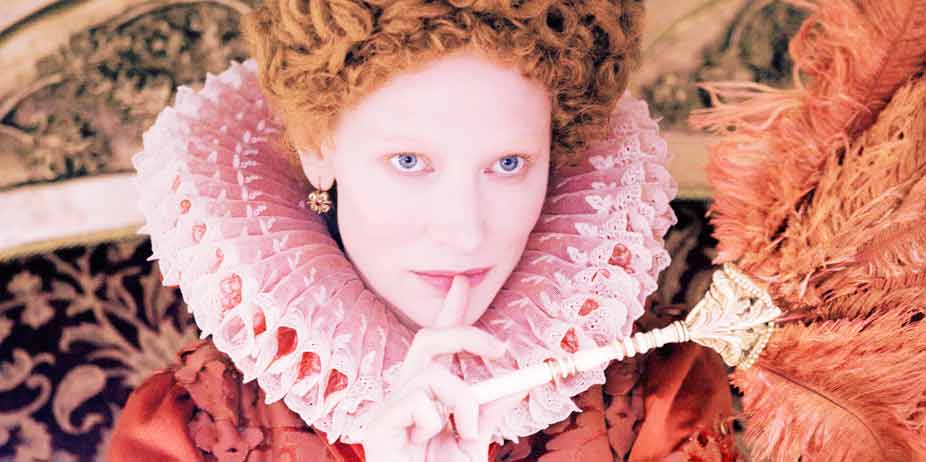
Elizabeth (1998)
The reign of King Henry VIII was the bloodiest era England has ever known. His most notable acts of violence were among those in his own household; through betrayal, beheading, and assassination, he managed to keep the throne. After his death, his eldest legitimate daughter rose to power, ousting her half sister. Under her hand the nation was torn in two by opposing beliefs, a Protestant country, and Catholic monarchy.
Concerns run high among the nobility, for Queen Mary Tudor has been unable to produce an heir, and her husband the King of Spain no longer seeks her companionship. If Mary were to die, her Protestant half-sister Elizabeth (Cate Blanchett) would assume the throne. Advised by the Duke of Norfolk to find some charge against her younger sister and have her executed, Mary has Elizabeth imprisoned in the Tower on false charges. But due to a lack of evidence and a begrudging sense of honor, Mary fails to sign the death warrant, and on her passing, Elizabeth is named queen. Deemed illegitimate by the church and loathed by the most influential members of the court, the newly crowned monarch faces the unknown with only a few loyal friends. One of them is her lover, Lord Robert Dudley (Joseph Fiennes), who cannot seek her hand in marriage without arousing a public outcry, for Elizabeth must marry royalty in order to protect her kingdom in a time of strife.
The royal treasury has been depleted, their armies are weak, and they have lost the northern territories to Mary of Guise. Political passions run dangerously array at court, for the queen is disliked among the Catholics and the church in Rome has sent out an assassin to see to it that she does not keep the throne. With numerous countries vying for her power, and William Cecil (Richard Attenbourgh) pressing her to choose a husband, Elizabeth is torn between her love for Robert and her loyalty to England. But not even her formidable guardian Walsingham (Geoffrey Rush) can stop the inevitable political strife, passion, and warfare that mark Elizabeth's reign, and eventually transform her into the monarch noted throughout history as the virgin queen. Elizabeth is a beautiful film with enough intrigue and scandal to keep most viewers enthralled, but it bears little resemblance to actual events.
The deaths of her enemies, the betrayal of a loved one, and other events that mark the film's dramatic moments are altered from the facts, while some others are loosely based off historic events. (There was a bisexual duke that sought her hand in marriage, but was not this particular duke.) Covering only the monarch's younger years in a heavily fictionalized account, viewers shouldn't expect to see Mary Queen of Scots or William Shakespeare; instead, it follows Elizabeth's struggle against a traitorous court, religious rivalries, and hopeful suitors seeking a crown. The film is brilliant to look at, a true piece of artistry from the director of The Four Feathers. The camera movements enhance the experience with beautiful close-ups and unique angles. From the first moment, as religious prisoners are lead to their execution, to the final closing ceremony, the viewer is enthralled not only with the story itself, but the gorgeous cinematography and masterful costume design.
We are left guessing at motivations and intentions, but all is revealed in the end. Blanchett's performance won her a Golden Globe. At times, she seems quiet and uncertain of herself, but key scenes show her for the strong, versatile actress that she is. She has a magnificent supporting cast, most notably Geoffrey Rush as her protector. His lucid, commanding presence lends a sinister air to the film; and there are times when we are uncertain of his loyalties. The tone is both romantic and frightful; the sight of a cloaked figure moving toward a terrified Elizabeth, a sudden, unexpected assassination attempt, and a shocking turn of events that leave the young queen emotionally devastated. Elizabeth paints both sides as deeply flawed. Having a good grasp of political problems within the church at this time, that element did not disturb me as deeply as it may others. Christianity in the middle ages was less belief in God and more a struggle for power; either side sending out assassins is hardly surprising. I do carry a complaint with Elizabeth's obvious affair with Lord Dudley despite her personal faith, yet the film does paint a realistic picture of how any life without Christ can become grievously flawed. What's more, it points out how religious intolerance can tear apart a nation.
Sexual Content:
A prince makes inappropriate advances toward the queen in subtitles and makes a joke about male size. A man is a cross-dresser. Elizabeth implies that if she were to marry her late sisters husband, he would only be interested in sharing her bed once or twice a year, to which Dudley replies that he would not be so foolish. He comes to her room one night and they engage in heavy petting behind a curtain. A member of court uses mild innuendo to reference his alliances and says he rather favors one side over the other. The woman he is speaking with is found the next morning dead in her bedroom. Robert becomes frustrated with Elizabeth and takes one of her ladies in waiting as his mistress. They're shown having sex against a wall in the castle, before she starts screaming, having been poisoned by one of the queen's gowns. A woman's bare breasts are seen on two occasions, once as she's dressing her consort (beneath a sheer gown) and again while engaged in sexual practices.
Language:
Language consists mainly of many uses of whore and bastard in reference to the illegitimate queen.
Violence:
People are burned to death, heads are shown on a pike, and a man is graphically tortured for information. A bloody battlefield is panned, showing many dead bodies. A mans throat is non-graphically slit. A Catholic priest is given orders by the Vatican to assassinate the queen and anyone in alliance with her. He is shown from a distance killing a man with a rock, sending blood spurting into the waves. A man is shown being tortured. One of the ladies in waiting is found slightly bloody after being poisoned. Elizabeth is forced to allow her men to hunt down and kill those in opposition to her, although she shows them mercy in the Tower
Other:
Social drinking.