Elizabeth: The Golden Age (2007)
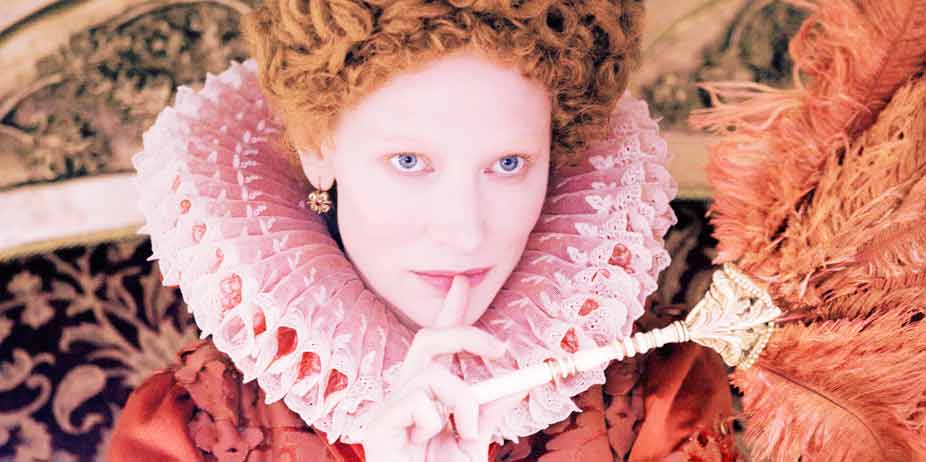
My favorite monarch is Elizabeth I of England. I have read dozens of books about her, and seen just about every film there is where she plays an important or even minor role. When I learned my favorite actress was reprising her role of my favorite queen, I was absolutely ecstatic, and much to my delight, the sequel more than lived up to my expectations.
With Europe torn between the Protestant Reformation and the Catholic Inquisition, the Spanish King (Jordi Moll) believes God has called him to a religious war against England, whose Protestant leadership threatens the Roman Catholic Faith. Sending emissaries to the imprisoned Mary Queen of Scots (Samantha Morton), Philip hopes to tempt her into treacherous action against her cousin, Queen Elizabeth (Cate Blanchett). With her throne so unsettled with the promise of war, and her advisors continuing to persuade her of the advantages of marriage with a foreign power, Elizabeth is content to play to an array of diplomats and ambassadors promising their king's hands in marriage, but her romantic interest is captivated by the dashing Walter Raleigh (Clive Owen), who comes boldly into her presence as an adventurer and explorer, and most of all, a buccaneer. He is known for the looting of Spanish ships, and hopes to continue to do so with her blessing.
As Elizabeth and her beloved friend and lady in waiting Bess (Abbie Cornish) are wooed by the charismatic Raleigh, her trusted protector Frances Walsingham (Geoffrey Rush) unearths a plot against her, little knowing the actions they take in retaliation will lead them to war. The Golden Age is a cinematically gorgeous production with outstanding performances and surprising humanity to its characters. The one thing that struck me the most profoundly is that finally someone has captured Elizabeth Tudor in her true form, that of a powerful and temperamental but ultimately loving monarch torn between personal desire and the demands of her throne. Never before has an actress brought me to tears over Elizabeth's plight of having to rule England alone, unmarried and without children, yet Blanchett does so on more than one occasion, with such raw vulnerability that you cannot help loving her despite her faults. I had always seen Elizabeth as untouchable, but after this, no longer will she be a cold figure in history.
I adored the early scenes with her, since they were full of a subtle humor that came across as playful. It is nice to believe Elizabeth could have a deep friendship with someone, that she could be as overjoyed with discussing potential suitors with her favorites as she is formidable in times of overwhelming threat. The rest of the cast are excellent, particularly Rush, as this time he presents a more humane and touching Walsingham. I do enjoy the original film but this one seems far more powerful because it connects in ways the other one did not. It's not nearly as dark but deals with just as threatening of forces. One thing in the film's favor is that it is gorgeous to look at and the score is wonderful. It even adopts some of the original material into certain scenes to grant a feeling of connection between the two productions. Historically, timelines are a little off and changes are made to various characters for the sake of dramatic storytelling, but it's a great deal closer to the truth than its predecessor, not to mention shows more restraint when it comes to content. The PG13 rating is certainly earned but never exploited, a fact I both appreciated and respected, even though I could have done without a couple of things.
Religion plays an enormous role in the film because it motivates Philip to war. Prayer books, crosses, and rosaries are present in numerous scenes, but the ultimate conclusion is that the Catholic Church was a tyrant and Elizabeth a hero for standing up against them. She too spends time in prayer, but also consults an astrologer on two occasions. It is well documented that this is historically accurate and the man cannot tell her more than "fleeting ghosts" of what is to come. Ultimately, he determines that mankind will do what it is in their nature, and it is up to Elizabeth whether or not she will stand firm, rather than the predictions of the stars. If I had one complaint, it would be that the film is difficult to follow the first time through. It takes the viewer a little while to catch up, where a bit more explanation would have been helpful to distinguish allies from enemies. Apart from that, it truly is an astounding accomplishment.
Sexual Content:
A montage that involves Bess and Raleigh in intimate circumstances and also includes brief backside nudity as Elizabeth disrobes before a mirror to examine herself. That shot did not have to be there, but fortunately the camera is fairly quick to slip away behind a screen. No actual sexual content is involved, but there are close-ups of Raleigh untying Bess' corset that show quite a bit of cleavage. It's implied they have premarital sex with harsh consequences -- Bess becomes pregnant, threatening not only Elizabeth's high opinion of her but her place at court, and even Walter's life. Much is made over the Queen being a virgin, and therefore marketable as marriage prospects. A young man is presumably nude in a prison cell, but is huddled in shadow in a corner, so we don't see much.
Language:
Language consists mainly of many uses of whore and bastard in reference to the illegitimate queen.
Violence:
Violence is present but is only occasionally gruesome. Ships collide with one another and burst into flames. Men drown in the midst of a storm. A man's tongue is cut out before he is shot and killed; another man is hanged (we see his feet drop). The worst of it comes when we discover a man has been tortured for information; he is shown hanging in a spiked cage, and when the door is opened, it reveals grotesque, bloody wounds on his face. Another man is shown covered in blood after similar mistreatment. We never actually see anyone tortured. There's an implied beheading, but the emotional build-up to the event is more impacting than the actual event.
Other:
Social drinking.