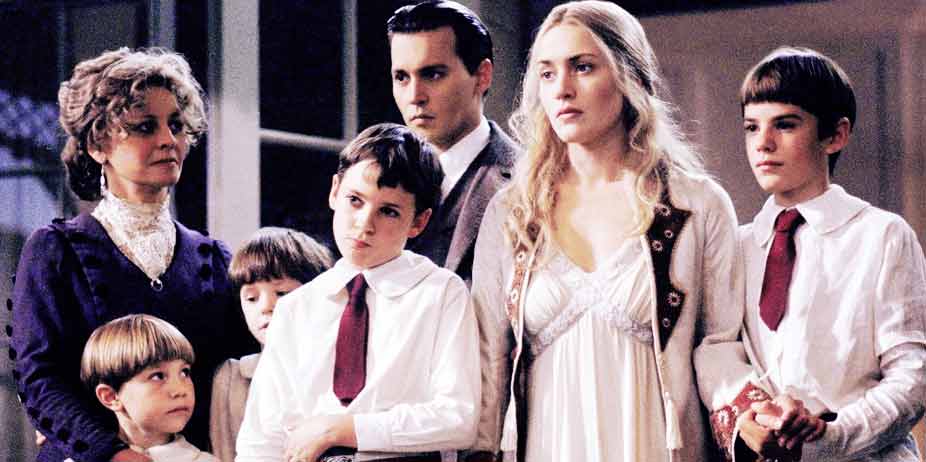
Finding Neverland (2004)
Every once in awhile a rare film comes along that is absolutely beautiful from beginning to end. Finding Neverland is just such a triumph, gorgeously filmed, exquisitely acted, and destined to become a classic in the annals of cinema history. It may not provide a thrill every thirty seconds, but it's a wholesome, marvelous tale about life's sorrows and equally its magical moments, through the eyes of a talented young writer on the eve of greatness. In 1909, J.M. Barrie (Johnny Depp) was popular by name only, but his plays were met with high expectations and shallow reviews. Content to play cricket with his dear friend and fellow author Arthur Conan Doyle (Ian Hart), and avoiding his uncomfortable home life with his emotionally distant wife Mary (Radha Mitchell), one day in the park he comes upon inspiration.
It is a small boy, sprawled beneath the park bench. Michael has been imprisoned in the dungeon by his older brother, the evil King George, for being heir to the throne. The youngest and eldest of the Davies' family boys respectively, they are a handful for their mother Sylvia (Kate Winslet), who is a struggling widow still mourning the loss of her beloved husband. The boys fill the empty ache within Barrie's soul and invite him to create a magical world for them, where Neverland is a dream come true and also where beloved lost ones go, where pirates and Indians can be found in the wilds of a closed London garden, and magic is never far away. To them, he becomes a replacement for their father, and a special mentor to Peter, the most serious of the foursome. The little boy has lacked imagination since his father's death and reluctantly begins to open up to Barrie's charm, embracing the wonder that is creativity.
But Barrie's friendship with Sylvia and her sons is frowned on by society, most particularly the patriarch of the household, Sylvia's mother Emma du Maurier (Julie Christie), a socialite by all standards who desires to take command with an iron fist. Most particularly it places a strain on Barrie's marriage. But while the delightful family in impoverished settings invoke his most wonderful masterpiece, a tale of a boy that never grows up and his adventures in Neverland, Barrie may be threatening the slender thread of happiness in his home... and will soon have to guide the children through further difficult times. While the film is very innocent and charming, it does not deal on a superficial level. There are serious issues in play here, such as the loss of loved ones, the worth of childhood, and the importance of strong relationships within marriage. While not the highlight of the film, very important is the unhappy match of Barrie and Mary, two distinctly opposite individuals unable to provide for the other what they need most.
Barrie is happiest when around children and encouraged in his creativity, while Mary wants praise from society, to be loved and pampered. Both admit that they have not given all they should to the match, and ultimately find happiness elsewhere, but never inappropriately. It is implied that Mary eventually leaves her husband and becomes involved with someone else, but in a striking contrast, Barrie's friendship with Sylvia remains just that, a friendship. He does admire her very much but never offers anything but support and unconditional love. It's the most touching romance I've ever seen, because it's all about mutual respect and selflessness rather than sexual attraction. Arguably the finest scenes belong to the children, but Depp brings a depth to the role that is uncanny. If this doesn't earn him an Oscar nomination, it should. He is capable of breaking your heart with his plight one moment, and warming it the next with subtle flashes of humor. Freddie Highmore is wonderfully talented and will have you weeping into your handkerchief. Kate Winslet is always wonderful but here really plays off Depp well; you can see the distant affection between them, and she seems delighted with her young costars. There are instances of kite flying, putting the children to bed, and long adventures in the country, amateur theatricals and the real thing, and some truly delightful dialogue.
In one touching instance Barrie muses that boys should never be sent to bed, for the wake up one day older and before the blink of an eye, their childhood is gone. George is encouraged into manhood, filling those shoes with surprising authority for such a young boy and standing up to his grandmother when it's needed. Even Emma du Maurier comes to accept Barrie and agree that he is a positive force in her family's life. There is little in the way of objectionable content. Barrie's only flaw is that he spends too much time with the Davies' family and not enough with his wife. Contrasting the two, the audience can hardly blame him, for his wife's world is very distant and cold even when he's affectionate and giving, and in the wonderful place the boys create, he is loved unconditionally. There is only one vulgar word, used early on to illustrate how bad the play is; after that the dialogue is rich and completely without offense. There is no sexual content but mild amounts of cleavage do appear on the women in the story at various points.
Conan Doyle references the public's curiosity toward scandal, and mentions that they've begun to speculate on why Barrie would spend so much time with children. Barrie is offended by this and grandiosely stands up for himself, showing complete revulsion for the idea that they're anything but wholly innocent. Emma more than once alludes to the fact that being seen in the company of a married man has not done Sylvia any favors. Thematic elements do come into play, along with mild doses of violence. There is a death implied by the end, and a weepy scene involving children in the park after a funeral. The boys get into a violent scrap and beat up on one another. Peter becomes enraged and breaks up their clubhouse, shattering glass and stomping on all their home-made props. A boy falls from a moderate height and breaks his arm. It is not for the very young, but older and more thoughtful audiences will find much to ponder and even more to love about Finding Neverland.