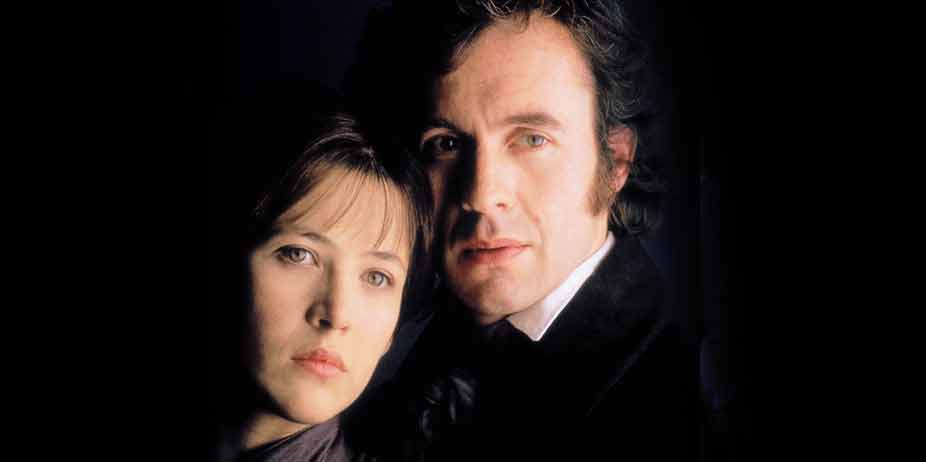
Firelight
(1997)
One of the more controversial films of my acquaintance, Firelight is an exploration of love set against a sobering backdrop of loss. Its unique premise and exquisite plot play out against stirring cinematography and a beautiful musical score. But not astonishingly, it is certainly not for everyone.
The film opens in a darkened room. Elisabeth (Sophie Marceau) has come to be interviewed for a less-than-respectable proposition. She's asked to be seated in a chair in front of an older woman, who is speaking for an unseen gentleman behind a dressing-screen. Insisting the man speak to her himself, Elisabeth agrees to the terms of his proposed agreement. Several weeks later she is abroad and dining in a fine hotel. When she returns to her room, the man (Stephen Dillane) is waiting for her. She doesn't know his name or why he wants a child. All she knows is that for five hundred pounds, she is going to bear him an heir. They spend three nights together, forming a natural bond through intimacy. Then he leaves, never to be seen again.
When the child is born, she is taken away by the nurse without her mother so much as laying eyes on her. But Elisabeth never figured on how much she would love her daughter. Spending hours writing her messages the girl will never read, and painting her exquisite pictures in a little journal, she eventually begins the search for her child. It leads her to the wealthy manor house of Charles Godwin, her unnamed former lover, where she is employed as the girl's governess. Louisa (Dominique Belcourt) is a spoiled, confused girl who is never scolded or punished, only praised and admired. She has managed to run off six governesses in the past year and because Elisabeth is a foreigner, Louisa intends to disobey her as well. The house is full of sadness. Charles lives there with his "adopted" daughter, his wife's sister Constance, and a bedridden invalid wife. She was thrown from a horse but failed to die, remaining instead completely incapable of speech, movement, or even conscious thought. In all valid terms, she's dead but her body still lives.
When he returns from London and his annual visit to see his father, Charles is shocked to find Elisabeth in residence. He wants her sacked immediately, fearful she might disclose their dark secret, but the laws of propriety demand she have at least a month's notice. Begrudgingly, he allows her those few weeks with their daughter. Louisa is uncontrollable and Elisabeth is steadfast in her determination to calm her violent spirit, even if it means going against the master of the house. Like it or not, several nights of passion have created an undying bond between them, and the spark might ignite again while they dwell under the same roof.
Though one might wonder at the title of this quiet period drama, much discussion revolves around firelight. In the hotel, Charles says the fire casts more light than one would expect, implying his unease with what he is about to do. Later, she tells an enraptured Louisa that when the lamps are extinguished and the only warmth and light comes from the fire, it's a magical time. You can say and do and think whatever you like because time stands still and doesn't exist; when the lamps come back on, it never happened. It's moments like these which lend true depth and romance to an otherwise questionable plot. One cannot help liking these characters and hoping they will be brought together, despite his marriage. In this sense the writer fails, for he seems not to know how to separate the ideals of the characters from their actions. One of Charles' reasons for loathing his father is his many affairs with women, yet he follows in his footsteps by taking Elisabeth as his mistress.
Attempting to help Louisa understand what womanhood is, Elisabeth reminds her that because of her sex, she will not have any rights as an adult. She cannot hold property or work in business, but will either be forced to marry or take up the lonely position as a governess. But whatever men can control, she tells her, they cannot control our minds! The only power women have is to use their minds, to be knowledgeable and literate. This a great little stand up and cheer moment but begins to fall to pieces when we look at the larger image. Charles doesn't want his daughter to be treated like a plaything but his relationship with Elisabeth is built around their three-day affair in France. The one truth the film holds is that intimacy is not casual, but leaves a long-lasting mark and creates a bond between two people. Both are haunted by images of their past. "I remember..." he confesses to his mostly-dead wife, "I remember too much." Elisabeth also remembers their nights of passion, and the most innocent of caresses can remind her of the past.
As you may have guessed, in order for them to be able to marry, the invalid wife must be dispatched. In an age when medical choices were nonexistent, Charles had no other choice. He turns down the covers, puts out the fire, draws up the sash, and cries as he watches her freeze to death. It's either murder or mercy. Elisabeth confesses later she had no idea desire was so powerful, to have invaded and ruined so many lives. But when Charles asks her if she regrets any of it, she says no. "No... God help our souls!" There is little or no religion in the film aside from a few remarks. There are four scenes of sexual content, two of them fairly mild and brief, the others considerably longer in which we see more of Elisabeth than I would have liked. (A chemise on her would have been nice!) t's implied Charles swims nude in the lake early each morning; we see him fully (but obscured) through the rippled, dirty glass of a window when Elisabeth comes unexpectedly down the passage. She later visits the sight again, watching him, but this time the camera stays above the waistline. The f-word pops up in dialogue when Charles' father asks if she's sleeping with his son.
Sophie Marceau and Stephen Dillane have very soulful expressions; their gentle dark eyes and meaningful glances are more expressive than pages of dialogue, and their chemistry is fantastic. One glance between them is sexier than most love scenes I have ever seen. The relationship between governess and daughter is also very touching as they learn to trust one another. But the unavoidable adultery and nudity somewhat ruins the cinematic experience.