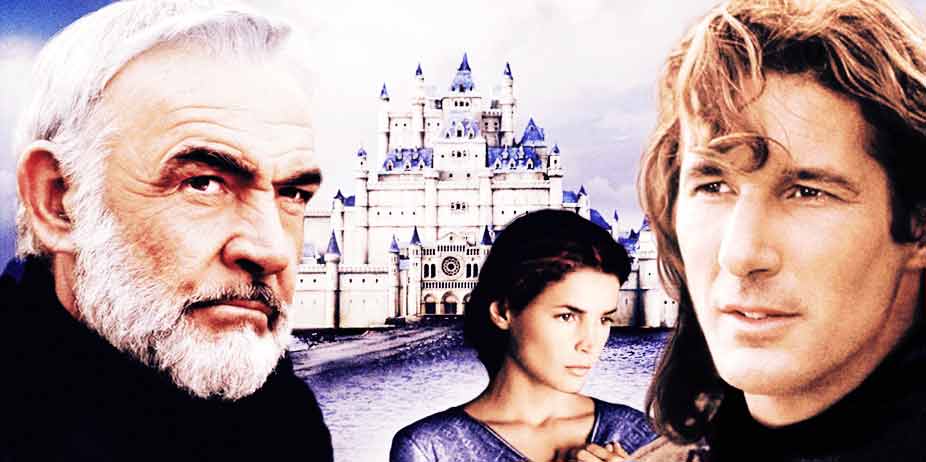
First Knight (1996)
The story of King Arthur and his beautiful Lady Guinevere is the stuff legends are made of. This pair of lovers and the knight who managed to come between them have long been speculation for storytelling... but rarely does a film show them as honorable and likable... even religious... icons. First Knight dares to do as much, proving displeasing to many lovers of the original legend... but winning fans among more conservative audiences.
It is a time of tribulation and warfare in England when one must live by the sword or die by it. Prince Malagant (Ben Cross), Arthur's former First Knight and head of the Round Table, has betrayed his honor and left to follow his own destiny. His lands border the estate of Leanesse, governed over by the beautiful Lady Guinevere (Julia Ormond), but his true quarry is Camelot. Burning, pillaging, and murdering at will, Malagant inflicts terror upon the peasantry who turn to their lady for help... but there is little she can do without accepting an alliance with Camelot. Torn between her freedom and a love for her people, she decides that the best manner in which to protect her tenants is to accept the offer of marriage by King Arthur of Camelot. But while on her journey to the golden city, Guinevere's caravan is attacked by Malagant's men. Arthur's knights are slaughtered and herself, along with her handmaidens, taken prisoner.
In a daring escape and only after aiding her ladies to safety, Guinevere flees into the wood and is rescued by the wandering swordsman Lancelot (Richard Gere). A magnificent and fearless fighter but also a notorious womanizer, he attempts to seduce her but she refuses his advances and goes into the welcoming arms of King Arthur (Sean Connery), expecting never to see Lancelot again. However, an ill wind blows no good and Lancelot arrives in Camelot the day of her public engagement. Braving the gauntlet to win a kiss from the would-be queen, Lancelot is praised by Arthur for bravery (and stupidity); admiring the man's courage, the king invites him to join the Knights of the Round Table in Malagant's place. Their arch-enemy in the meantime is determined to have Leanesse and will stop at nothing to seize control of her kingdom. And when a challenge upon Camelot herself leaves Guinevere in enemy hands, Arthur may loose everything to save her.
The love affair that brought an end to Camelot has been
speculation for generations. This story covers the basics, ignores
the myths surrounding Arthur, and turns him into a true living
breathing person of integrity, honor, and Christian compassion.
Never has the story been so poignantly realistic, or the characters
so memorable. King Arthur is portrayed
as a devout Christian, asking for God's mercy and wisdom in dealing
with Malagant, his knights, and even Guinevere. "I take the good
with the bad," he says to Lancelot early on. "I can't love people in
slices." What a praiseworthy ambition! Yet he doesn't hesitate to
punish sin where it's due. Christianity is cast in a respectable
light; there is no Merlin, magic, or witchcraft.
Gorgeous scenery, compelling dialogue, magnificent costumes and the sheer magnitude of the Camelot that lives on in myth draws together a film that, despite its very few flaws, will touch your heart. The most moral and compelling Camelot story of all time, First Knight is a film that teaches good ideals and the value of honor. An afternoon well-spent for lovers of the Arthurian legend.
Sexual Content:
Lancelot befuddles Guinevere's captor by insinuating that he was only after the woman (vague suggestions of rape). Malagant terrifies Guinevere by tearing off her dress, but she is still suitably (and modestly) covered. There's one passionate, adulterous kiss.
Language:
None.
Violence:
Explicit and often brutal warfare. Hand-to-hand combat, impaling by arrows and swords, the burning of a church, the threat of rape.
Other:
None.