 The
Four Feathers (2002)
The
Four Feathers (2002)
The Four Feathers is a film that stands out, mainly because it deals with some controversial topics... the Islam faith, Christianity, and war. The film couldn't be more timely. Its lessons are needed. The roots are British, but the spirit is American.
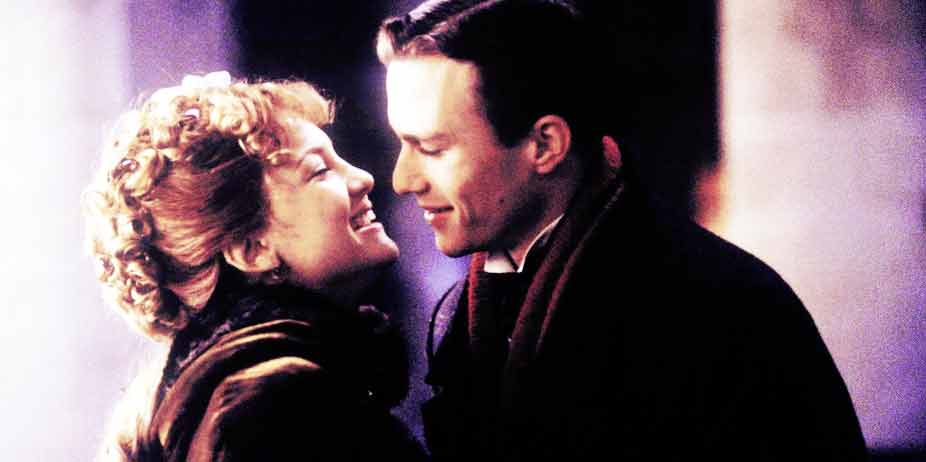
England is enjoying a vast wealth under the leadership of King Albert and Queen Victoria. It is more a matter of honor to join the British regiment than a necessity, for imminent war is not upon the horizon. Harry Faversham (Heath Ledger) is the son of a highly decorated war general. He and his friends Jack Durrance (Wes Bentley), Willoughby (Rupert Pentry-Jones), Castleton (Kris Marshall), and Trench (Michael Sheen), are all engaged in Her Majesty's army. Wealthy and respected, Harry is engaged to his beautiful childhood friend Ethne Eustance (Kate Hudson). He looks forward to the day when they will marry, have children, and tell stories around the fireplace at Christmas. He has not the stomach nor the mindset for war. Unfortunately, battle is inevitable.
An uprising of the natives in the Sudan force the British out of their occupied territories, and the reserves are being called in to settle the dispute. Harry and his friends are to be shipped out within the month. It is only then that Harry's true colors begin to bleed through the successful facade that he has put up. He is a coward at heart, with no desire to risk his life for some "god-forsaken country in the Sudan." Risking his honor and family name, he asks to be removed from the regiment and is sent away in disgrace. His father refuses to see him, instead turning him from the house. Willoughby, Caastleton, and Trench find him cowardly and turn away in disgust. Durrance is the only one to stand by him when the others send him three white feathers to signify their disgust at his cowardice. Ethne stands by him for a time, until she learns it is not for her sake that he has withdrawn, but out of fear. Then her white feather joins the others.
Disinherited and alone, Harry is left with nothing left to live for... except to restore his good name. Determined to return the four feathers to each of their owners, he journeys into the Sudan to save his friends' lives. But an English ex-soldier traveling alone is a prime target, and if he's discovered, it will mean his death. When his hired guard is violently murdered by his black slaves, Harry is left alone in the vast desert. But even if he makes it as far as the British camp, perils beyond his wildest dreams lie ahead. These elements combined make for a labyrinth of stories that each revolve around different forms of love, courage, virtue, nobility, and self-sacrifice. The Four Feathers is a profoundly moving piece that deserves recognition for its bold stand on heroism. It struck me deeply how Christian everyone is. They uphold the same honor system and values that every man or woman of faith should. Characters are even shown in prayer (one man begs God for courage and forgiveness, should he have to kill anyone in the upcoming battle).
One interesting plot twist involves a character revealing that he's become a "guardian angel" to someone merely because "God put you in my path." This is one of the more profound of the film's elements... the character risks his life for someone else just because his God told him to. As Christians, we're called to do the same -- obey, not question. I also admired the system of values that the characters held to -- keeping their word, and honoring friendship and courage above all others. This is a wonderful film. It's well written, beautifully acted, and memorable to the last. The characters are likable and the situation surprisingly realistic. The message is well worth hearing. Premiering in a time when the world is shaken by a shockingly similar war, it pits Christianity against Islam with tact and respect. There is one faithful Muslim amongst the radicals; but Christianity has the last word. Even with its worth, the film is not for everyone. There's a lot of battle violence, although of the non-graphic variety. Many horses topple and throw their riders; there's a lot of shooting, hand to hand combat, and a few implied stabbings. It's not as brutal as some PG13's I've seen, but viewers should be aware that dead bodies are often shown.
We see them scattered in the desert (apparently stripped, although all are in out-of-focus shots), hanging from the gallows, and piled in a ditch. A man's face is left scarred when a gun backfires; one stomach-turning exchange shows a man attempting to drink camel blood. Sexual content is moderate. There's brief backside nudity in the gym during the opening credits. Dialogue briefly centers around prostitution. Two slaves are shown in a sexual embrace by the camp fire. Their bodies are blocked, in silhouette, and the shot only momentary. I generally dislike any kind of sexual content in films, but like Les Misrables, I feel the movie is worthwhile despite its minor flaws. As a period film, it's lavish to look at. The Sudan is barren, England is lush and comforting. The acting is sublime. There's not a weak link in the cast; we'll probably see a few of the actors in the Oscar lineup this spring. While not for younger viewers, The Four Feathers is a wonderful, meaningful, insightful film for teens and adults.