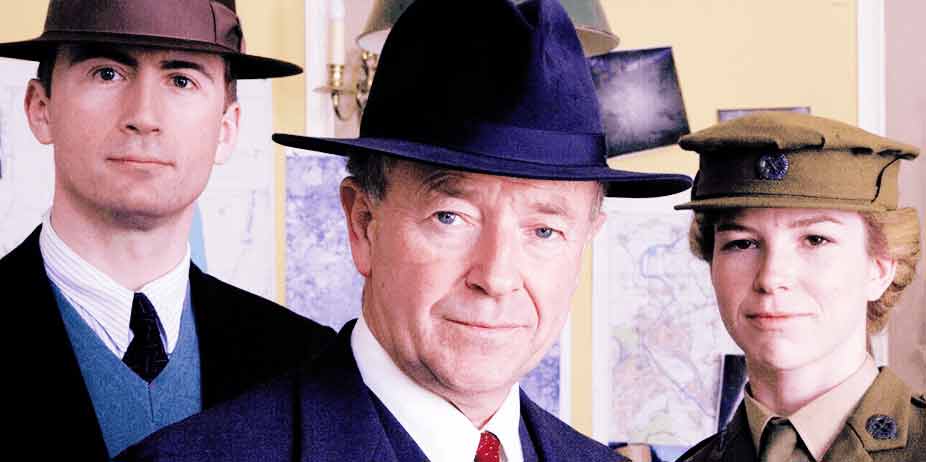
Foyle's War, Season One
One of the most creative mystery programs in the history of the BBC, Foyle's War is not only wonderful from a historical perspective, it's brilliant from a literary one. It's not hard to see why this detective has picked up fans on both sides of the Atlantic.
As World War Two rages over Europe, Detective Christopher Foyle (Michael Kitchen) feels his skills would be better used aiding the war effort than investigating domestic crime in Sussex. His plea to be reassigned is refused by his commanding officer (Edward Fox), who instead offers him additional assistance. Plucky Vicar's daughter Samantha Stewart (Honeysuckle Weeks) is assigned as his driver. Curious about the war efforts, as well as the stylish murders he investigates, Sam proves she can be resourceful, cunning, and helpful in almost any situation. Regarding her warily for her youth and inexperience, Foyle turns his attentions to local crimes. Having just finished tracking down a government official who, for a price, can make certain wealthy young men aren't called to serve in the war, he is lead to a small village community disrupted by prejudice against local German immigrants.
Thomas Kramer (David Horovitch) and his wife Elsie (Elizabeth Bell) are arrested in the middle of the night at their cottage in the village of Lower Fenton after being seen with a camera. Kramer is a German immigrant. The local post officer observed several suspicious signs that they might have been communicating with German pilots. They are taken to a holding camp, where Elsie suffers a fatal heart attack. Their nephew Mark Andrews (Benedict Sandiford) is appalled by their treatment and goes to the local magistrate for help. Henry Beaumont (Robert Hardy) has a beautiful German wife who has not been investigated by local authorities. Because of her nationality Greta (Joanna Kanska) is regarded with suspicion by the locals, who have been told Germans are the enemy. Through a series of events, Greta winds up dead with a swastika carved into the tree over her body. Foyle must then investigate what appears to be double-murder in the magnificent English countryside, targeting Greta's stepdaughter (Rosemund Pike) as his primary suspect.
In the meantime he must contend with a local suspicious bar owner, the beautiful barmaid behind the counter, and fatherly stress at home. His son Andrew (Julian Ovenden) has been called up to serve as a RAF pilot. Foyle has also become aware that Paul Milner (Anthony Howells), a former sergeant with the police force, has been badly wounded overseas. Having respect for the young man's abilities, Foyle attempts to recruit him to his small force, all the while juggling Sam's theories and suspicions, and his own feelings about the brutal manner in which Greta was murdered. These elements combine for an intense, interesting exploration of historical events, bigotry, and life in war-torn England. The other installments in the first season are "The White Feather," in which Nazi sympathizers play a role in a brutal murder in a local hotel, "A Lesson in Murder," where an conscientious objector winds up dead in his prison cell, and "Eagle Day," which involves a government cover up in a local RAF training facility.
The entire series is fantastic, full of snappy writing, memorable characters, and well thought out mysteries that are full of red herrings, suspicious actions, and subtle but important clues. The acting is very good from a host of talented English thespians, particularly Michael Kitchen in the lead. His Foyle is tender-hearted, patriotic, and very likable. He believes in the meaning of the law rather than the letter of it, and shows compassion where it's needed. The first season has a wonderful host of guest stars, including Charles Dance, David Tennant, Sophia Myles, and Anton Lesser.
Content varies throughout the episodes but is rarely overly graphic or offensive. The first episode includes the discovery of an adulterous relationship, as well as part of a tryst in a car (only kissing is shown). In the third episode, the opening scene is a naked man being hosed off in prison (his arms and legs conceal anything explicit). The finale uncovers a sexually aggressive officer who "forced" one of his girls to have "relations" with him. He pinches Sam hard on her bottom. The violence ranges from implied (a bomb lands on a local tavern, and bodies are shown being carried out later) to more graphic (several brutal fist fights, bodies shown with knives stuck in their chests, and a man being shot at point blank range). There is not much profanity, other than a handful of minor terms, and two muffled abuses of Jesus' name from a RAF pilot in fear for his life.
What makes the show good is not only its careful attention to historic detail, but also its character development. Foyle is a man above reproach who is not interested in retaliation or bias, just figuring out who did what and how they should pay for it according to the rules of society. He is quiet and withdrawn but also immensely understanding when he needs to be, without being too soft on wrongdoers. His relationship with Sam develops into one of fatherly affection that is delightful to watch. Milner and his wife are also memorable, as their relationship is one immense struggle to remain together despite his unfortunate handicap. The series may be too intense for children but adults will find it an enjoyable, often thought provoking way to spend the afternoon. Or more than one, since I have the feeling that much like my family, after one episode you are not going to want to stop anytime soon.