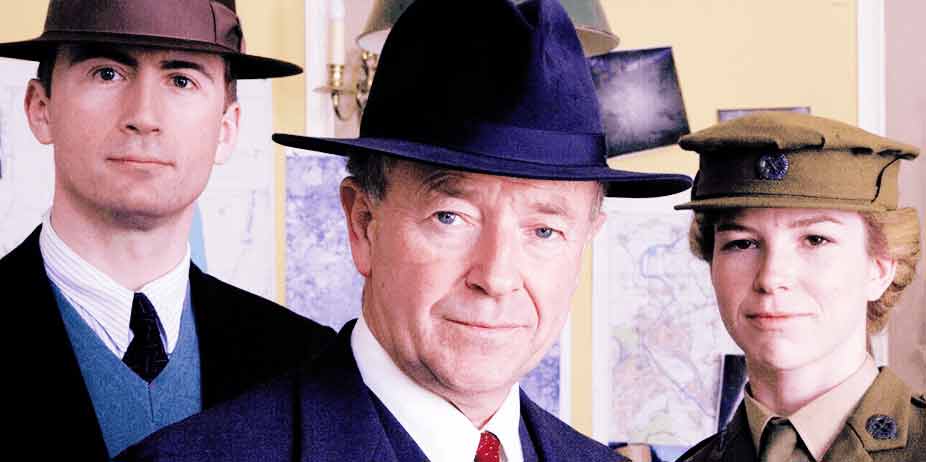
Foyle's War, Season Six
There was such protest over the cancelation of the popular WWII mystery series that ITV has wisely brought back Detective Chief Superintendent Foyle and his friends for another set of whodunits, set in the tumultuous months after the war has ended...
Although having submitted his resignation as the head of police in the small town of Hastings, Christopher Foyle (Michael Kitchen) is still heading up the task force since they cannot seem to find an appropriate replacement. He is approached by a former commanding officer from his own time in the service to assist in finding and returning an escaped Russian POW to the authorities, so he can be returned to the motherland. Unusually, the Russian's escape coincides with a local murder investigation when a fairly well known artist turns up dead in his country house. Since abandoning the force, Foyle's former driver Samantha Stewart (Honeysuckle Weeks) has been acting as his housekeeper, and it seems his murder may have had something to do with attempts to prevent his Russian gardener from being deported. Foyle stumbles into the investigation unintentionally, and his presence does not particularly please Detective Inspector Paul Milner (Anthony Howell), who has been assigned to a neighboring district and has jurisdiction.
When the investigation leads Foyle to a mysterious organization in London known only as "The Russian House," he begins to suspect ulterior motives behind the government's interest in the case, and his life is placed in danger. This three-episode installment into the film series is magnificent, although it does tend toward generalizations when it comes to newer characters, particularly the Americans. What is so likable about it is that it draws attention to little known facts and facets of the war. This time around, it explores the horrific mistreatment of returning Russian soldiers at the hands of Stalin, uncovers a secret in the forming of German-English military movements, and discusses in-depth lingering racism within the military. The characters we know and love are back for a second time, but since the series revolves around Foyle we see much less of Milner than usual (he does make notable appearances in the first and last episodes). Sam is still her typical cheerful, nosy self but even she is a little unrecognizable at first, when we discover she has posed nude for an artist -- something that doesn't seem like her at all. Foyle refrains from commenting but it is apparent to the audience that he is disappointed in her decision, and Sam too comes to see the error of her ways.
Lesser plot threads include Foyle driving himself about the countryside, Sam meeting and falling in love with a handsome young innkeeper (Max Brown), and Milner being forced to deal with an incompetent assistant. The plots are coherent and thought-provoking with the usual sarcastic sense of humor, and while at times the conclusions can be foreseen, it's still fun to watch Foyle discover the truth. The series is known for its authenticity and it's delightful to stroll through the streets of Hastings and encounter period costume and automobiles. Michael Kitchen remains wonderful as the mild-mannered and sensible detective, and is often the source of wisdom although that does not prevent him from dealing severely with inferiors when they have need of it (his frosty exchange with Milner at a crime scene is particularly memorable but much needed in light of the circumstances). My only complaint is that once again, the Americans are cast in an unfavorable light. One story revolves around racism and segregation among the troops, and all of them are depicted as either racists, opportunists, or simply immoral. (A black soldier has an illegitimate child with a British girl, and another man on the base is revealed to have been blackmailing a young woman into sex. Others are involved in beating up blacks among their ranks and expressing racist sentiments.)
The consequences of immorality are explored in the sense that rarely are the morals of those involved in murder above reproach. This lends a sad twist to certain incidents as we realize immense amounts of turmoil, emotional devastation, and even murder could have been prevented by more positive choices. The content is no different from previous installments -- the murders are seldom gruesome but involve occasional blood. We see a woman being strangled. People are shot and killed. A black man is badly beaten up by fellow soldiers for having dared to dance with a white girl at a party. Dead bodies are found or uncovered under different circumstances. British slang and a few profanities are thrown about. Sensuality is limited to the implication that an unmarried couple are intimately involved (kissing, the fact that they have a child), a brief sketch of a topless woman, and references to love affairs. We see a woman getting dressed after having slept with a man.
Fans of the series will not be disappointed in this latest installment, which ends on a high note and opens the way for another set of adventures on American shores as Foyle attends to "unfinished business." It can stray occasionally into political correctness but for the most part is a lovely way to spend a rainy afternoon, especially with a cup of tea.