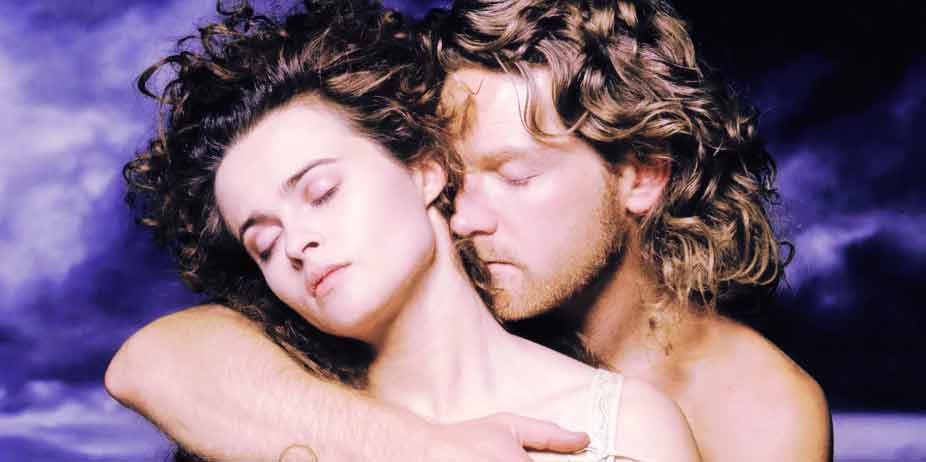
Frankenstein (1998)
The immortal novel by Mary Shelley is more of a study of human nature than a horror story. When I read the book I was struck with the amount of truth in it, the emotion of mankind attempting to recreate something in his own image, of playing God, but then realizing that only God Himself can instill within mankind a sense of right and wrong. This is what remains so horrific about the novel, a human without moral standards unleashed on society, and the creator who is so ashamed of him.
Our tale opens in the frozen north as Captain Walton (Aidan Quinn) and his crew are icebound in a storm. As they prepare to trek across the ice and reach the north pole as part of their expedition, they come across Victor Frankenstein (Kenneth Branagh), who tells them a tragic story. In his childhood, Victor was pampered by his parents. His mother (Cheri Lunghi) doted on her son with unshakable fondness while his father (Ian Holmes) was largely absent in his medical practice. Into the house came an orphan girl, Elizabeth, who over the years became Victor's dearest friend. Marveling at his genius, Elizabeth (Helena Bonham-Carter) encourages him to study abroad. Victor does not only want to enter his father's profession, but also make greater use of science than the doctors before him. Studying the works of mesmerists, alchemists and scientists throughout the ages, his wild notions earn him the disrespect of the school's most prominent teacher, and the admiration of his newfound friend Henry Clerval (Tom Hulce). Together with an eccentric professor (John Cleese) they strive to recreate human life. Professor Waldeman has come very close to reproducing a stronger, better human being, but believes his work was blasphemy and dismantled the project.
When Waldeman is murdered in the midst of giving vaccines to the people of the streets, Victor breaks into his lab and determines to resurrect his project. Unbeknown to Henry, he forms a human experiment with the very best body parts of those fallen with the plague. In the meantime his letters to Elizabeth have lapsed and hoping to come into knowledge of him, she's come to the university to find him. The city is under quarantine and he refuses to allow her to remain at his flat, choosing his work over his future wife. That night he brings the creature to life... and is horrified with what he has done. Like Waldeman, Victor realizes that it is a terrible thing to play God. He rejects his own creation, and starts the monster on its terrible descent into madness. Surprisingly accurate to the book and yet varied in the same terms Coppela took with Bram Stoker's Dracula, the film is remarkable for its equal blend of beauty and horror.
The scenes with the Frankenstein family early on are filled with light and happiness, but colors grow progressively darker as the emotions of all involve change until finally it's all bitter winds and ice. There is artistic license taken namely in the creation of a bride for the "monster," but it doesn't detract too horribly from the enthralling but terrible primal story. The movie gives you the same mingled anticipation and dread as the book, while providing a lush backdrop to look at. There are moments when it drags but for the most part the audience is carried along, eager to learn what happens of these characters while at the same time fearing the inevitable outcome. The creature is much more empathetic on screen. We cringe for him when he's beaten by villagers for his hideous appearance, and thrown out into the snow by the family he has vowed to protect.
I was warned that this movie was extremely graphic in the way of gore but went in expecting much worse than it was. Most of the time the camera shies away from anything overly gruesome but there are exceptions. Victor is shown pickling a brain. It's implied that he hacks off arms and legs for his experiments. He's shown sewing limbs together with jagged stitches, leaving the creatures hideous as a result. In a brief but graphic shot, a woman's heart is ripped out of her chest by the creature and held out for Victor to examine. It's still pumping. Her bloodied body is shown several times. Two people are hung, their necks broken as they bounce at the end of a rope. The creature describes strangling a little boy in great detail. A woman purposefully lights herself on fire and leaps to her death through a second story window. There's a particularly disturbing birth scene in which the woman and her husband/doctor are shown covered in blood. Victor also uses birthing material to fuel his creature into life, collecting it from a midwife.
His creature is nude and we catch numerous glimpses of side and back nudity as it's hoisted up on a crane, dumped into a tank, swarmed over with electricity-charged eels, and they slip in the sludge. He's caught up in the chains of the laboratory and hoisted above the ground, the links just barely covering his genitals. Helena and Victor get steamy with foreplay on their wedding night (including groping and deep kissing) before they're disturbed. Some reviewers condemned this relationship, saying it to be incestuous, but Elizabeth is not related to him. There are a half dozen mild profanities and one abuse of Jesus' name. The movie is very dark in the sense that it follows an emotional track. I didn't appreciate the nudity but for viewers prepared to use the remote, it's an interesting take on Mary Shelley's dark masterpiece.