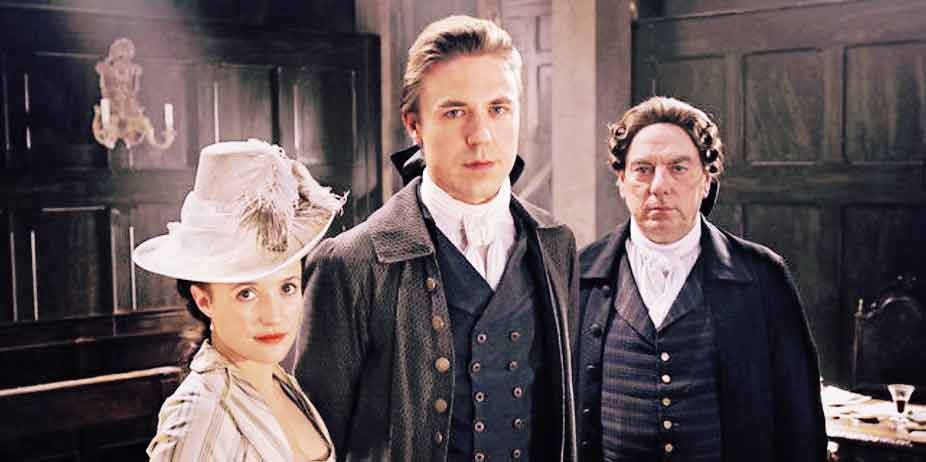
Garrow's Law, Season Two (2010)
I love the Georgian era as much for its costumes as anything else, but it was also significant for seeing the most dramatic change in the British legal system. And the man they largely have to thank for it was William Garrow, at the heart of this period courtroom series.
When a slave ship is forced to hurl some of its occupants overboard due to limited water rations, no one blinks an eye... until the insurance company discovers that it may have been fraud after all. William Garrow (Andrew Buchan) is known as much for his personality in the courtroom as he is his dogged determination to have justice, and is to him in association with his friend and colleague Mr. Southouse (Alun Armstrong) that they go for assistance. His undertaking of the case elicits the indignation of a local freed slave in the country who wishes to draw attention to the matter of the trade in the first place, a case that cannot be brought forward unless Garrow can prove that more than limited water rations were involved. Unfortunately, he finds a distraction in the return of the beautiful Lady Sarah (Lyndsey Marshal) from her country home. Once more in London after her confinement and the birth of a beautiful son, Sarah soon realizes that her powerful husband (Rupert Graves) had grave doubts as to her fidelity, and intends to punish her imagined sins in whatever way he can contrive that will be the most legally painful.
Hoping to prevent her marriage in the wake of a divorce, Sir Arthur instead chooses separation and enlists an attorney (Anton Lesser) with a proven track record for sticking it to secondary parties to prove his wife has been unfaithful. But she hasn't... although she is considering it, given how poorly she has been treated. I must admit that in spite of the lovely costumes, something about this period series just does not work for me. Maybe it is the lack of passion or the fact that it never feels entirely real -- in spite of some good acting, it never sweeps me up into its literary prose and causes me to forget that I am watching actors. Perhaps it is the style of filmmaking or the script, or even the delivery of the lines they are given to work with, but it doesn't completely work and winds up a bit passionless where it should shine the most. It also has a habit of dealing with some unsavory topics, since it is not always theft that sends people to the dock -- sometimes it is a charge of rape or sodomy, the latter case making up the second episode in this season.
In the hour-long story arc, we find out that a man has been accused of sodomy against another man; we then hear in gratuitous detail the alleged crimes before some investigation learns that he is a frequenter of "molly houses" (homosexual brothels). Therein, we see cross-dressing male couples waiting for a room so they can partake of their "bridal bed." The Madame (who is indeed female) confesses that she has known the man in the dock carnally and often. But in the end, we discover that sodomy did in fact happen -- but it was consensual, and had been going on for some time between two men entirely "in love." It concludes with two men embracing and kissing. And here is where it falters, with an entirely modern perspective expressed by Garrow that who cares where love originates, so long as it is love? Should it not be pursued? (Even, in his case, if the woman is married to someone else.) It's laughable considering the Georgian period in which the series is set that he and Lady Sarah both would take such a passé view on what was then a hanging offense. But then, their morals leave a bit to be desired as well -- she laments that they are being punished for "pleasures" they have "not yet known," and asks him if he would like to know them; he turns her down not out of any moral obligation but because he will not give her husband the satisfaction of being right.
References are made to sexual affairs, and a maid is told to inform a man of everything she finds unusual about her lady's undergarments. Another courtroom case opens with mentions of sexual escapades, since it revolves around a man who promised a woman he would help her conceive; Garrow asks her if she still has a menstrual cycle. We discover a married man has been having an affair, and got a woman with child. There are some scattered profanities, while religion is all but non-existent (except in the form of a woman praying before her son is sent to the gallows). For whatever reason, this series fails to resonate with me or even hold my entire undivided attention. It raises some interesting points about the legal system in that era but the politically correct overtone to the entire matter makes it less impacting than it could have been. In many ways it is a shame because an enthralling legal drama set in one of the most moral-enforced time periods in history could be compelling viewing. Nevertheless, it's an entertaining diversion, even if it doesn't stick with you beyond the end.