|
GLADIATOR
REVIEWED
BY CHARITY BISHOP
Our
rating: 3 out of 5 Because
of: violence, wartime gore
Rated:
"What
we do in life echoes in eternity." This is a line of dialogue
from Gladiator, the epic tale of a Spanish military leader forced to a life of slavery
when his honor is threatened. Though the film is well worth the R-rating
for scenes of dismemberment in the heat of battle, it also provides an
extremely rich, well planned plotline, exceptionally memorable characters,
and a thought-provoking premise. If you're able to overlook some graphic
battle scenes in the coliseum, I would encourage you to rent this film
merely for the grand experience. It was much less gory than I anticipated.
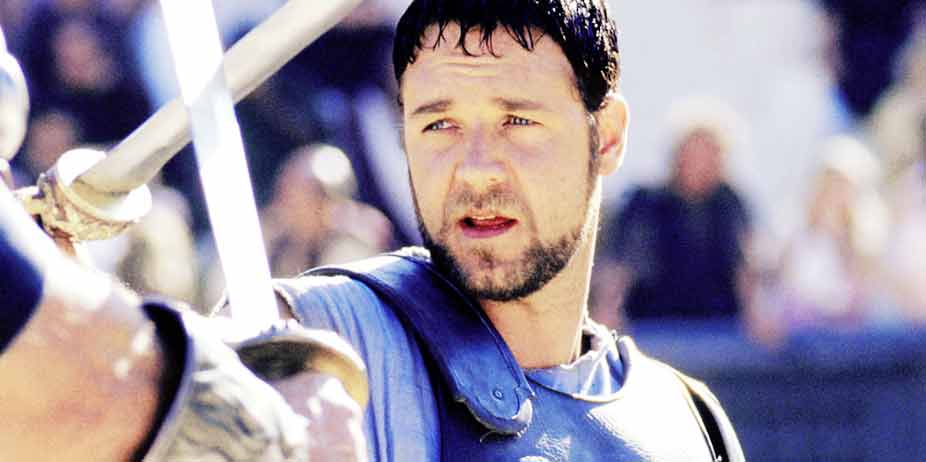
Opening in the age when Rome ruled the territories from Israel to the
coast of Ireland, the film introduces us to the
greatest military leader they have ever known, Maximus (Russell Crowe), a man favored by
the dying emperor to succeed him in power.
Caesar
(Richard Harris) believes Rome has been corrupted and knows the people are
unhappy with the current government. His desire is to instill a democracy
where the senate and elected officials will have more power than the
emperor. Maximus is a natural leader. The people follow him without
question... if he were able to persuade those in power in Rome of the
worth of this ideal, Caesar's dreams of a powerful self-governed nation
would come to pass. But his son and heir Commodus (Joaquin Phoenix) stands
in his way. A power-hungry, mentally deranged young man who has long
sought his father's good opinion, the future emperor of Rome is not about
to let solitary rule to slip through his fingertips. Commodus murders his
father and asks the allegiance of Maximus to the throne. The general
scorns him, and is in turn punished. Maximus is taken into the wood to be
executed, his family to share the same fate.
Managing
to escape from his keepers, Maximus flees home... but is too late. His
wife and son have been murdered, his fields and harvest burned, his home
laid to ruin. Driven by revenge, he vows to avenge their deaths one day.
Weak from battle and injury, he's captured by a caravan of slave traders.
His new owner intends to use him as a gladiator, to earn favor in the
violent sport of Rome. Unwilling to fight in the training duels, Maximus
proves himself unbeatable in actual combat. His distaste for this cruel,
barbaric practice is evident. In the meantime, Commodus knows the senate
plans his removal and entertains the Roman people with the promise of
great sport. There will be 63 days of gladiator games in the great coliseum,
to honor the memory of his father. Maximus' greatest desire is to fight in
those games, and stand before the emperor... so he might deliver the fatal
blow.
Only
one thing stands in his way... the beautiful Lucilla (Connie Nielsen), a
former lover and older sister of Commodus. She knows her brother's evil
nature, suspects he had a hand in their father's death, and must
constantly reject his overly friendly affections. These elements combine
into a story that, while theologically is way off, represents the age of
Rome excessively well. The magnificent buildings, the violence of the
gladiator games, the cheering of the crowd. We have the wronged hero who
must fight to survive. The beautiful woman in distress, and the cruel
villain, who in key scenes reveals a childlike helplessness. Gladiator won Best Picture, among numerous other awards, and is well worth
it. The screenplay is rich with authentic, memorable dialogue. The grand
scale and costuming are impressive. The acting is first-rate. Though put
into spattering blood a bit, the CGI is incredible. The movie has a
slightly sober but moving conclusion.
Coming
from a completely secularized Hollywood, it's not surprising there's no
mention of the Christianity that was sweeping across the world at this
historical time. I would have appreciated at least one religious
gladiator, since they were the most persecuted people in the world. Women
and children were fed to the lions; men were given the opportunity to
fight their way to freedom. The religion portrayed here is authentic to
the period but sadly secular. Maximus prays to his ancestors for
protection before small wooden figurines (idols). He has a warped view of
the afterlife in which he will meet his family in rolling wheat fields.
Even though wrong in its premise, this element is easy enough to accept
based on who Maximus is. He's a Roman centurion raised in a secular
culture.
Though
having been warned about graphic violence and gore, Gladiator was
much less bloody than I anticipated. There's no doubt the R-rating is
earned, as the opening battle scene proves... as men are stabbed,
beheaded, impaled, and set on fire. The film's first shot is a headless Roman soldier on
horseback
while his men are taunted by an opposing leader dangling his head. During
the gladiator games, Maximus and others are forced to kill their
competitors in any way possible. They are dismembered (one woman is cut in
half), chopped, and granted other forms of death. Tigers are released on
long chains during one climactic battle in which Maximus is the victor. He
is encouraged by the crowd (and the emperor) to cut off his fallen foe's
head. Instead, he lets him live. Several of the gorier aspects can be
easily enough avoided using the fast-forward button, but the last two coliseum
battles are largely nongraphic. Even the villain's eventual death isn't
overly gruesome.
To
me the violence was overly brutal in some respects but also showed an
amount of restraint. The director knew when to say enough so he wouldn't
completely lose his male audience. The under-plot between Commodus and Lucilla
strays once or twice into sexual tension. The young emperor is much an
enigma; we're never quite certain of his intentions or emotions. But his
affection for his sister goes beyond brotherly interest, and once or twice
pursues to a near-kiss. He once lays her back on the bed and fingers her
lips, but then decides against kissing her and instead lays his head
against her shoulder, asking for reassurance. At the risk of giving away a
major plot twist, I'll say that later he threatens her son's life if she
attempts to run away or kill herself, and informs her that she will bear
him a son. A slave in a loincloth shows near backside nudity. Commodus
attempts to provoke his enemy's anger by mentioning his wife's reaction to
being raped.
Older
viewers can handle the thematic side, and also the violence, if they go in
knowing this is a secular story with various unreligious aspects. The
pleasure of seeing such an excellent cast (which also includes Derek
Jacobi, and Djimon Hounsou), and the historical accuracy bring back the
grand days of cinema when epic tales like Ben-Hur
and The Robe graced the screen.
|