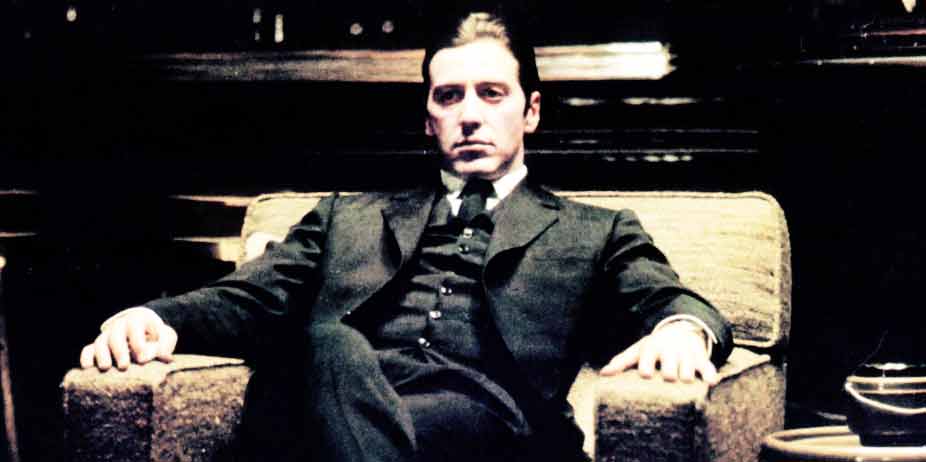
The Godfather II (1974)
This sequel is considered by many to be an improvement on The
Godfather. My first viewing, I found it hard to switch between two
different time periods, but in the years since, it has grown on me, and
I even agree that it’s the superior film.
Gunshots interrupt a funeral procession and leave a boy dead. His mother
pleads with the Don responsible to spare her only remaining son but he
refuses. Subsequent events find Vito (Robert de Nero) in New York,
working as a grocer’s assistant until a local Italian bully forces him
out of a job. Everyone submits to this man, including the
quick-thinking, fast-fingered Clemenza (), but Vito offers to kill him
if the others will pay him to do it. Soon, he’s the go-to man on the
street, the local Godfather.
Many years later, his youngest son Michael (Al Pacino) finds relocating
his family to Nevada difficult. One of the senators in his pocket wants
repayment for his favors and refuses to grant the family any of the
assistance needed to expand. Michael’s takeover of the casino has made
him some powerful enemies, and his brother Fredo is a public
embarrassment. Michael promises his wife (Diane Keaton) to legitimize
the family but first must discover who has ordered a hit against him.
If the first film was about a man’s descent into evil, the second is
about the loss of his soul. Michael’s life is shown in direct comparison
with that of his father, through separate narratives. While we watch
Vito cement loyalty and create a family, we see Michael’s decisions turn
former friends and even his wife against him. It’s a brilliant idea once
the viewer becomes accustomed to it, a way of introducing material from
the book left out of the first film for pacing reasons. Yet, if you’re
unfamiliar with names and characters, it can prove difficult to follow!
Even though his performance didn’t earn him an Oscar, Al Pacino is
magnificent as an icy man who forsakes his conscience and his family
along with it. One of the finest scenes and consequently, the most
difficult to watch, is his confrontation with his wife. Kay tells him
something he doesn’t want to hear -- and the composed, normally distant
man snaps. His rage is evident despite hardly changing expression. The
rest of the cast is equally superb, particularly De Niro as a lovable
but intimidating Vito. He brings just the right amount of danger and
charm to the part, a perfect foil for the earlier interpretation by
Marlon Brando.
The atmosphere is haunting and it has reproduced the same dull,
colorless scheme of the first film, granting the audience a feeling of
isolation and the absence of true happiness. In the original film we saw
Michael abandon good intentions to protect his family; here, we watch
his increasing desire for absolute power drive everyone he loves away
from him. Coppola once said the first two films are about the deaths of
brothers and their impact on Michael, but I disagree. I think The
Godfather series is about the death of Michael; his body may be
unharmed but his soul is tarnished, and that’s a truly tragic thing to
watch.
Sexual Content:
Scantily clad women are seen several times; innuendo; we see a naked baby boy; a man kisses another on the mouth (a death kiss, implying he's about to be assassinated).
Language:
Three f-words, eight abuses of Jesus' name, two GD's, and other mild profanities.
Violence:
A man with a cord around his neck is dragged away to be strangled; the police interrupt and a shoot-out transpires. Vito wraps a revolver in a towel and shoots a man in the chest, the face, and his mouth (blood spurts). Other characters are shot and killed; a man is sliced open with a knife (we see it go in and his murderer drags it all the way up across and through his chest). A man slaps a woman so hard she falls down. Blood covers a bed where a dead prostitute is (she's covered up).
Other:
A woman taunts her husband with having had an abortion.