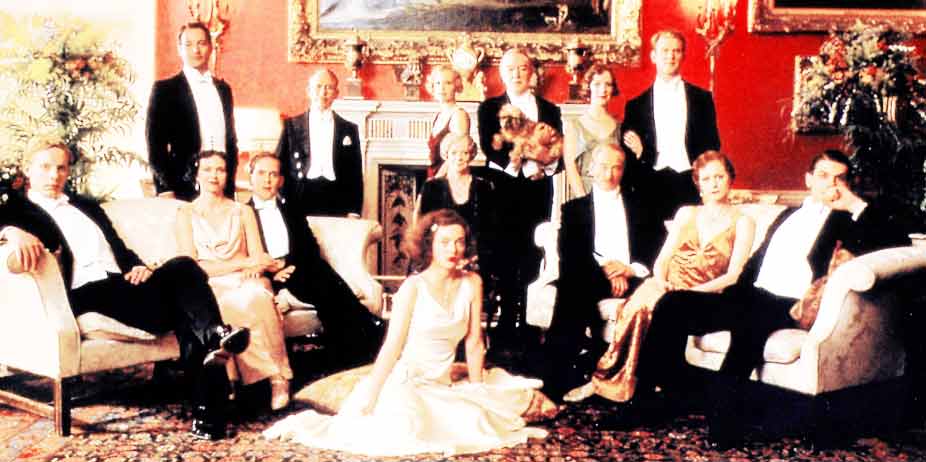
Gosford Park (2001)
While it is true that many have complained that this film is one of the "dullest" that they have ever watched, it remains one of my favorite "upstairs downstairs" murder mysteries. Even that is a bit of a stretch, since it is much more human drama than enigma, since it's mostly about the lives of those who work in an old country house, and those who live "upstairs," in a world of overly sentimental, wealthy imperfection.
In Agatha Christie style, a number of wealthy guests are called to the country estate of Gosford Park for a shooting party. All have some involvement with the host and hostess... cousin, friend, aunt, daughter, business associate. There is the Countess Tremble (Maggie Smith), who secretly relies heavily on her host and nephew Sir William McCordle (Michael Gambon) for financial aid. There are Lord and Lady Stockbridge (Charles Dance, Geraldine Somerville), the former of which having the distinction of having served in the war, and his wife secretly in love with Sir. William; Freddie and Mabel Nesbitt (Claudie Blakley, James Wilby), a unhappily married couple in financial grief, the happily married but financially insecure Mr. and Mrs. Meredeth (Tom Hollander, Natasha Wightman), and a visiting motion picture star (Jeremy Northam) and his brash American producer (Bob Balaban).
But as the guests flock to the marble corridors of the great old house, downstairs is where things are really hopping... in the servants' quarters. There are the valets, the footmen, the ladies' maids, the usual gossip and banter, a pecking order to be found, and a new house to get used to. Among these is the reliable Mary (Kelly Macdonald), servant and representative of the countess. She is asked to room with Eliza (Emily Watson), a gossip-loving blonde bombshell who has many a good piece of advice to offer over little everyday affairs. But things are never quite as they seem, and there is a curious unfolding of events among the servants, under the careful watch of the housekeeper (Helen Mirren), and her curious rivalry with the cook (Eileen Atkins). Then there is the sensitive, mild mannered head valet (Derek Jacobi), and the butler concealing a shameful past (Alan Bates). The motion picture producer's valet Henry Denton (Ryan Phillipe) is not all he appears.
Proclaiming to be Scottish, he knows very little of proper decorum or status below stairs. He is found in odd places, seems almost overly forward with the ladies, and has a flawed accent. Then there is the mysterious Robert Parks (Clive Owen), a valet who grew up in an orphanage. There are also a number of other minor trivialities... flirtations between the kitchen maid and one of the guests... the slurred speech of an alcoholic butler... the animosity between housekeeper and cook. As Mary attempts to unwind the mysteries downstairs, they run rampant among the guests. Arguments, fragments of overheard conversations, possibilities that entwine into a dozen or more subtle plots. What is Freddie Nesbitt up to with Isobel? Is McCordle really going to cut the countess' allowance? What history exists between Sylvia and Lord Stockbridge? And what of the motion picture actor and his producer, who seems to be jotting down notes all the time? When one of the guests is murdered, everyone becomes a suspect. Gosford Park is a labyrinth of mysteries. There is not one, nor two or even three... simultaneously there are a half dozen little enigmas playing out against a vivid backdrop of English country life. Remains of the Day gave us a vivid idea of the caste system existing between the English servant class; Gosford Park does it better. The brilliant thing about the film, unlike many other movies, is the fact that we only intrude on scenes accompanied by a servant, therefore we are experiencing it as if WE lived downstairs. The story unfolds through gossip and snitches of overheard conversations just as if you were a part of the working class.
True to form, there is murder, scandal, deception, blackmail, and sexual intrigue. Everyone is hiding something, from the footman to the master of the manor. The fun thing is watching it all unfold and overlap into a successful story with a surprising conclusion. From a cast of excellent British actors, along with a few American names, we are given magnificent performances. (The ones I have named aren't even all of them -- there's also the likes of Stephen Fry, Richard E. Grant, and Sophia Thompson running about!) Part of the irony of the piece is the satire of it all. Upper class hierarchy, old schoolgirl rivalries, even the master's irritating little dog. Those unfamiliar with such humor will probably find it flat and the film difficult to follow. (To coin a memorable line from the film, 'You British really don't have a sense of humor, do you?' to which the maid replies, 'We do if it's FUNNY.')
The nice thing about Gosford Park is its restraints; aside from five or six f-words to gave it the R-rating, it deals in suggestion more than the obvious. Altman has complained before that most films are too blatant, and has shown elegant restraint. Unfortunately, it cannot save the characters from being immoral. Nearly everyone in the cast is found to be having an affair, or the result of one. There's a heavy emphasis on master/servant relationships, particularly among the maids. Henry Denton becomes a sexual plaything to Lady McCordle, who has had many such relationships in the past. Her husband is well known for being a philanderer, while other indiscretions are hinted at among the guests. It makes the mood of the film a little uncomfortable. Most of it is left to subtle hints, knocking on doors, and mild dialogue, but Mary does intrude on a couple unknowingly in the laundry room. The maid and a gentleman from upstairs are locked in a sexual embrace but it's barely even seen, it happens so quickly (and they hurriedly leave). This relationship is presumed to have continued later, since one of the valets finds them together in the kitchen; this time the young man is on his way out.
Henry comes in to Sylvia and in a languid, bored state she has him unbutton the back of her gown presumably before sleeping with her. (Sex, apparently, is just as boring to the British as everything else is.) A man touches a woman's breast under the presumption that he's wiping off dog hair. There are also a couple hints of homosexuality, though the context is never made clear. The producer asks if he'll see his valet tonight, but it could have a double meaning due to a plot revelation later (the DVD includes several cut scenes that made clear the homosexual nature of the relationship); and one valet teases another, saying he likes seeing the master in his boxers. We see two women bathe in which they show a lot of leg and bare back but nothing else. Language is high merely due to the coarse mouth of one of the guests; other profanity and abuse of deity is surprisingly minimal. Violence consists of some bird-hunting scenes and a scene in which Henry forcefully pins Mary down and tries to kiss her.
For older viewers, Gosford Park is an entertaining if at times slow-moving murder mystery with an Agatha Christie style conclusion. It's also a beautiful glimpse into the middle-class hierarchy among the British during the 1930's. It brings up some questions about the morality of the era, whether certain choices made by characters are right or wrong, and exploits the false mask that the guests put on for others. It also has some wonderful musical talents by Jeremy Northam (who knew he could sing so well?) and a gorgeous backdrop. But since content becomes an issue in quiet, subtle ways, I wouldn't recommend it too loudly for anyone unfamiliar with the genre.