Goya's Ghosts (2007)
I had never heard of this film until it was advertised a few days before its release on DVD, and I was curious about its take on the Spanish Inquisition, so I rented it without high expectations. Goya's Ghosts is an obscure and self-contained little film that seems meaningful even though it overlaps such a tremendous amount of history. It's not a masterpiece, but nor am I likely to forget it anytime soon.
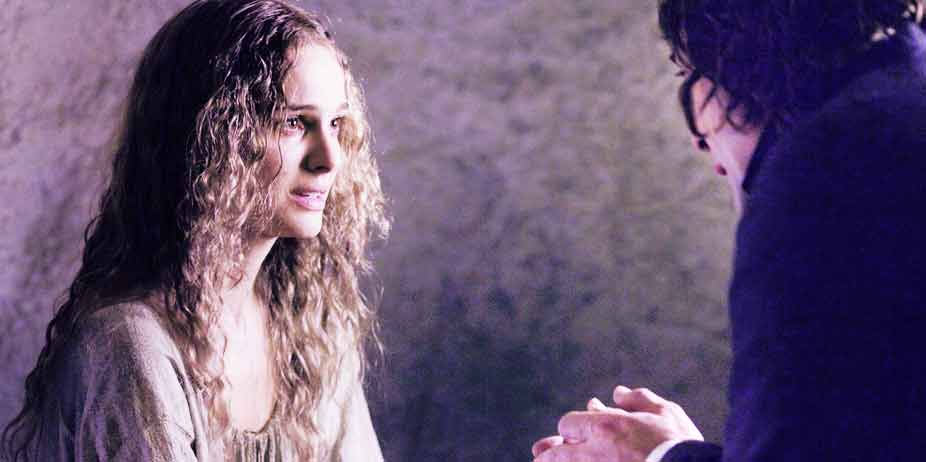
Spain lies beneath the ruthless and tyrannical judgment of the Inquisition in the late 1700's, where men of the church are instructed to keep watch for any kind of subtle behavior that might indicate a fall from grace. Foremost in the church's inquisitors is Lorenzo (Javier Bardem), who is open minded enough to defend the recent works of his majesty's favorite painter, Goya (Stellan Skarsgård). Though his talent lies primarily in creating masterful paintings, he is also quite popular among the common people for his humorous and often offensive sketches that make a mockery of the paranoia of the Catholic Church. He is currently engaged in painting Lorenzo's likeness, but one of his pet projects is sketching the daughter of a wealthy local benefactor. Inés (Natalie Portman) is beautiful and carefree until her dislike for pork is noticed at a tavern, and she is sent before the Inquisition to defend herself against an allegation that she has secretly converted to Judaism.
Unable to withstand their torture, she signs a confession and is imprisoned. Goya involves Lorenzo in attempting to obtain her release, little knowing that his actions will spur on a tremendous rift between the priest and the church, expanding across borders and through long years ripe with change, for Napoleon has arisen to conquer the world. This time period has been so ignored by film that it's a delight to look into the cultural and religious happenings of Spain during those tumultuous and often horrible years, when first the common people were oppressed by the church and then by the French. Probably what is the most impacting, however, are the performances from a truly magnificent cast. Portman actually depicts two different characters who look alike but are wonderfully different, something she maintains in an alteration in her movements, the way she composes herself, and even her smile. It broke my heart to see what happened to Inés, while Lorenzo wavers between being pitiable for his mistakes and hated for his utterly selfish behavior.
Goya tends to be so brutally honest that even the queen does not like what she sees in his work (namely, that he did not make her as beautiful as she likes to think she is) and yet cares profoundly for the people around him. The movie is not something rampant with happiness, for it deals with some very harsh and serious topics, and some audiences may find it depressing, but somehow it never manages to be dull. The R rating is thanks to several instances of partial and side nudity, mostly centered around Portman when she is racked (we see her from the side, at a distance) and then when she is imprisoned without a stitch of clothing (her arms and legs do a good job of obscuring anything explicit). There is brief upper breast nudity when soldiers attack women in the street, tearing open their bodices. It's implied many women are raped, but we do not see the actual incident. Lorenzo takes advantage of Inés twice in prison (implied but not shown). The church is cast in a negative light, but no more negative than it deserved, since it was a time of ruthlessness rather than grace.
Priests condemn lewd portraits but see nothing inappropriate about stripping a girl of her clothes and torturing her. When Napoleon invades, they are rounded up and imprisoned; one of them is shot. There are battle skirmishes, explosions, and gunfire in the streets. A woman asks where a man wants to "do it," since she believes he has paid for sex rather than conversation. There is also some nudity and crudeness in various paintings hanging about the palace. A man is slowly strangled to death in a public execution. Bodies are strewn the length of the street after a skirmish. It's a movie that is not for young audiences, and the partial nudity does put a damper on it, but for fans of the historical changes of the era, will be an eye-opening visual experience.