Gunpowder, Treason and Plot (2004)
While countless novelizations and films have followed the life of Elizabeth I, few have focused on the equally turbulent reign of Mary Queen of Scots, despite the fact that the two are irrevocably entwined. This four hour miniseries by the BBC follows the life of Mary and also of her son James, who succeeded to the English throne following the death of Elizabeth Tudor.
Spirited away to France for her own protection as a child, Mary Stuart (Clemence Posy) is ill-prepared for the reign pressed upon her after her mother's death. Her newfound role as the Queen of Scots is threatened by religious turmoil and diversity, for the nation is heavily Protestant and she is a devout and unapologetic Catholic. Her brother attempts to influence her decisions, while her cousin Queen Elizabeth (Catherine McCormack) secretly hopes for her eventual downfall. The only man she can trust is the volatile Bothwell (Kevin McKidd), a Scottish lord who desires to be more than just her subject. Then there is the handsome Lord Darnley (Paul Nicholls), who captures her heart and her hand in marriage, reaping serious political consequences.
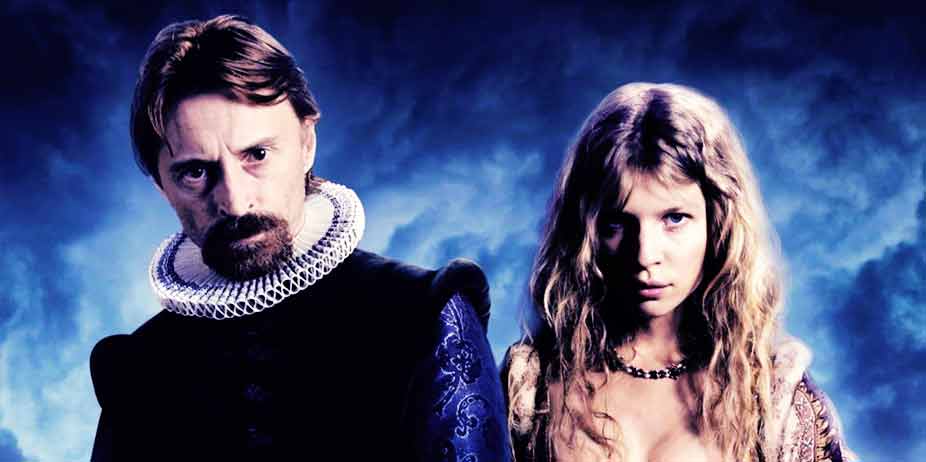
With Mary's eventual downfall comes the rise of her son James (Robert Carlyle), whose continued persecution of the Catholics in England launches a plot among the Catholic nobles to destroy his reign. Together with his unhappy wife (Sira Stampe), James fights to be respected by an unfriendly Parliament, and to leave his mark on history, despite the courageous but misguided men (Richard Coyle, Richard Harrington, Sam Troughton) that stand against him. The result is a miniseries with both its moments of brilliance and its sequences of utter boredom. I thought the first half was quite good, but the second half was not nearly as entertaining. I have never seen Mary quite so lovely or likable, and the actress was able to switch from English to Frence fluently without losing the interest of the audience. She had a nice chemistry with Bothwell, but I did not feel the change of Lord Darnley was as well developed as it could have been, nor did it touch on the fact that Elizabeth was adamantly against the marriage, since Darnley was also in line for the succession.
The second half of the movie was not great. If the real James I of England was like that, I can see why the Catholics wanted to blow him up. From his brutal bedroom tactics to his unyielding martyrdom of priests by the most horrible means possible, I spent the entire time hating him and hoping the plot to assassinate him would succeed. I tend to doubt he was that much of a morally skewed tyrant, since it was James after all who authorized the King James Bible (as a means of uniting the Catholic and Protestant scriptures), and wrote devotedly of both his faith and morality. The content in this series also leaves something to be desired. I'm surprised it was broadcast on network television, because of the explicit sexual content. Both Mary and Anne's wedding nights are brutal, loathsome affairs. Darnley passes a couple "doing it" in a stairwell. Mary and Bothwell's later tryst is excessively graphic and involves nudity, as is a scene in the second episode where a man first beds a woman, and then strangles her to death. Her naked dead body is found by soldiers the next morning. James is depicted as bisexual, and one scene has him propositioning another man, offering to exchange "religious freedom" for "favors."
All of that doesn't even touch on the violence, which ranges from a man being strangled, another drowned in a trough of water, others ripped apart by bullets, attacked by soldiers, hit over the head, gruesomely tortured, hanged, and beheaded. Severed heads are seen on pikes. We see just enough of a priest being "hung, drawn, and quartered" to be horrified by it. (Hanged, then his heart is removed.) I thought that, minus the offensive sexuality, the first half of the miniseries was absolute brilliance, but the second half fell far short of my expectations. Leaping from the enigmatic, charming Mary to her angry and abusive son did not win any bonus points with me. I think it could have been a much stronger presentation if part two had picked up where part one left off. I would have liked to see the continued power struggle between Mary and Elizabeth.