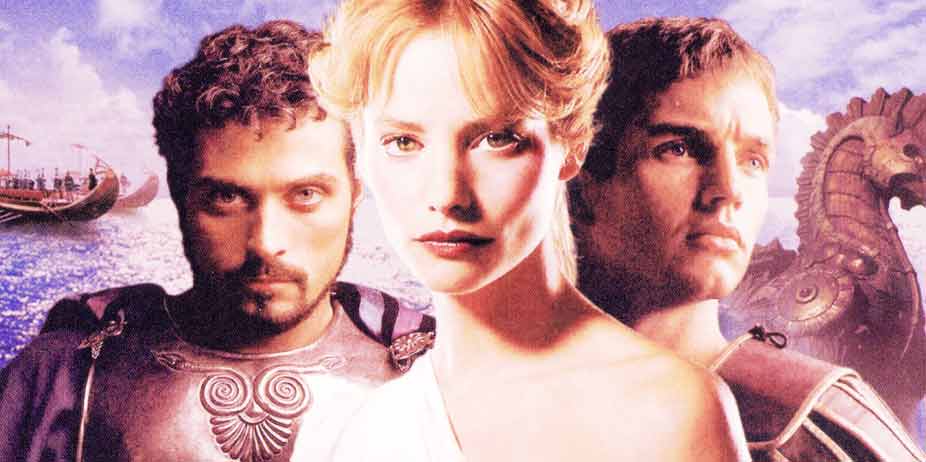
Helen of Troy (2003)
Two worlds waged war over her beauty, and she brought an
empire to its knees. This enthralling television series
takes us into the world of Helen of Troy, the woman "whose
face launched a thousand ships." The story begins in the
royal palace of Troy as a baby's first cries pierce the
evening. The Queen has just given birth to her second child
when her first, Cassandra, known for having visions and
dreams, comes screaming into the room. "Kill him!" she
cries. "Kill him! If he lives, Troy will burn!" Because she
deemed the child male before even the doctors knew, her
father (John Rhys-Davies) takes her words as truth. He
orders the court council to take the baby boy to the tallest
mountaintop and throw him off the cliffs. The man is unable
to murder an innocent child and instead leaves him there.
The child is found by a local goat farmer, who calls him
Paris.
Many years later, Paris (Matthew Marsden) is a grown man who
loathes the brutality of Troy and longs for a beautiful
woman. He is visited in a vision by three of the goddesses,
who offer him either riches beyond comparison, power above
all other, or Aphrodite... beauty of the ages, found in the
form of a neighboring kingdom's younger princess, Helen
(Sienna Guillory). He sees her face, and she witnesses him
in the waters of a costal village. Helen's older sister is
being married to Agamemnon (Rufus Sewell), heir of yet
another kingdom. When his eyes fall upon Helen, Agamemnon
sees only great beauty. Aware of her increasing lure over
men, Helen flees the courtyard and is kidnapped by
vagabonds. Instead of harming her, the captors treat her
like royalty. She comes to love her kidnapper just in time
to see him perish at the hand of her brother, who is also
fatally wounded. Her father calls her a curse upon all men
who bear her company, and offers her willingly to any
kingdom.
Paris has journeyed to Troy in order to fight in the games
and win back the bull the king's captain of the guard has
stolen as a prize. Cassandra (Emilia Fox) recognizes him as
the child who should have perished long ago. His parents are
overcome and welcome him into the palace, where he is
groomed as heir to the throne. When Agamemnon's younger
brother makes his claim on Helen, Paris is sent as an
ambassador to discuss various land treaties. The same day
she is paraded before his royal court, Paris arrives. They
recognize one another from the vision they shared so many
years before. Their friendship will become dangerous and
ultimately lead all Roman kingdoms to war against Troy for
the recovery of a queen and the defeat of an empire. Some
are motivated by greed, others by lust, yet through it all
the passion of Helen and Paris burns brightly.
Taken at face value, this is a stunning network adaptation. The filming is more breathtaking than anything I've seen in Hollywood. They use unique camera angles and close-ups in order to build tension and imply great drama. One of the finest moments is when Cassandra realizes that the young man fighting her younger brother (Daniel Lapaine) is the child she ordered should be executed. The acting is incredible... everyone reacts with great feeling and passion and are given a fantastic script to work with. Even if you know nothing of Troy, you immediately understand the motivations behind everyone's actions. The "casting of lots" for Helen, her kidnapping, even the fabled Trojan horse.
With a fantastic cast behind it, the production team went all out to recreate a believable empire of splendor. Various palaces and courtyards are constructed in breathtaking beauty. Most of the computer animation cannot be told from the real thing. It's beautiful to watch and has a marvelous score but the battles are dull and unimaginative, the violence is often overdone, nudity and a rape scene demoralize Helen, and after the credits roll, on reflection one wonders why they spent three and a half hours of their life investing their time in it.
Sexual Content:
Many of Helen's outfits are sheer, showing her breasts through them. There are dozens of instances of backside nudity, on Helen and various male characters. Agamemnon takes her by force after conquering Troy. It's not overly graphic but we know without a doubt what is happening. Her husband is forced to watch.
Language:
None.
Violence:
Hundreds of men are mowed down with arrows, and stabbed with the sword. Men go in for hand to hand combat, intending to "fight to the death." One character is skewered with a spear, then struck again in the chest by his adversary, who ties his body behind his chariot and drags it through the streets. Another is stabbed viciously many times. It's implied the king is murdered (we see men stabbing toward him in the background as the villain walks away). Enraged over an in-the-family murder, a woman pulls a knife on her husband and stabs him in the pool. The water turns red with blood, and she leaves his body floating upside-down as she walks away.
Other:
Agamemnon sacrifices his daughter on an alter to gain approval from the goddess of wind. (We don't see anything, merely hear her laughter cut off abruptly.) There is much talk of gods and goddesses. Cassandra is given to wild fits and "visions" in which she foretells the future.