Henry VIII (2003)
He was known for two things: his lust for women and his notorious beheading of two of his wives. King Henry VIII is one of the most infamous "bloody" monarchs in England's history. What is written about him is scandalous, and that makes an excellent place to begin for any self-respecting novelist or filmmaker. Unfortunately, this one is heavy on romance and scant on actual details, but nevertheless is it a diverting way to spend three hours.
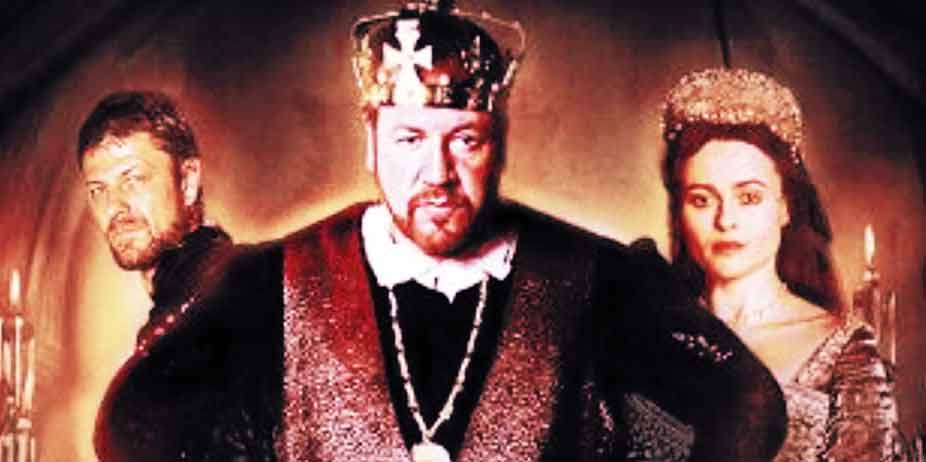
The one vow Henry made to his father on his deathbed that when he became king, he would produce an heir that would continue the magnificent Tudor line in the monarchy. Forced into marriage to his dead brother's wife Katherine (Assumpta Serna) in order to prevent war with her native Spain, he hopes and waits for the son he has always wanted, but she cannot but bear him deceased babies, with the exception of one child, a daughter, Mary. A womanizer accustomed to having his way with all of the women of the court, Henry (Ray Winstone) turns his attention to the beautiful and unreachable Anne Boleyn (Helena Bonham Carter), who is soon to be married to a man beneath her station. Giving his friend and fellow conspirator Cardinal Wolsey (David Suchet) the task of preventing the alliance and assisting him into winning over Anne, Henry finds it difficult to win her favor after encouraging her fiancé to marry elsewhere.
Determined not to wind up like her older sister, pregnant with the king's child, Anne refuses to come to his bedchamber until he makes her queen. Desperate for the heir she promises can be got for him, Henry controversially seeks to have his marriage to Queen Katherine annulled. But once his marriage to Anne is finalized and she cannot produce the heir he so desires, he will go through a succession of whirlwind romances and desperate attempts to secure England with the Tudor name. Among his wives will be the quiet and virtuous Jane Seymour (Emilia Fox), the outcast Anne of Cleaves (Pia Girard), the violently temperamental Katherine Howard (Emily Blunt), and the devoted Katherine Parr (Clare Holman). In the end, Henry will have his son, little knowing that it is Anne Boleyn's daughter who will ultimately take the throne.
Many things weigh in both for and against this lavish production, namely that there is such a good cast list despite its numerous historical inaccuracies, and it does paint a more realistic and likable image of the monarch than most films are prone to do. Henry manages to win you over with his childish determination despite his dreadful behavior, and I was quite fond of him up until about halfway through the first installment, when he did something so terrible I could never forgive him. The actor has been critiqued for being all wrong for the part, but my judgment is less biased than most, and I found him quite delightful. His leading cast of ladies were wonderful as well, although as much as I like Helena, the fact that she was pregnant during filming was all too painfully obvious, not to mention that she's quite a bit older than Anne should have been.
Content varies from surprising restraint in some aspects and shocking detail in others. There is quite a bit of warfare and blood, since some early scenes take place during a battle against power-hungry traitors seeking to take the crown. Executions are carried out without us seeing the actual stroke of the sword or axe, although a surprising amount of blood spatters across the faces of bystanders. A freshly decapitated head is held aloft for the crowd to jeer at. A traitor is first attacked and stabbed, then hung drenched in blood to die out in the sun over the side of the castle. The most disturbing act of violence is Henry, in a fit of rage, raping one of his wives. I was shocked not only with the scene itself, but how long it seemed to last. (The one redeeming aspect is that on the DVD, you can see it coming and skip to the next scene without missing any plot points.)
Much is made of the king wishing to bed Anne. There are various sexual innuendos and mild fits of dialogue, as well as a sex scene immediately following the wedding (a shot of her bare back is shown, along with movement). The king's bare backside is briefly shown when he dives into a pond. One of his promiscuous wives is shown in her younger years as having a lover; sexual movement is included before they hear someone coming. A man pulls off a woman's gown, revealing her breasts to the audience in order to see if she's "worthy" of being the next potential queen. Henry is unable to consummate a marriage; dialogue reveals how humiliated he is. Katherine is involved in an adulterous relationship, which is hinted at but never graphically depicted.
What I liked about the production is that it followed all of the wives with reverence, but it also left out a great deal of important plot matter. In all actuality, it would have been a far better six-episode mini-series than a two-part series, since there's such a wealth of history that could have been used to further fill out the missing pieces. For example, I appreciated that Jane made reference to bringing both of her stepdaughters back to court for reconciliation with their father, but they left out the fact that Anne Boleyn was framed through blackmail and murder, as well as the fact that she was the principle instigator of Henry's first divorce; this film made it seem as though the annulment had been considered for some time. That being said, it does get under your skin enough to make you want to see it a second time, if only to ponder the ultimate tragedy of Henry and his unfortunate wives.