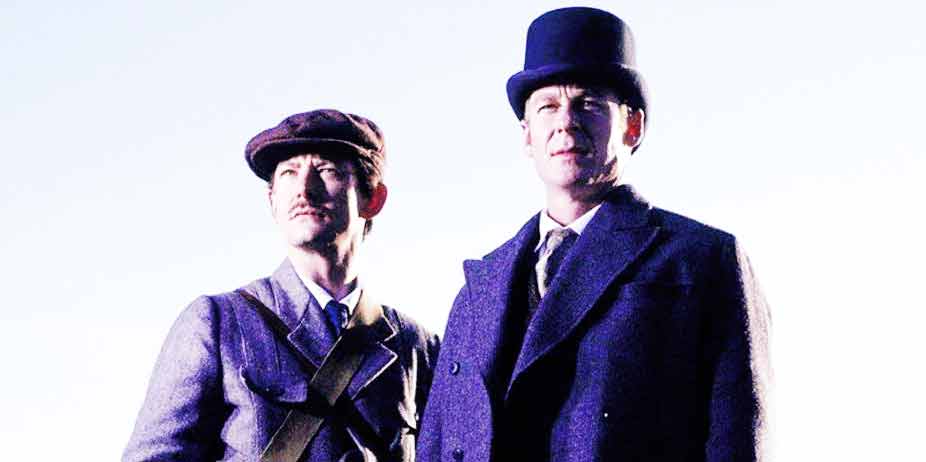
The Hound of the Baskervilles (2002)
The Hound of the Baskervilles is one of my all-time favorite mystery stories. Despite the fact that the illustrious Sherlock Holmes himself is notably absent throughout much of the text, something about the eerie splendor of Baskerville Hall and the demon hound who stalks the heirs of Sir Hugo never fails to impress. There have been many attempts to translate this novel to film. Sadly, this recent adaptation proves once again that the book has been filmed many times but never properly. What is it about the original storyline script writers fail to understand? You can't dismantle such as tale as this one and tape it together with the pieces out of order and sometimes even missing and expect a wonderful response. Still, I guess it depends on just how much of a true Holmes connoisseur you are. Some people love this version. Others threaten to set the hound on PBS if it ever tries another Conan Doyle adaptation. Out of either category, I fear I fall into the latter.
The film opens with the flashbacks of Dr. Mortimer, a practicing physician in the moor called before the coroner's court to explain the death of Sir Charles Baskerville, a close friend and local landowner. He explains to the judge that the man's features were contorted and the cause of death was heart failure. The death is ruled accidental and Mortimer travels to London to the esteemed Baker Street detective to reveal more of the facts. Sir Charles, he believes, died of sheer terror. The deaths of the Baskervilles have always been swift and bloody thanks to the family curse... a horrific tale dating back to the middle ages in which the home's original founder, Sir Hugo, discovered his wife to be having an affair. In a drunken rage he beat her nearly to death and then when she tried to escape, followed her across the moors and murdered her. When her faithful hound saw what had been done to its mistress, it fell upon Sir Hugo and tore out his throat even as it was pierced by Hugo's blade. The ghost of the hound is said to haunt the moor, waging vengeance on all of Sir Hugo's heirs.
Mortimer has not come to seek Holmes' aid in solving the death of Sir Charles, but rather for advice in what must be done with the remaining heir Sir Henry, who was left the bulk of the estate. Holmes (Richard Roxburgh) advises the man to keep Henry under close watch and bring him around in the morning. As he confides to Watson, the death of Sir Charles was no mere accident. The footprints Mortimer described could have meant only one thing... that he was 'running for his life... running until he burst his heart and fell dead upon his face.' Another case prevents Holmes from accompanying Henry to the Hall and so he sends Watson (Ian Hart) instead. Neither know what sinister events may unfold on the moor at night, when the powers of evil are exalted... I wasn't able to view this when it premiered on PBS so I tracked down a copy through the library system. Needless to say, I wasn't overly excited going in.
The Sherlockians who had seen it before me had left their impression and my reaction was much the same as theirs: Doyle's book, and indeed the characters of Sherlock Holmes and Watson themselves, have been grievously wronged. The terrible thing about it is that sometimes the film sticks beautifully to the book, giving us scenes few others have captured, such as the moon rising behind the figure on the tor or Holmes' examination of the portrait of Sir Hugo. His initial meeting with Stapleton comes right out of the book's dialogue. It is the little moments such as this which make the film dimly shine through the grime accumulated in the murder of a brilliant book. I don't mind some artistic license. I'm not one of those who believes a film adaptation should be precise and always accurate in translation. But I always insist the characters and message remain truthful to the author's intent. Here, The Hound of the Baskervilles fails miserably. The film leaves out entire sub-plots and minor characters which create the fabric of suspects needed to carry the mystery off. The criminal is obvious right from the first merely because he's the only character we truly get to know.
Watson, thankfully, is no bumbling idiot and does reflect certain aspects of the Canon on whole, such as his appreciation for beautiful women, his sense of humanity against Holmes' cold logic and reason, and his capability in handling a revolver. But his character starts falling to pieces when the writer identifies him as incredibly petty. Like a little child he throws a tantrum fit when Holmes doesn't give him all the details. The last line of the film is the clincher. Looking Holmes right in the eye, he says, 'No, I don't [trust you].' This from the ardent, adoring Dr. Watson, who believed Holmes was the most brilliant sleuth of all time and willingly handed his life into Holmes' hands on a regular basis? Holmes is transformed into a drug addict who injects cocaine whenever he's trying to solve a crime. (The real Holmes only used a narcotic every once in a while; NEVER to stimulate his thoughts while on a case, but rather to keep himself from going mad when he wasn't working.) The scene of him diligently injecting himself in the train toilet room with a mark-mottled arm, as well as slamming the door on Watson in a similar procedure just after first learning of the case, is shameful. Obviously the scriptwriter doesn't know the true Holmes... but then this becomes apparent when Holmes bodily threatens a cabby, falls into a bog at the climax and panics, and mistakes a fallen figure on the moor for his client. He is also overly cold and calculating. Holmes did, contrary to popular belief, have a wonderful sense of humor. This one doesn't.
The one bright glimmer in the film is the performance of Richard E. Grant as Stapleton. He's utterly winning, just as charming, cynical, and sinister as Doyle wrote him. His scenes with Neve McIntosh as Beryl are brilliant... oozing just the right amount of sexual tension and intimidation. He's the best Stapleton I've seen yet... too bad the rest of the cast founders in the bog. Richard Roxburgh is not a good Holmes. He's not nearly angular enough and lacks the charismatic energy needed to portray a case-driven detective. Watson is a mixed bag at best. To be fair, I believe we've come to accept so much of a stereotype when it comes to Watson that Ian Hart's more lean, realistic portrayal seems strangely out of place. Matt Day as Sir Henry isn't even worth mentioning. His lines are wooden and flatly delivered. The hound is one of the biggest disappointments... an obviously fake CGI prehistoric hyena-dog lacking the book's glow of phosphorous.
Families may also be somewhat waylaid by the content. There is no sexual content other than Sir Henry making a cheeky remark about wishing he could exercise the ancient right of landownership to bed all the local women, but violence becomes often graphic and brutal. The opening shot of the film is of a corpse, the facial features twisted in horror, the hands stiffened as if clawing the ground, laying mostly naked on an examining table. In that same sequence of scenes a prisoner escapes into the moors and is chased by two policemen... who both fall into a bog and drown. Later two men are attacked and mauled by the hound, one to death. Watson and Holmes come across his bloodied corpse and the audience sees the damage... realistic maul wounds in which half the man's neck has been ripped out. The climax becomes bloody. The dog is brutally killed after he graphically mauls someone. A character is found hanging dead from the rafters in the barn. Several people are shot, one in the forehead (implied). There are many minor abuses of deity, one or two profanities and an inappropriate cry of "Jesus Christ!" by Sir Henry. A man lies about having a mistress to protect another secret he's keeping.
But by far the element which will make Christians uncomfortable is the séance, something invented by the filmmakers as a way to inform the audience who believes in the supernatural and who doesn't. Mrs. Mortimer, the doctor's wife, is a medium and Henry asks her to contact his dead uncle. She does so, with horrifying results. (The spirit speaks through her.) The actress who played Mrs. Mortimer confesses to having consulted a real French medium who gave her some tips (and some advice from Sir Arthur Conan Doyle himself) on her realistic portrayal. I'm sure you can understand my disappointment and concern. The Bible tells us to avoid mediums and those who consult spirits, because the ghosts of dead people do not return. Séances consult demons impersonating dead loved ones. I find it difficult to believe everyone present at the dinner party would be agreeable to such a thing. In the words of Watson, quoting what Holmes might say on the subject of mediums and ghosts, 'The world is full enough as it is: no ghosts need apply.'