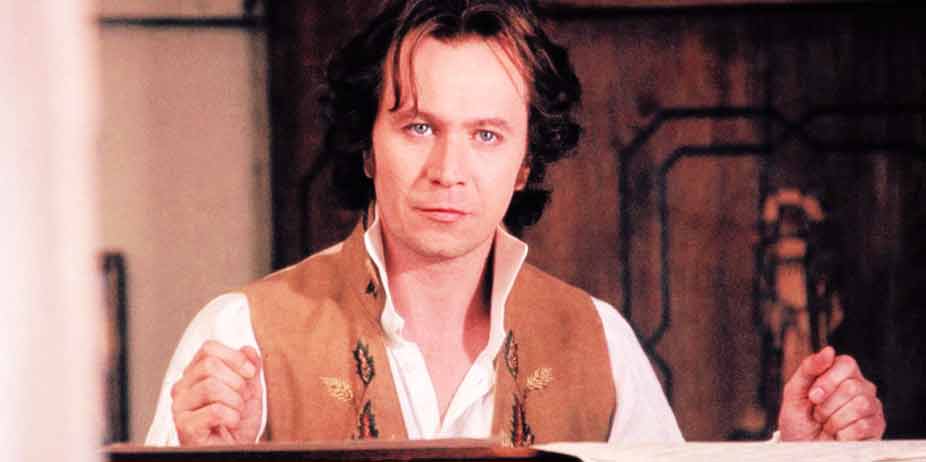
Immortal Beloved (1994)
Who was Beethoven's immortal beloved? This is the question solved in an enthralling film rooted deeply in a love of music. Shortly after the great composer's death, his lawyer Anton Schindler (Jeroen Krabb) is attempting to determine who is left the keeping of his music and fortune. Beethoven's brothers believe they should have a fair share. Others think the composer's nephew and adopted son should take part. But he has left it all to his "immortal beloved" in a last will and testament. Schindler begins to unravel a mystery that has spanned several decades. He traces Beethoven's adventures back to his appointment to meet with a cloaked woman in a roadside inn. She came, stayed a time, and then departed again when he failed to appear. His carriage was stuck in the mud, preventing his arrival until just after she'd gone.
The innkeeper remembers him as a man of black temperament who threw a chair through her window and refused to pay for it. Others have similar views of the man. He was passionate, energetic, spoiled to a fault, and yet his music was highly popular. Then there were the women in his life, a long string of young ladies enticed by his musical skills. Nanette Streicher (Miriam Margolyes) was one of the first, a girl of aristocratic background who managed to insult him on their first meeting. Over the course of teaching her music, they shared a particular fondness for one another and fell in love. But marriage was not to be. Schindler is forced to leave this woman's house without an answer to his problem. She is not Beethoven's Immortal Beloved. His digging into the man's past will unearth love stories, scandals, faces familiar and unfamiliar, and the tragedy that led the composer nearly to madness.
Featuring Isabella Rossellini and Gary Oldman in the incredible leading role, Immortal Beloved is many things. It's a romance in a way, but also a tragedy. There is heartache and sorrow but also joy. It's the story of a musician but also a man. Some of it is based on fact but by in large the story is fictional. It plays with your heartstrings. One moment you want to shove Beethoven out a window for his cruelty, and the next you find tears in your eyes as he is humiliated before the public for his deafness, or stands watching the musicians play, knowing they are "butchering" his wonderful compositions. Beethoven was deaf and for a time the audience forgets, but then it is brought upon them so severely that we're shocked and horrified. Oldman does a magnificent job playing a difficult character. He brings both innocence and bad temper to the role, making Beethoven likable even in his worst moments. You grow to understand him, but even then much is still a mystery. The screenplay is well written but not always clear.
There are confusing moments and while the ending twist is unforeseen, it will also leave you scratching your head. The costuming is very well done, as is the musical score, compiled of all Beethoven's most famous pieces. The script lightly touches on some of his shocking political beliefs but spends much more time developing relationships, told in flashbacks throughout. The single problem with the movie was I felt that it lasted too long. There are sequences without music in which actions are done, but these weary a viewer when they've already been held captive for two hours. The opening scene is the longest intro I've ever seen, merely a funeral procession marching through the streets. I was also very confused toward the end, until I realized that the flashback of a little boy escaping his evil father was meant to portray the emotion of Beethoven's final composition. That being said, there are also issues that conservative viewers will have trouble overcoming. Language is minimal but present, a half dozen mild profanities and a few crude anatomical references. Beethoven repeatedly calls a woman he dislikes a "whore" and a "slut."
Violence is limited to the bombing of Vienna. A woman and her children hide beneath a table. One of the children escapes and is killed an in explosion. Beethoven becomes enraged and destroys a hotel room, shattering a window in the process. A fistfight erupts between two men. One of them is suffering from consumption and starts spitting up blood. A girl has her hand violently slapped for being a poor piano player. Beethoven has a flashback in which he remembers his father boxing his ears repetitively after failing to astound an audience with his talent. The scene is difficult to watch and lengthy. Worse is a scene in which a woman is raped by soldiers on the road, and rampant female nudity in early sequences. A woman unlaces her gown and removes the top while she runs through an orchard with the composer. He comes in to another woman barely covered in bed. A girl is shown bathing and her breast is seen through the wet gown. Partial nudity is seen when Beethoven bursts in on his newly married brother; she rapidly covers up with a sheet. He passionately kisses several women. It's also implied that he carried on two extramarital affairs. Without the nudity the movie is enjoyable for lovers of musical drama. It has the same impact as Amadeus, primarily a fictional account but interesting nevertheless.