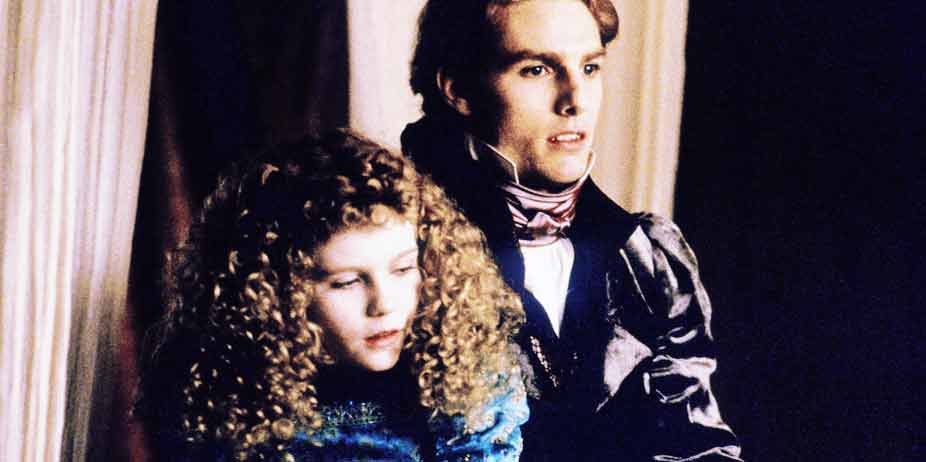
Interview with the Vampire (1994)
One of only two adaptations of Anne Rice's bestselling Vampire Chronicles (the other being the abysmal Queen of the Damned), Interview with the Vampire is an accurate retelling of the novel. It takes many liberties for the sake of dramatic effect and time restraints but is nowhere near as captivating as the volume on which it's based. It also takes time to become accustomed to the leading men, and is somewhat darker and more macabre than most films in the genre.
In a grungy room above a filthy New Orleans street, a journalist asks to know the story behind a stranger for a collection of human interest stories he's writing. His companion (Brad Pitt) reveals he is a vampire and has been wandering the earth since the time of his "rebirth into life," several hundred years before. He was an unhappy plantation owner after the death of his wife in childbirth, until Lestat (Tom Cruise) sought him out in a darkened alley. The vampire left him with the mark of death and then made him an offering... eternal but condemned life. Without knowing the consequences of this choice, Louis agreed. He became a vampire and began to haunt the city streets in search of prey with Lestat, who took great pleasure and pride in his killings. He sought out the most elite, the most deserving of death, as well as the many wretched women of the night. Some Lestat tortured, others he took gently, but all fell beneath his gleaming fangs. Unable to bring himself to feed on fellow human beings, Louis survived on rats until the night he met Claudia (Kirsten Dunst). Taking pity on the little girl's terrible plight of a mother died of the plague and none other to care for her, Louis bit her.
Fleeing the house in humiliation and guilt over his crime, he returns to find Lestat has brought the unconscious little girl home... and transformed her into a vampire. Claudia at first loves her newfound life; she is as cold, unfeeling, and bloodthirsty as Lestat, but loves Louis more for his tenderness. Adopting her as a surrogate daughter, Louis begins to show concern for the abnormal pattern Claudia is undertaking. She has grown distant and unhappy, enraged with both of them because as an immortal she can never bodily grow older. She is an aged soul in a child's body, never to experience the wonders of womanhood, dependent on others for protection. Then comes a time of great betrayal and the horrors that lie beyond, in Paris with a coven of evil vampires beneath the control of Armand (Antonio Banderas).
For the most part I did not like the alterations to the novel, even though Anne Rice helped devise them. In the book Lestat is captivating; he instills a sense of horrified allegiance in the reader. We're repulsed by his delight in taking victims but also drawn to his egotistical nature. Tom Cruise' version makes him a creature we cannot like no matter how hard we try. There is nothing of kindness in his Lestat, only snarling cruelty. He is far more brutal. The first minutes of film are nothing like the original work. That Lestat and Louis were friends before the bite is neglected, instead it pairs them as complete strangers who loathe one another from the very beginning. Brad Pitt's interpretation is much closer to the book's Louis and he's very likable, but the movie really belongs to Kirsten Dunst, who won a Golden Globe for her performance. From the instant the little girl opens vampire eyes and springs forth with a desire for pretty bonnets and dolls, we cannot help adoring her. There is also a fair dose of morbid humor, and the surreal feeling of observing everything at night gives a haunting atmosphere. The costuming is absolutely gorgeous and the make-up is divine.
With movies of this genre come a great deal of violence and gore, since essentially it's all about blood. They attack people and bite into their necks, with often graphic results. Lestat's favorite activity is to slice someone's wrist and drink from it, or let it drip into a crystal glass. That's also how he "creates" vampires (by offering them blood from his wrist). He torments two prostitutes, first by killing one and then biting the other in the breast, leaving her to bleed to death. Louis murders poodles rather than bite their owner; he's seen sucking on rats. One extremely gruesome scene involves a vampire being poisoned; his throat is visually slit open with a knife and blood streams all over the room, pooling around the body as it shrivels and dies, and nearly getting on Claudia's silk slippers. They throw the body in a swamp and blood bubbles up from it. The half-disfigured vampire comes back to haunt others later, attacking in an attempt to avenge his murder. Louis becomes enraged at the barbaric methods of vampires in Paris and sets their coffins afire in daylight, using a scythe to slice them in half when they emerge in burning flames. (A head is decapitated from its body, and two men are cut in half, with gruesome results.) Two vampires are locked in a cell meant to reveal them to daylight and scream as their bodies disintegrate; we see the charred remains later (nothing but ash).
I can understand the gruesome violence involved to a certain degree but it's the pointless nudity that is beyond my comprehension. Claudia, Louis, and Lestat observe a naked woman bathing through a window (everything is briefly seen). We see the same woman again, dead and disintegrating (her upper torso nude) in a room. In Paris Armand "amuses" an audience by stripping a maid naked and feeding on her. The scene involves graphic full female nudity that's pointless to the film other than being gratuitous. Mild sexual elements are involved in some scenes; Lestat likes to feed on prostitutes and often trades innuendo with them. Vampirism has sensual overtones, with victims acting pleasured at the initial bite. It's a film that will appeal most to fans of the novel, but even then they must be prepared for some of the changes.