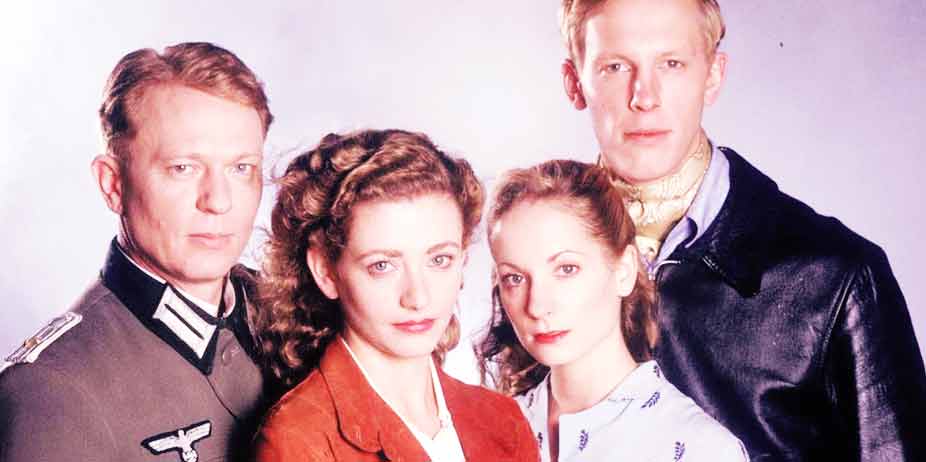
Island at War (2004)
The BBC has a talent for WWII dramas. At a time when their nation was under attack from Germany, the fear, insecurity, and above all, hope that they would persevere was passed through generations. They are proud of their heritage, and it shows in their dramas. Island at War is the first installment in what the BBC hopes to be a long-lasting drama surrounding the five-year occupation of the Channel Islands by hostile forces. While it is remarkable for its characters, and the ability to bring a distinction between barbarians and good-hearted Nazis, the series unfortunately is rampant with adult themes and content.
Europe is reeling from the German forces rapidly taking command of the world. Hitler has marched into France, and begins to strive for English occupation. Between the two nations lie the Channel Islands, predominantly British in origin but peopled with refugees from the war. The elected official of the islands reassures the people that they will not be abandoned by the motherland, shortly before British troops begin pulling out en masse. The islands have been left open for Nazi invasion, and before long, bombs start dropping on the populace. Boats loaded with fleeing citizens make for the mainland, but those who remain behind will face occupation. Among those that choose to make a stand for democracy and pride is Senator James Dorr (James Wilby), a native islander and second highest in local parliament. The tumultuous relationship between the senator and his wife Felicity (Clare Holman) is only worsened when they are forced to invite the occupier into their country estate.
Baron von Rheingarten (Philip Glenister) is excessively observant, surprisingly forgiving, harsh to those who disobey his orders, and has a purely sexual interest in Felicity. His attempts at friendship only further the rage she holds for the Third Reich. As his men pour into the town of St.Gregory, the natives covertly turn against them. Store owner and recently widowed Cassie Mahy (Saskia Reeves) refuses to serve Germans and winds up unhappily employed with one. Her daughters, dealing with the death of their father in an air raid against the docks, are torn between their hearts and heads. June (Samantha Robinson) rapidly becomes unpopular among the locals for singing at German events. Her older sister Angelique (Joanne Frogatt) warns her not to fraternize with the enemy, but is drawn to a German airman by the name of Bernhardt (Laurence Fox). Forced to leave his study of law and become a navigator, the young man regrets all he is forced to do in the name of Hitler, but their romance is ill-fated.
Unknown to the occupiers, there are still a number of Jews remaining on the islands. One of them is Zelda (Louisa Clein). She keeps the local photography shop, which draws the interest of the brutal Oberleutnant Walker (Conor Mullen). Determined to force her into a relationship, he seeks every possible advantage while attempting to persuade her that he is a man of honor. His constant berating of the Jewish race, combined with the efforts of the occupiers toward hostility, make for an unhappy union. Senator Dorr's son Philip (Sam Heughan) comes with a companion to the island on an English spying mission. When the submarine fails to return to pick them up, both young men are left to the care of a constable and his wife (Owen Teale, and Julia Ford). It is only a matter of time before they are discovered.
One of the best things about this miniseries is its portrayal of moral ambiguity. Characters are constantly asked to appraise their actions, dealing with very serious issues, from willingly assisting the enemy, to whether or not theft is justifiable in the wake of an occupation. There are more villains than just the green-clad occupiers, although the Nazis bear the primal brunt of accusations for amoral behavior. It is very accurate, and much of the plot was taken from actual historical events on the islands, even though the town itself is fictional. The characters are what drive the piece, and are very well constructed. You are immediately drawn into their plight. You feel fear on behalf of Zelda when a drunken officer comes pounding on her door at night. The anguish of the town when one of their own is brutally beaten and shot as a warning against spies. The pain of Angelique and June when they find their father's mangled body on the docks. No one makes all the right choices, but no one is ever evil all the time. There are good and bad Nazis, just as there are good and bad islanders.
I really wish that, in the light of how good it often is, I could recommend it as a study of the gray areas of war. Such issues are raised as whether or not it's worth championing the right cause, knowing it will create a backlash (agreement is reached in the senate to restrict Jews, but when they learn that their sources were wrong, and there are still Jews left on the island, their grief is evident), greed at the expense of others is contrasted with overt generosity, and the fact that the enemy is still human are all poignantly explored. But present in this wash of remarkable stories is flagrant immorality, sexual content, and pointless nudity. Violence tends toward the extreme. In the opening scene, English soldiers attempting to swim out to a rescue boat are mowed down by enemy gunfire, accompanied by sprays of blood. It's implied that a prisoner is beaten nearly to death (we hear his screams, and see the result). Gunfire takes out enemy soldiers and locals. A spy is shot and killed.
More prevalent are thematic elements. Numerous veiled insinuations of rape if women are not sociable toward the officers are present. Cassie Mahy is forced to lie face-down in a mess of broken eggs because she refused service to a German. Other women are threatened, abused, and intimidated. In one painful sequence, an officer cannot be physically violent with a farmer's wife and resorts to sexual humiliation. He forces her to undergo a physical examination (we don't see anything), and threatens to spread the rumor that she's been acting as a prostitute for enemy soldiers. Prostitutes come in by the boatload from France, and are seen mingling with Germans at a social event. Oberleutnant Walker takes one of them into the greenhouse and starts to abuse her. There's some movement, her complaint that it's painful, and him forcing her to turn around before they're interrupted. He then goes in a drunken state to Zelda, but fails to make any overt advances. (He asks to go up to her room, and she refuses.) Later, in the guise of protecting her Jewish ancestry, he forces her to undress for him (backside and upper female nudity are shown; presumably, he then forces himself on her). Cassie is shown having sex on a kitchen counter with her German supplier. Soldiers are shown skinny dipping in the ocean from a distance (backside only). There's a fair amount of sexual tension between Baron von Rheingarten and Felicity. She offers to sleep with him if he prevents from having her son killed. Angelique and Bernhardt consummate their love (implied, but unseen).
I found the miniseries to be enjoyable from a purely historical perspective, but could not condone the BBC's decision to become graphic. You can imply Zelda's humiliation without forcing the audience to witness it. The presence of a half dozen abuses of Jesus' name also failed to impress me. The series has many good points, but its flaws are also grievous. It's an excellent study in human nature in a time of war, but families will be disconcerted with the gratuitous sexual content, and unnecessary depiction of harsh adult elements.