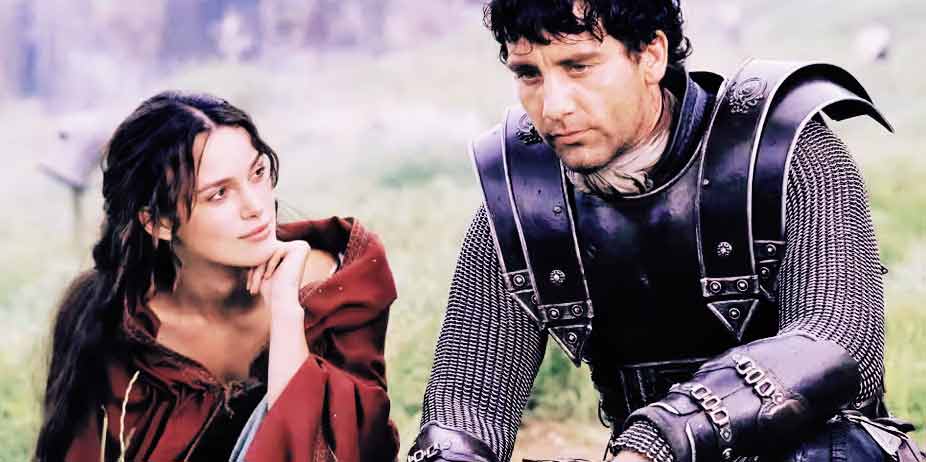
King Arthur (2004)
King Arthur is definitely an action film... with a bit of romance, a
smattering of comedy, and a whole lot of drama. I
wasn't quite expecting that, but came out liking it.
It's worth it if only to consider the story of
King Arthur from a new angle, as realism
rather than as a mystical legend.
In the early Dark Ages, a band of Sarmatian knights
led by half British, half Roman Lucius Artorius
Castus or Arthur (Clive Owen) meet with Roman Bishop
Germanius to receive their release papers after 15
years of forced service in the Roman army. They
are (understandably) upset to discover that they
must forego their freedom awhile longer: Rome has
decided to pull out of defeating/defending the
island, leaving the country and its natives
vulnerable to an invasion by the Saxons. Arthur
and his knights are sent on one last most dangerous
of all suicide mission: to rescue a Roman family
from the bloodthirsty Saxons by crossing through the
perilous Woads territory (enemy natives led by
mystical woodsman Merlin) and bringing them back to
safety. Only
when they succeed in this trial will Arthur and his
knights be given their papers and allowed to return
home as free men.
The honorable Arthur must do a little convincing to get his knights to agree to this last most perilous mission: after all, this band of real men is weary of fighting and ready to return home. Soon his loyal yet rough-and-tumble knights agree, and Arthur and his band (including Lancelot played by Ioan Gruffud and Galahad played by Hugh Dancy) begin their perilous journey across Britain. Along the way they encounter Merlin and his crew, who for some unknown reason let them live and pass through the haunted forest alive. After rescuing the Roman family (along with some natives in dire need), Arthur and his knights are forced to turn and fight the Saxons (who outnumber them by the handful!). They are helped by a native warrior woman Guinevere (Kiera Knightley), who ends up forcing a confrontation between Merlin and Arthur. Arthur is finally faced with the choice to return to Rome or stay and fight for Britain alongside Merlin and the lovely Guinevere.
The overall tone and feel of this film is dark, with lots of smoke and fog used in the battle scenes: although this film centers around battles and fight scenes, there is an underlying storyline that makes it entrancing and interesting. The knights are not larger-than-life heroes, chivalrous and pure legend not reality: they are real men. You cant help but cheer for Arthur and his knights as they fight against the odds to defeat the enemies of Britain and gain their own release: but when the time comes for this band of men to go home, will they go or will they stay?
Clive Owen does a phenomenal job as King Arthur and has gained respect in my eyes: Kiera Knightley was great, as always, as the Britain-warrior-woman Guinevere (although a completely different aspect of this legendary character, it never was so over the top as to annoy me), and Ioan Gruffud as Lancelot and Hugh Dancy as Galahad were wonderful as well: in fact, I think all the actors did a good job. If you like the story of King Arthur, you will like this: from the beginning to the end, you are taken on a real-life adventure with King Arthur and the knights of the round table.
Sexual Content:
A coarse joke about a mans penis and an instance of a man trying to rape a woman (he struggles with her on the ground but is stopped). One character has a dozen kids outside of wedlock. One scene of premarital sex (foreplay is intimated with a fair amount of skin but no clear nudity before the camera pans out).
Language:
Scattered profanities.
Violence:
Bloody and frequent.
Other:
Prayer is mocked and the Roman church and its leaders are doubted some throughout, but Arthur does have a strong faith in God, which comes across very well, although his knights are mostly portrayed as atheists.