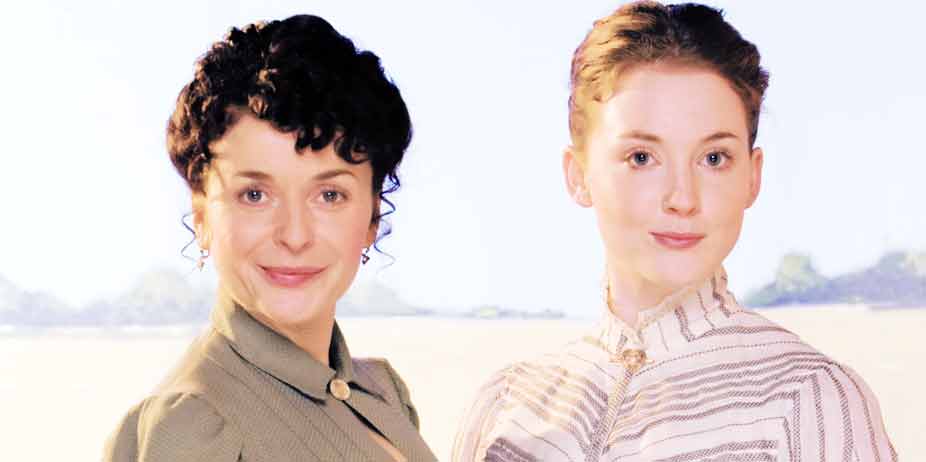
Lark Rise to Candleford, Seaosn Two (2009)
One of the more delightful series produced by the BBC in recent years is Lark Rise to Candleford, loosely based on the autobiographical books of author Flora Thompson. Fans of the books complain the novels are nothing like the series, but individuals unfamiliar with the source material will find it a diverting and wonderful experience.
Christmas has come to the small town of Candleford with a dusting of snow and a ghostly northern wind. Laura Timmons (Olivia Hallinan) remains employed at the post office under the guardianship of her cousin Dorcas Lane (Julia Sawalha). Her parents are eagerly anticipating her return home for the holidays, but with their housekeeper recently having passed away, the Pratt sisters setting out for Paris, and the eccentric postman Thomas Brown (Mark Heap) due to visit his sisters in the country, Dorcas will be left on her own. Concerned that her friend and employer will have an unhappy season without her friends and family around her, Laura tentatively approaches her mother to ask permission to remain in town. Emma (Claudie Blakley) grants her permission on a whim and soon comes to regret it, but neither she or her husband Robert (Brendan Coyle) can bear crushing Dorcas by taking it back.
On his way home one afternoon, Robert encounters a strange young woman in the woods whose gaunt appearance and mysterious quest for a man in the district unnerve him -- but he is not the only one to have encountered her, for people have begun to behave strangely in the village of Lark Rise and Laura is half-convinced that the post office is haunted. Mr. Arless has returned from sea, leaving his wife Caroline (Dawn French) to worry that he will up and leave them again, and the Pratt sisters, after an encounter on the road with the sinister gypsy girl, find they cannot control their tongues and wind up in a bitter argument. The spell the woman has cast over the two towns accompanies a sense of rivalry between Dorcas and Emma as one unknowingly infringes on the other's maternal instincts.
As with all stories set in this charming little Victorian hamlet, there is the customary resolution of hurt feelings mended and hearts put to rights, but this time around the pilot episode has a slightly unnerving undertone that involves a ghost story. Christmas ghost tales are something of a tradition in Victorian fiction and so I was not altogether surprised, but audiences may find a scene in which a dozen of the main characters attempt to summon a ghost out of the woods a little iffy. (There are no incantations, but the character of Queenie does call out several times for the spirit to visit them.) One of the more touching aspects of the episode is that Dorcas eventually encourages the ghost to find peace and puts her spirit properly to rest with kindness. The rest of the season involves various romantic attachments and broken hearts but concludes with a wedding. There is the new housekeeper at the post office, an often-too-chatty and miserably inept girl named Minnie, who wins over our hearts without even trying, and most of all, hotel-owner James Dowland (Jason Merrells), a source of constant contention and romantic tension for Dorcas.
For the most part, the series maintains the integrity and moral lessons of the first season -- characters are encouraged to make amends for past mistakes and everyone is forced to deal with their own troubles, while also accepting the encouragement of friends. Laura occasionally butts heads with her father but inevitably discovers he is right. Dorcas remains the moral staple of the show, a woman of unflinching beliefs but immense compassion. However, a moderate amount of modern ideals and principles also seem very out of place in the hamlet. One episode late in the season features one of the Pratt sisters walking out with a married man, which seems very out of character for her. (They kiss on two occasions.) Another finds Laura lecturing her parents on birth control, something I doubt was widely commented on in the 1800's. One of the older couples in Lark Rise has never been married, despite having lived together for thirty years.
James Dowland has hardly a sterling reputation -- while never graphic, dialogue intimates that he has carried on a long-term sexual affair with an older woman in order to maintain enough funds to purchase a hotel chain, as well as a history of philandering behavior (a child resulting from one union). There seems to be a bit more innuendo between the Timmons' this time around; a couple of episodes feature references to making more children and involves some flirtatious behavior in a field of wildflowers. I thought that in a few instances, political correctness strove to overcome the originality of the stories but the new characters and development of the original cast is wonderful. There are many lovely episodes and all of them leave the audience with a sense of contentment and happiness, which is more than I can say for most original dramas.