 The
Legend of Zorro (2005)
The
Legend of Zorro (2005)
When I heard that the sequel to one of my all-time favorite movies was hit with a PG rating, my expectations for the daring follow-up to the story of Elena de le Vega and the outlaw bandit Zorro went down significantly. I was expecting the story to have been watered down so much that it lost the original flair. Imagine my delight, then, to realize ten minutes into the production that The Legend of Zorro is almost as good as the original.
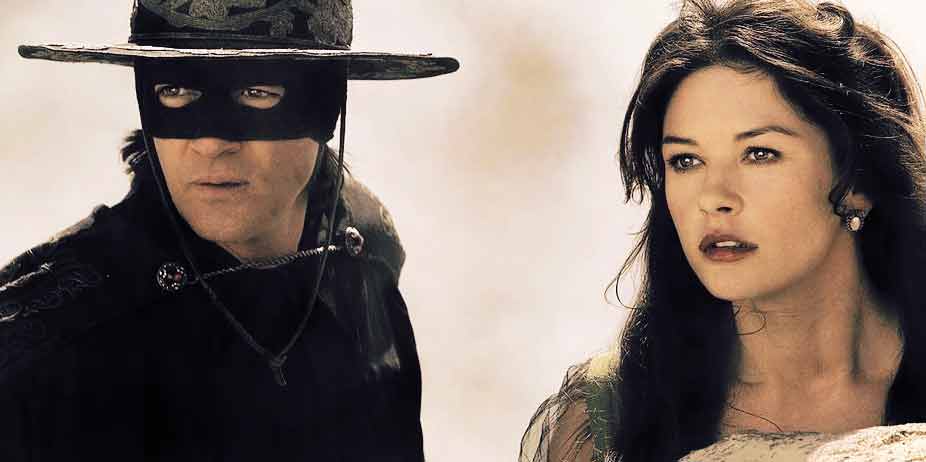
While the north and south threaten to go to war against one another, states are still joining the union. Among them is California, but on voting day, chaos erupts in the town square. The masked bandit Zorro is forced to intervene and his identity is compromised while battling a scarred, scripture-quoting renegade. Returning home to his spacious estate and false identity as a don, Alejandro (Antonio Banderas) believes it will soon be time to hang up the mask. Once California is a free state, they will no longer be threatened by invading forces. His wife Elena (Catherine Zeta-Jones) is disappointed in his pledge to continue risking his life, believing that his duel identities are preventing him from having a lasting relationship with their son. These differences and a little influence from blackmailing outsiders lead to a divorce.
Taken to a drunken lifestyle that his good friend Frey Felipe (Julio Oscar Mechoso) disapproves of, Alejandro is coerced into attending a siesta at the home of a neighboring don. Once there, he realizes that Elena has taken up with the owner, a European from her extensive schooling abroad. Armand (Rufus Sewell) never quite forgot his beautiful classmate and now seeks to make her a part of his new vision for California. Jealousy prompts Alejandro to become suspicious, but it soon transpires that his suspicions about Armand are more than justified. Elena is playing a dangerous game, one that might end in her death. Caught up in the middle of it, their son Joaquin (Adrian Alonso) battles his anger toward his father, his disappointment in his parent's divorce, and proves more than once that he is indeed the son of Zorro.
No end of nefarious villains meet a bitter end in this excellent installment into the Zorro films, but it lacks the more brutal and gruesome scenes of its predecessor. The violence is still action-packed but refrains from dismembered limbs and strangling. Bad guys are dispatched through explosions, set on fire, gunned down in the street, and stabbed. A man tied to the front of a train is plowed through a barricade; another falls into an enormous cactus and comes up with tines sticking out of his face. Men fall from great heights, threaten the lives of women and children, and are knocked in the groin. There's some astonishing swordplay. It was enjoyable to see Elena and Zorro fight alongside one another. Their chemistry remains one of the finest things about the film, particularly when at odds, such as in the siesta. I found it a little unusual that they cast one of the first film's lesser characters in a completely different role, but everything else was exciting and adventurous.
For the most part the film is reasonable family viewing, although there's a slightly ridiculous scene shortly after the divorce in which a Spanish maid happily admits to removing Alejandro's clothes after he comes home drunk. It's implied that she sees him naked, but the audience only sees his chest. Elena mentions "spending the night" with Armand in order to get him to agree to let her come back that evening (with ulterior motives). Frey Felipe is a wonderful character whose only fault is occasionally tasting wine. He's faithful to what he believes and maintains a dignified presence. Others are not so faithful. One priest at Joaquin's school is portrayed as vindictive toward the children, and the secondary villain rambles on in racist terminology, abusing scripture and claiming to be God's judgment on "lesser men" (Mexicans). He has the scar of a cross burned into his face. I never felt the film was anti-Catholic in any respect, particularly because Alejandro goes to the church for answers when he has reached the end of his rope. Bowing before the alter, he asks for courage and wisdom.
No Zorro movie would be complete without a fiery Spanish dance, the humorous antics of Zorro's black stallion Tornado, and some passionate kissing, and this one lives up to all expectations. If you enjoyed the original, wear the cape for a couple of hours and indulge in The Legend of Zorro.