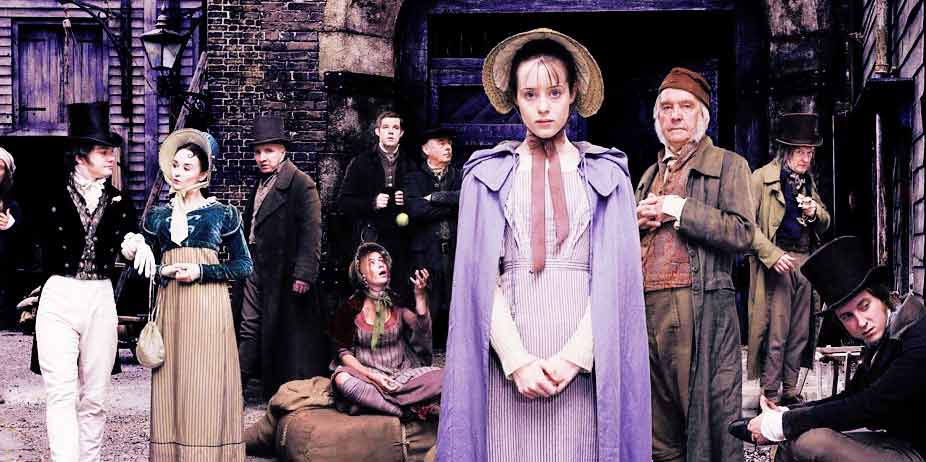
Little Dorrit (2008)
Mystery. Murder. Suspicion. Betrayal. Secrets. What author comes to mind more than Charles Dickens? In yet another excellent adaptation by the BBC, one of his greatest novels of political and moral intrigue comes to life under the talented pen of Andrew Davis. It is somewhat ironic that the story of intrigue and financial struggles should see the light of day in the midst of an economic upheaval, but perhaps one that Dickens might be amused with.
The recent death of his father has brought Arthur Clennam (Matthew MacFadyen) back to London from the orient, with a mission to remind his mother "not to forget" her promise. The nature of this peculiar errand, the result of his father pressing into a hand a pocket watch at the hour of his final breath, is unknown to Arthur, only that his strict, unapologetic mother (Judy Parfitt) refuses to explain. She assures him it is none of his business. Having spent the last fifteen years abroad, Arthur has lost interest in the family business and intends to strike out on his own. Knowing his mother is not a woman who is kind without a motive, her recent hiring of young Amy Dorrit (Claire Foy) arouses his curiosity. Following her home one afternoon, Arthur discovers that she lives at the Marshal Seat, along with her father, who has gained an elite reputation as the unofficial "head" of the debtor's prison. Arthur becomes convinced that his mother may have something to do with Mr. Dorrit's sad predicament and does all he can to unravel the mystery.
In the meanwhile, the gate keeper's son sets his sights on Amy, little realizing that Arthur's kindness has made her fall in love with him, and Arthur faces his own set of problems with the reintroduction of an old flame, a potential new one, and the general mischief of his acquaintances. Among them are the Meagles family, whom he met abroad and whose parents are most desirous of him marrying their daughter, and thus preventing her from becoming involved with a penniless artist. But it would not be Dickens without a sinister French murderer, a woman with a mysterious past, a deeply resentful servant, and all manner of mismatched and peculiar characters.
In the seven and a half hours, the audience meets and falls in love with certain figures, gains a healthy respect and mistrust of others, anticipates upheaval and financial ruin and hopes that somehow everything will be put to rights before the end -- and in true novel fashion, it all comes together in the final hour and the loose ends are all but neatly tied up with a pretty purple bow. There are some complaints I had with the production but they are minimal in the grand scheme of the adaptation. The rush to include everything at the end leaves a few questions hovering in the air about the mystery. I also gathered that in several instances, we were not being told the entire story, particularly about two of the female characters. There was no resolution to a minor plot, but as it was secondary that is nothing to quibble about.
The casting is quite lovely -- I liked MacFadyen much better here than as Mr. Darcy, for his Arthur is more personable and less refined. The entire production rested on the beautiful portrayal of Dorrit by Claire Foy, but the supporting cast (no doubt familiar to costume drama fanatics -- there are numerous known faces here) was also lovely. The costume design is marvelous, showing a gradual trend in styles and fashions as various characters come into money. There were, regrettably, a few obvious references that foreshadowed various plot twists that I'm not certain were intentional. (I suspected a few episodes in what the climax of the film would be.) However, the carrying off of those anticipated scenes was fantastic -- particularly in the last half hour. I would recommend it in a heartbeat if it were not for one minor aspect that tainted Dickens' vision.
Davis has a history of exploiting sexuality wherever he can in his productions -- there is the more innocent wet shirt scene in Pride & Prejudice, for example, or the highly controversial homosexual twist he put into his recent Brideshead Revisited adaptation. In the novel, there is a bitter, formerly jilted female character by the name of Miss Wade who manages to get her claws into the resentful Tattycoram and persuade her to abandon her adopted family to work in Miss Wade's employment. Davis has chosen to read between the lines and incorporate her as a lesbian. It is never blatant but occasionally apparent, particularly in her first few scenes where there is an obvious sexual tension between the actresses. Miss Wade reassures Tattycoram in quiet voices, and strokes her chin tenderly. She even draws her in seemingly for a kiss before the girl runs off. It was somewhat startling and felt out of period, but did not taint the production too badly.
There are a few scattered profanities. Other than the female tension, there is a scene in which a man becomes overly familiar with a woman on a bed but the most we hear is giggling in the background. Several characters meet violent ends -- one is stabbed brutally in the street; another is crushed beneath falling debris, which also nearly claims the life of a bystander. A person suffers a heart attack. A man is found having slit his throat in a public bath house; there is blood in the water and on his neck. A scene in which a man shows evidence of having lost his mind might be disturbing to more sensitive viewers. It is not as brilliant or heart-wrenching as the earlier Bleak House, but kept pace through to the end, in which the viewer wears a smile with a little bit of heartsickness that it has come to an end.