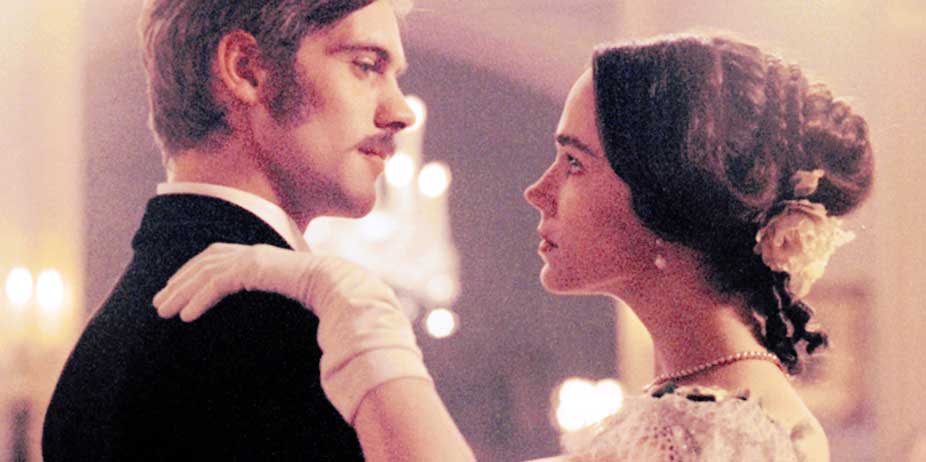
Madame Bovary (2000)
Gustave Flaubert's novel created quite a controversy in Victorian England upon its publication. It was accused of offending modern sensibilities about morality due to its unashamedly adulterous heroine. Time has desensitized audiences toward acceptance of adultery, however wrong, but even the most intrepid viewer cannot fail to be horrified by the graphic depictions of her adulterous liaisons. After the tragic death of her mother, Emma (Frances O'Connor) desires to leave the nunnery and return to her father's house in the French countryside. Discontent and "empty" since the event, her interest is peaked by the local physician, come to tend her father's misfortune in falling from a tree and badly injuring his leg. Charles Bovary (Hugh Bonneville) is nursing a broken heart after the death of his wife, and finds solace in Emma's notions of life.
The two are soon married, and Emma realizes that the passionate love life she anticipated through reading novels is sadly erroneous. Her husband is unsatisfying and her life unhappy beneath the domineering control of her mother in law, Marie Louise (Eileen Atkins). Knowing his wife will not be happy until they move into town, Bovary does so, introducing her into good society and igniting a dangerous flame in her friendship with the impressionable young artist, Leon (Hugh Dancy). The birth of her first child places an emotional distance between them that makes her vulnerable to the advances of a notorious seducer, Rodolphe (Greg Wise). Making her acquaintance quite by chance in the illness of his traveling companion, he persists in being allowed to visit her, taking her on long rides into the woods and immediately having his way. Concealing the affair from her unassuming husband, Emma's affections increase to the point of desiring to run away with her lover. The consequences will be devastating.
Though the production is beautifully filmed and has lovely casting, it seems laborious at times. There is radiance in the costuming and the novel is well expressed, however the primary fault lies in the decision of filmmakers not to covertly imply Emma's indiscretions, but to reveal them to us in all their hot, lurid sexual perversion. There's no delicate way in which to say this, but the audience is given a glimpse of a contrast between lovers; the mechanical, emotionless and downright repulsive act with her husband, and an impassioned, raw, even violent tryst with Rodolphe in the woods. There are four graphic and uncomfortably long love scenes, all with movement and two of them involving partial nudity on both parties, numerous instances of kissing and caressing in bed, indications of manual stimulation, and daydreams in which the heroine imagines herself kissing one of her lovers. Though not overtly sexual, Bovary does a medical examination to determine if she's pregnant.
There's also some gore in the medical letting of blood, a festered open wound, a badly mangled club's foot, and vomiting after a character consumes poison. Beyond the obvious sexual issues the film presents lies a much more dangerous premise. First it asks us to believe that Emma is in "love" with her lovers, when the reality is that she is lusting after them. She has chosen to be unfulfilled by her husband sexually, and builds up notions of what it must be like through tawdry romance novels. That anyone could believe a relationship based on lust is long-lasting or emotionally fulfilling is preposterous. We do see the effects of this affair begin to fade with time (as the "candle starts to burn out"), and her move on to new prey, but the film is not satisfying to anyone with the truth: that Emma's emptiness is the absence of God in her soul, that she has made her life miserable through her choices, and that her husband is not stupid or horrible, and therefore audiences cannot seek to justify her love affairs because of him.
Adultery is no matter to scoff at, but deeply wounding to both individuals involved, particularly the betrayed party. What we have here is a depiction of man's most primal urges that reinforce the notion that sex is base instinct that cannot be controlled. I was left with a feeling of deep disappointment over Emma's choices, anger that she would betray her husband so shamelessly (she confesses that she has no guilt over the affair), and overall repugnance for God's gift for a married couple. What feeble religion is involved is downplayed, mocked (Madame Bovary meets most of her lovers in the church, sits piously reading her Bible, and declares flippantly that she chose not to be a nun because Jesus would be a poor bridegroom) and ignored. You are much better off with more heartening, innocent costume dramas.