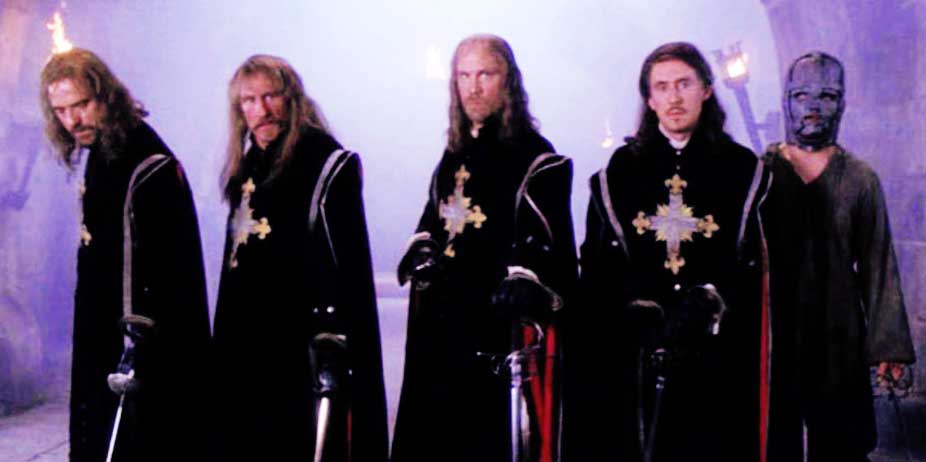
The Man in the Iron Mask (1998)
It's got all the classic elements for a great story: an evil but handsome villain, the chance to root for the underdog, four feisty musketeers, fencing, intrigue, romance, and suspense. All in all a terrific if rutted adaptation of the classic. The story takes place in 1662 France where the common people are starving due to the arrogance and deceit of the newly crowned King Louis XIV (Leonardo DiCaprio). The King cares only for his own pleasure and enjoys twisting and manipulating people to his advantage, including the only one of the original four musketeers to still bear the sword for the crown, D'Artagnan (Gabriel Byrne), who is now his captain.
Aramis (Jeremy Irons) has become religious priest. Athos (John Malcovich) is the father of Raoul, a strapping young musketeer, and Porthos (Gérard Depardieu) is still chasing anything in skirts. All have a strong hatred for Louis except D'Artagnan, who believes one day Louis will become the man he was born to be. Louis starves his people, arouses anger amongst the nobles and lusts after Christine, the innocent recipient of Raoul's affections. Borrowing a sin straight from the Bible, Louis has the lad sent into the heat of battle in the hopes he will be killed and brings Christine to the palace as his mistress. Arthos is furious and becomes the king's greatest enemy. They learn of an underworld conspiracy headed up by an anonymous enemy and Louis asks his priest Aramis to uncover the conspirator and kill him. The priest agrees, but when he draws together his three friends and colleagues in former conspiracy, the audience is shocked to discover he is at the heart of the rebellion. His quest is for the one man who can save France... a man Louis himself fears... the man in the iron mask.
D'Artagnon remains loyal to his king despite and will fight to the death to save him. Biblical elements play a large part in this story of honor and redemption but it's flawed in many ways. One such element is the slaying of a man in order to take his wife as a mistress -- does the name "David" ring any bells? Both Porthos and Louis take pride in their seduction of numerous females but D'Artagnan declares, "I think it is possible for a man to love one woman all his life and be the better for it." When Porthos interrupts a praying Aramis with an embarrassing spiel about the pleasures of women's breasts, the priest reminds him there are "more important things in life." Forgiveness, willingness to give your life for another, and doing what's right no matter what the cost make up the good side of this film, gorgeous scenery, an incredible score, and breathtaking period costumes notwithstanding.
None of the musketeers are portrayed as overly moral; Porthos is more dislikeable than anyone and unworthy of respect. My personal favorite was D'Artagnan, with Aramis coming in a close second. Their passion, faith in God, and compassion are uplifting. While it's revealed neither have lived flawless lives, we cannot help but love them. An flawed adaptation with a good heart. All for one, and one for all!
Sexual Content:
Porthos often cavorts with women (sometimes three at a time); sex is implied but not shown. Sexual noises are briefly heard; we see most of a woman's bare side and part of her chest after she is seduced; a man's bare butt is shown from behind as he tries to commit suicide; references to adulterous affairs.
Language:
A few scattered profanities.
Violence:
Frequent stabbings, sword fights, and shootings.