 Marie Antoinette (2006)
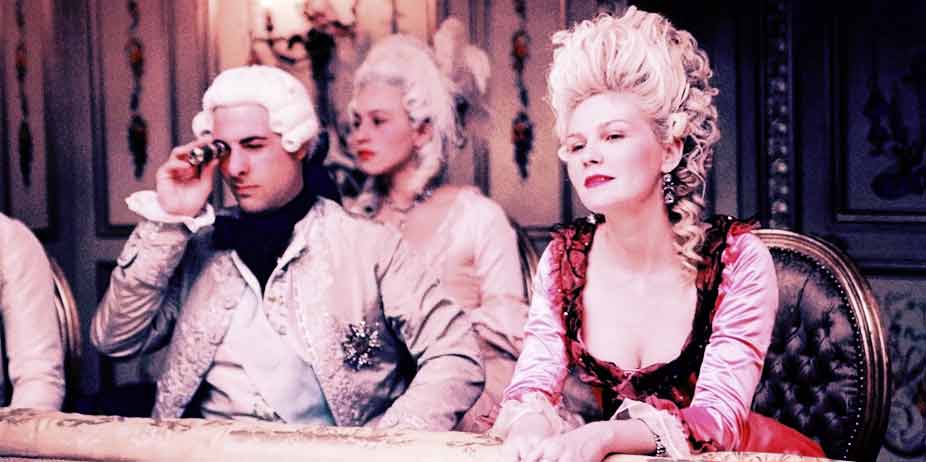
One of the most tragic figures in European history, Marie Antoinette was "married at fifteen, queen at nineteen, and died at thirty-eight" when the French Revolution's thirst for royal blood brutally ended her life. Director Sophia Coppola has created a film that appeals to overtly feminine sensibilities, rampant with absolutely gorgeous gowns, shimmering diamonds, and enough "cake" to make any young woman go home and look for the chocolate she's hidden.
Desirous of forming an alliance between France and Austria, the Austrian monarchy offers their youngest and most beautiful daughter, Marie Antoinette (Kirsten Dunst) in marriage to the French crowned prince, Louis XVI (Jason Schwartzman). Forced to leave her family, friends, and beloved dogs at home, Marie enters into a hostile land of suspicious faces. She is forced to endure what she believes is public humiliation at the hands of court tradition, and worst of all, her husband shows no interest in consummating the marriage. This is known throughout the realm and reaches the ears of her mother, who blames Marie for not being tempting enough. In the meanwhile, her interest in the best of society brings her into the circle of the Duchesse de Polignac (Rose Byrne), whose fascination with handsome men has made her a reputation at court.
Surrounded with the beauty, fashion, and status that money has to offer, Marie lives oblivious to the torment of the French people, realizing only too late that she has been hailed as something of an uncaring monster to the starving public. I will not touch on the historical accuracies or inaccuracies, for much has been made of them elsewhere, but if nothing else what the director creates is a lavish representation of court life, from the flirtations to the food, the expenses, the glittering gemstones and burned-out candles. The film seems to wander along without a true purpose other than casting a little illumination on her life, full of glorious nothings. Marie was neither useful nor greatly respected, but she was nevertheless a woman caught up in one of the great shames of France. Kirsten Dunst is a very believable, empathetic, and charming queen, the kind of young woman you would want at every party, but with a deeper layer of insecurity and sorrow that makes her human.
The rest of the supporting cast here is very good, but humorously, what almost seems to steal the film from the actors is the food, and the costuming, which was gorgeous enough to make me gasp in every scene. Every single shot is breathtaking, from the queen dancing through the garden and running her hands through the grass in a field of flowers to the interiors shot on-location throughout French museums and palaces. I heard many people complain at its length on departure from the theatre, but just as many sigh with envy over how beautiful it was. And if that is what Sophia intended, it is good enough for most patient costume drama watchers. It seems a shame, then, that she would place so much discreet nudity into her screenplay. One of the film's earliest scenes has Marie being completely stripped of her clothing, in a shadowy but obvious silhouette from behind. Shortly thereafter, she is introduced to the custom of being dressed by members of the aristocracy. She covers her breasts with her arms in frontal shots, but there are several long shots from behind that reveal a little too much. A later shot has her wearing nothing but stockings, garters, and a fan preceding a sexual scene. Her nightgown is slightly sheer, as is her bathing gown when she rises from the tub.
There is only one scene of actual sexual content, but half the film dances around the prince's unwillingness to consummate the marriage. He makes a halfhearted attempt in bed to kiss her, but then turns aside. Five years later, after much prompting and berating from family members and peers, it's implied he does go through with it. There is some innuendo (blatant and otherwise) and discussion of the king's mistress. Marie does engage in a brief adulterous fling with a member of court. To be honest, the film enchanted me and while I did feel that it moved too slowly at times to be a Hollywood production, I very much enjoyed it. I also appreciated the fact that the director ended it where she did, with Marie's last ride away from the palace where she managed to find eventual happiness. Some of the most heartwarming scenes are of Marie and her daughter at their summer cottage. It is that image the audience takes away with them, rather than the horrors of what followed.