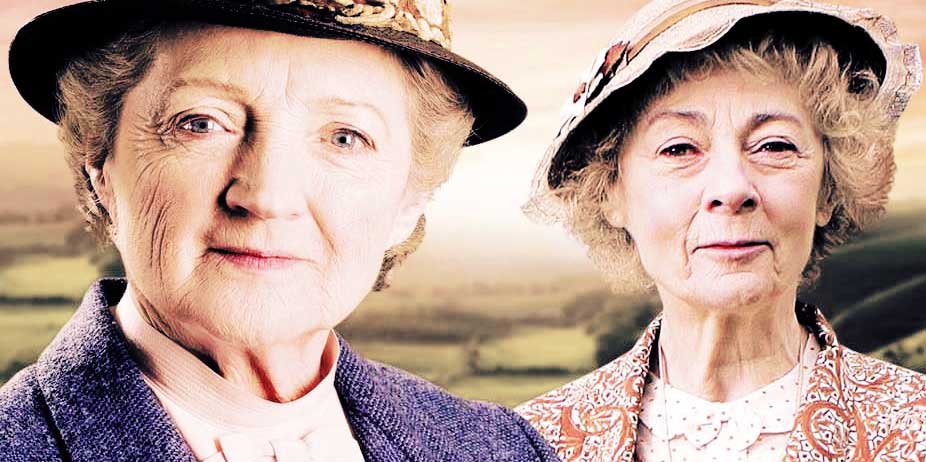
Miss Marple, Season Two (2005)
Messing around with an established author's best-known work is never an intelligent move on the part of filmmakers, but that's what the BBC has done with their latest representation of Agatha Christie's amateur sleuth.
Arriving in England with the intention of preparing for her impending wedding and purchasing a house for them to live in, young Gwenda (Sophia Myles) soon unearths a mystery. Strangely drawn to a manor on the cliffs, her uncanny intuition as to the house's original floor plan and wallpapering turns sinister when she experiences a vision of a woman being strangled at the foot of the stairs. As her fiancée cannot escape his business arrangements in India and return ahead of schedule, he instructs his solicitor to phone someone in to take care of it for him. The man calls Miss Jane Marple (Geraldine McEwan), a friend and amateur detective with some experience in clearing up mysteries. The charming older woman wastes no time in unearthing a tangled series of events that involve a traveling musical troupe, a missing woman, and any number of suspects, all of which will change Gwenda's life forever.
In the next episode, she just happens to be visiting a convalescent home when Tommy (Anthony Andrews) and Tuppance (Greta Scacchi) pay a visit to their cantankerous old aunt. And when the aunt turns up dead in the middle of the night, well, she's off on another adventure, this time to an old town full of secrets and sinister inhabitants. I have mixed emotions about this season of the series because on its own merits, it's a reasonable gathering of mysteries, full of memorable characters and occasional flashes of sardonic humor. It also has a marvelous cast, ranging from Charles Dance to James D'Arcy, Paul McGann, Dawn French, Emilia Fox, Talulah Riley, Timothy Dalton, and Carey Mulligan. In short, its fabulous collection of British talent (that is only a few of the actors involved) is enough to recommend it! However, and this must be stressed to the utmost, the stories as presented here are almost nothing like the novels. In some situations, whodunit has been changed -- in others, entire characters, situations, sub-plots, and motives have been altered -- in one instance, to add a hint of incest. One must ask, was that really needed?
Agatha Christie's sleuths of Tommy and Tuppance have changed personalities -- Tommy is now a workaholic and a bit of a jerk (yet one cannot help liking him regardless, thanks to Andrews) while Tuppance is never far from a bottle and comes across as a bit of a boozer. If you haven't read the books it's likely you won't mind the mysteries, because they are overall quite enjoyable and two in particular have an immense amount of suspense. It's a pleasure to watch them unfold, luring us into the midst of a story and then throwing a mystery (or several) at us. McEwan does a reasonable job as Miss Marple, although there are times when she almost feels a little intimidating or sinister, rather than innocently manipulative. Where content is concerned, it is never graphic but does contain elements that might disappoint some audiences.
Adultery plays a role in several of the stories -- one of them involves a minister who is stepping out on his marriage; elsewhere, evidence of trysts are evident in children having resulted from the union. A man and woman flirt on many occasions, once with him filling the bathtub with more hot water for her when they are stranded in a hotel. (He doesn't see anything.) Homosexuality is hinted at in two instances -- one involves a rather flamboyant artist (his sexual preferences are never noted, but obvious through his mannerisms); in another, we learn that a man has committed suicide because he was incapable of acting on his "love" for another man (everyone is rather shocked). Hints as to the recipient's sexuality are also rather obvious in his behavior of hand-wavering and a slight speech impediment. A man forces a kiss on a woman who happens to be his sister and is slapped for it; Marple suggests that he had incestuous feelings toward her, which he admits to. Two women leave together on tour at the end of the final episode; it's unclear whether they do so as friends or something more.
Murders are carried out in different ways -- mostly through non-violent means such as poisonings, although we do see one woman being strangled several times in a flashback; elsewhere, a woman is bludgeoned in the back of the head. A man commits suicide and we see blood all over his desk. There's not much language except in the form of insults in "The Moving Finger," which features letters sent to townspeople full of outrageous accusations (twice, "b**ch" is used against a woman). Several people are shown being stabbed, with bloody results. The last mystery has a séance in it, in which an Ouija board is used to spell out impending death for a member of the group; we later learn someone in particular was guiding the outcome. Twice, ghosts are seen by the audience.
The mysteries are clever and Miss Marple manages to win the audience over with her subtle mannerisms and means of arranging people to suit her needs, but you are a fan of the novels you may be disappointed.