The Incredible Journey of Mary Bryant (2005)
If you are an Australian and can lay claim to having been transported from Britain to a penal colony, you are regarded as something akin to royalty. During the reign of King George, due to rampant poverty among the lower classes, the country was overrun with petty criminals. For want of something to do with them, England shipped many overseas to "New South Wales."
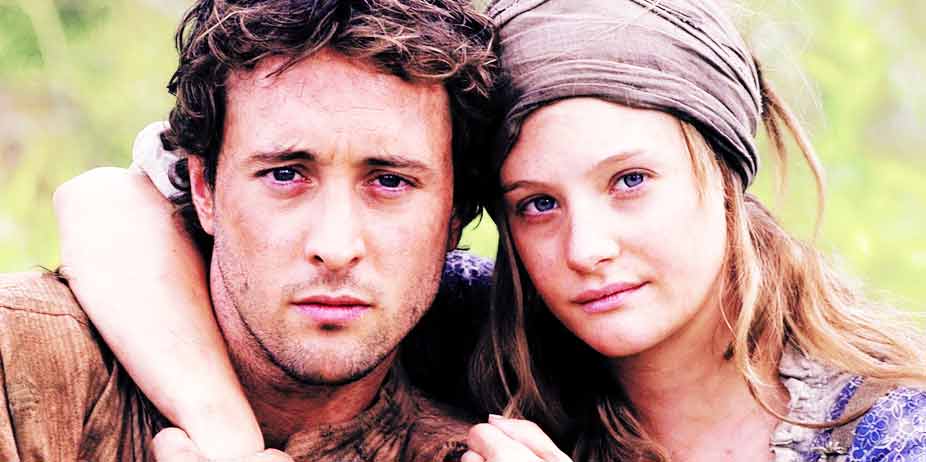
Young Mary (Romola Garai) has been convicted of highway robbery and sentenced to removal to the Australian colonies. Pregnant due to abuse in prison, her only hope lies in making an appeal to the compassion of one of the ship's seemingly lenient officers, Ralph Clarke (Jack Davenport). While arguments over the captain's table regard whether or not criminals can be reintroduced to society and saved from their wicked ways, below decks the passengers are crammed together in unbearable conditions. Mary makes the acquaintance of Will Bryant (Alex O'Loughlin), a smuggler who begins to fall in love with her. Rescuing her from drowning after she is knocked unconscious during a storm, Will unhappily grants her into the keeping of Clark, who is under the impression that she is a beautiful innocent.
When he learns that she is with child just as he is beginning to have romantic feelings toward her, this shatters his illusions and reveals a much darker side to his nature. On arrival at the colony, more lenience is given toward married couples, and Mary and Will take advantage of it. Under her guidance, Will becomes invaluable to the reigning authorities as the sole fisherman among the criminal classes, but efforts to build a civilization out of this untamed land proves more formidable than anyone anticipated. Faced with starvation, Mary and the others plan a daring escape that will involve manipulating Lt. Clark and stealing the cutter of Governor Arthur Phillip (Sam Neil). Its aftermath will lead to devastating consequences. Taken at purely cinematic value, Mary Bryant has a great deal to its advantage, namely the presence of an incredibly talented cast and costume department.
I am a fan of Romola Garai's work and this may be her most poignant and strong performance. Mary is a powerful and compelling character that at times becomes self-destructive but the audience never stops rooting for her. Jack Davenport plays a villain more empathetic than heartless and toward the conclusion you realize he has been the victim all along, both of his desire to believe in innocence and his willingness to risk everything for the woman he loves. Sam Neil has his despicable moments and O'Loughlin makes for a memorable husband. The costuming is absolutely beautiful and much of the cinematography is breathtaking. That being said, as much as I enjoyed the drama overall, there are numerous faults to be found with it. At times, the screenplay seems to lag and spend too much time lingering over the unfortunate circumstances in which the prisoners dwell.
The film also undermines itself by contradicting its key sequences. There are some beautiful scenes, particularly in the romance department, with gentle close ups that cut away when we want them to and not after; this is compared with some very graphic sexual depictions. It doesn't make a whole lot of sense and undermines the romance of the piece. There isn't a lot of bad language, but the women are referenced as "whores" by the men, who use mild profanity on occasion; Jesus' name is abused once. Thematic elements involve multiple deaths from topical diseases; the violence is memorable because it is so infrequent, consisting of men being shot and killed on the beach, stabbed with native spears, and hung from the gallows (this actual action is unseen). The worst scene of violence is when the male criminal class gets out of hand and proceed to rape the female prisoners en masse. The governor allows them to do it, ordering his men to stand down. Most of this scene is in quick shots but it's apparent what's going on. There are several instances of partial or brief female upper nudity in the aftermath; we also see topless native women and on a few whores. On first arrival, natives challenge the British officers on the beach and one man is instructed to drop his drawers to reassure them that they are indeed men (as opposed to women, with their long hair). We briefly see his backside. Female prisoners throw themselves at sailors, since those who are used sexually receive favors in return.
After Clark takes in Mary, a woman uses coarse language to imply he must be sleeping with her and grabs his crotch. (She is punished with a dozen lashes.) A woman's bare back and part of her naked side are shown when she becomes intimate with a man. In order to distract a guard, a female prisoner is shown involved in sexual shenanigans with him on two occasions (implied oral sex). There are two fairly graphic sex scenes, one between Mary and her husband in the woods, and one between Mary and Clarke, who is unhappily married to a woman he left behind in England. His interest in her at first is innocent, then slightly romantic, but she entices him into a sexual relationship. Even though he only has two scenes (one of them is split up between other action sequences) in the bedroom with her, there's an overall air of sexual dominance in his behavior toward her. Mary manipulates him into believing that she loves him in order to obtain information. She and other women use sex to get what they want.
I was disappointed that such emphasis was placed on depicting sexual escapades, because the film is very intriguing. It did not need graphic content to further the story and these scenes detract from the overall scope. The character depictions are remarkable and made me wish they had dug even deeper into their motivations. Just when you believe you have someone figured out, they do something to make you guess your own expectations. That's the sign of a brilliant screenplay! If you do choose to see Mary Bryant, go into it prepared to have your morals challenged. After all, these are criminals.