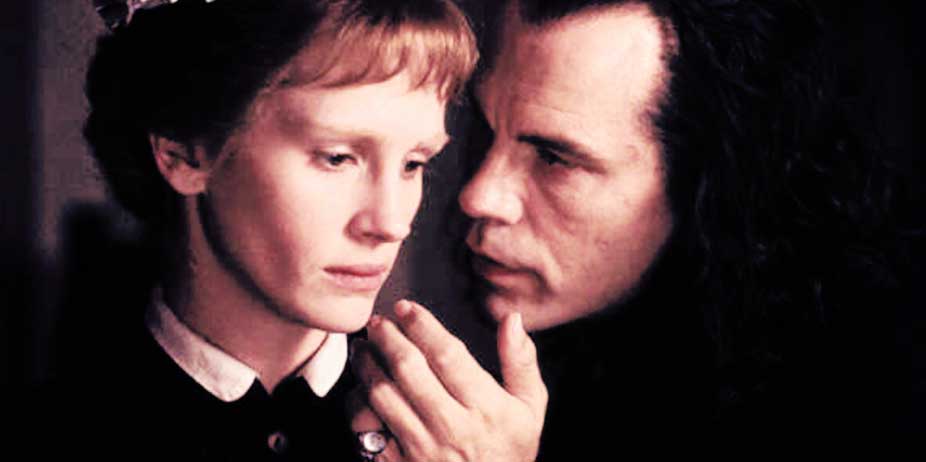
Mary Reilly (1996)
A few years ago I made a study of Victorian novels, with the intent of acknowledging their social, moral, and psychological commentaries. The three that stood out the most profoundly to me in some aspect of their theological depth were Dracula (a godless existence), Frankenstein (man's inability to reproduce or create a soul), and The Strange Case of Dr. Jekyll & Mr. Hyde, which illuminates the dangers of allowing evil even the smallest foothold in one's life.
Mary Reilly is the latter's story but seen through the eyes of an innocent housemaid. Mary (Julia Roberts) is grateful to live and work in the home of the eccentric but gentle Dr. Jekyll (John Malcovich). Having escaped an abusive childhood and found her way into service, she is both increasingly fond of her employer and curious about the long hours spent in his laboratory. Just when she has come to trust him, and senses that he too has become fond of her, Mary's world is turned upside-down by the appearance of Jekyll's new assistant, Mr. Hyde. The servants do not see much of him, but what they say of him in passing is that he is "just like the darkness." Snatches of his personality are revealed to her as she goes about her daily life, even encountering him one night in a terrifying confrontation. He has been given a set of rooms in a local brothel run by the accommodating Mrs. Farraday (Glenn Close), but it seems that a string of brutality and violence lingers in his wake.
As Mary fights off her fascination with the charismatic but terrifying Mr. Hyde, she cannot help but wonder what hold he has over Dr. Jekyll, and prays it will not destroy all of them. The film itself is much better than I anticipated. Roberts at first seems a little awkward in period attire, but soon grows into the character and although her accent is poor at best, she is both a likable and intriguing heroine, tormented both by dark memories of the past and her interest in a world that is beyond her comprehension. I have never cared for Malcovich, but he is exceptional in this film. For once, he seems to have truly gotten his hooks into a part and I cannot think of anyone who could have done it better. There is his weaker, more affectionate self, and the alternative, who is violent, aggressive, and without conscience. The director really knew what he was doing in setting up so many sinister and creepy sequences.
Many elements make this unsuitable for sensitive viewers or younger audiences, but for the most part all of it is handled somewhat discreetly. One of the goriest things is Mary watching in horror as a live eel is stripped of its skin and cut into pieces; she later ventures into a meat market where animal corpses are hung up to be disemboweled. A bedroom in a brothel is literally drenched in blood, along with a rat that has been cut open. Hyde is shown playing with a severed head. The most horrible thing is a child running along the street, and being knocked to the ground by Hyde, who then viciously stomps on her stomach. (He is shown paying off her mother, while the child screams and gropes at her bloodied garments in the background.) Hyde uses the silver tip of his walking stick to murder a congressman; it is shown impacting his head. Various bloodied instruments and sheets are glimpsed in other scenes. There's a creepy glimpse of two men merging into one; fighting in their skin with the audible sounds of ribs snapping into place. A man crushes a tea cup in his hands, then pulls a broken piece out of his palm.
It's actually some of the unseen and implied elements that may disturb viewers more than the violence. Though it is never shown, or even discussed, the implication is that Mary was sexually abused by her father, who also inflicted her with other torments (such as locking her in a cupboard with a rat, whose attack left her scarred on her neck and wrists; and by beating her with his belt). A man (Ciarán Hinds) visits the whorehouse several times, and always leaves with an underage girl. Mary experiences several intense dreams about Hyde, one of which finds him in bed with her. He tears open her nightgown (she is laying on her stomach) and licks her back, before turning her over. In a scene near the climax, he drags her kicking and screaming through the laboratory and forces her up against a wall, where he kisses her. I wasn't sure whether he intended to kill or rape her.
All of this sounds rather worse than it plays out on film, and in truth it could have been far more graphic than it actually was. The filmmakers, for the most part, showed remarkable restraint, particularly when it comes to the gruesome aspects of Hyde's trail of murder and mayhem. The most fascinating thing about the story is the same element that makes the book such a complex read: the notion that you cannot separate good from evil in your life, that you must never give in to darkness, since it will consume you, and that there is hope no matter how lost you become. True, it's somewhat intermingled with a peculiar frame of love story, but nevertheless audiences will remember one thing: that you can never escape the consequences of your actions.