Master & Commander: The Far Side of the World (2003)
Master & Commander: The Far Side of the World is an exuberant sea adventure that ranks of the intelligence and believability this year's surprise blockbusters lacked. It comes with a heavy historical basis, truly likable although not completely well-defined secondary characters, and excellent acting by all involved. It brings together an intriguing tale of a crew pitted against an unstoppable enemy and the insight, cleverness, and uniqueness which allowed them to triumph. The storyline does include graphic battles at sea, more violence than one might anticipate, and leaves the ending open for a sequel, but is a stunning glimpse into a bygone era, naval intelligence, and also illuminates some downright profound virtues.
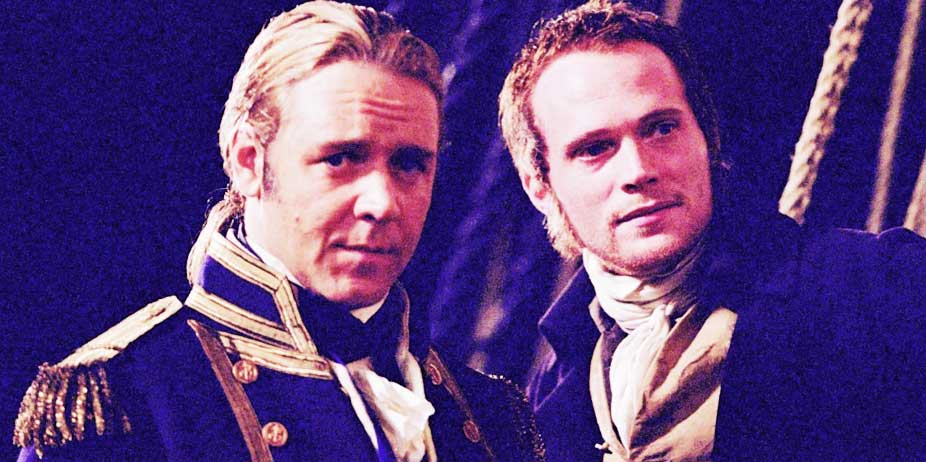
The year is 1805 and although the British navy still control much of sea-faring trade, French privateers under the command of Napoleon are rapidly becoming a problem. They loot and pillage anything under a British flag. The HMS Surprise under Captain Jack Aubrey (Russell Crowe) has been commissioned to hunt down and stop the most troublesome of these, the near-uncatchable Acheron. With 162 souls aboard, he pursues his quarry and finds instead himself the hunted, when Acheron time and again manages to catch him unawares. The story does not merely center around his struggle with pride and determination, but also follows the life of his close friend Dr. Maturin (Paul Bettany), an intellectual and budding naturalist. It's an ironic pairing... a man of science, and one of war. Their differences collide often, resulting in the growth of each character and eventually working together to obtain their ultimate goal.
The HMS Surprise is nearly sunk in the fog one bitter morning when she comes upon the privateer with little warning. Forced to list for repairs, Aubrey is determined to hunt down their quarry and see her taken or sunk. One of his crewmen was familiar with the Acheron's building process while she was still in the Colonies, and informs him why their cannons were unable to penetrate her hull: it's been triple-sided, giving them almost a foot of solid oak. Her only weakness is from behind, and the gun-ports. They would have to be nearly on top of her in order to successfully take her captive, and this proves extremely dangerous as they would be blown to smithereens in the process. Maturin encourages him to give up the quest as he's fulfilled his promise to track her thus far, but Aubrey's honor is at stake. Despite the feelings of the crew, he is determined to bring this hound to heel... little knowing he is not the hunter, but the hunted. This allows for some brilliant strategy as our enterprising crew find ways to keep alive in wartime.
That's not to say men aren't lost by battle or fierce weather; there's nothing good-natured about this sea-faring journey, which begins in utter seriousness and concludes on a similar note. This is hard-core navy life during the early eighteen hundreds, complete with rotting bread, seasickness, the bloody aftermath of battle, and dealing with guilt. Fortunately interspaced between the intense scenes of warfare are touching moments between captain and crew, and some truly soul-seeking conversations. Maturin accuses the captain of going after the Acheron merely out of an egotistic desire to avenge himself. Angrily, Aubrey denies it... but realizes later he was in the wrong and takes steps to release his wrath and work instead for the good of his men. This philosophy is shown numerous times, as individuals are sacrificed for the common good. Each time the audience is hit with the emotional impact of forcing to make such a choice.
There are many scenes of intense, violent combat, often with bloody results. Ships are blown apart by cannon fire, resulting in the loss of life. Bloodied bodies are seen strewn across the decks, and going under the doctor's knife. A little boy must have his arm amputated. A bullet must be removed from a man's brain, and the camera and crew gawk throughout the semi-gory process. We observe a self-operation with the use of a mirror, which sometimes proves bloody and disturbing. Many men are shot and killed in the final battle scene, or stabbed with sabers. The violence is all close-range, largely out of focus (which is extremely irritating in close-ups), and flashes rapidly past in an effort to maintain the PG13 rating while still giving paying customers a glimpse of the gritty warfare they came to see. Language also intrudes but is primarily British slang (the term "bloody") and mild abuses of profanity. There are numerous mild abuses of deity, but one f-word (unhistorical since it wasn't often voiced at this period) and a GD creep into the dialogue.
Other than the extreme violence, the film has little by way of offensive content. There is no sexual escapades or even hints of impropriety aside from an off the cuff remark (in response to a toast "to wives and sweethearts," the captain jokingly ads "May they never meet") and a background instruction for a sailor to put down a woman, since "this is a sailing ship, not a bordello!" For the most part all references to God are made with respect and burials at sea carry a distinctively religious overtone. There is one brief implication of the possibility of evolution by the doctor/naturalist. Most war films lack empathy, but Master & Commander takes you on an emotional journey, which is what sets it apart. Little boys taking charge of guns, being forced to contend with amputations, and yet clinging to their literary heroes. The usual superstition which was rampant among seaman at the time. Order and obedience among the crew, even if it means tying a man to the mast and giving him twenty lashes for insolence. Liberals will not like this film for a variety of reasons, primarily that it encourages patriotism, taking personal responsibility, and has an anti-pacifist worldview. These are not monsters but men, and the quiet moments when they all deal with guilt, fear, anger, and sorrow are profoundly revealing. For older audiences, this can be an excellent conversation-starter, but leave the kids at home.